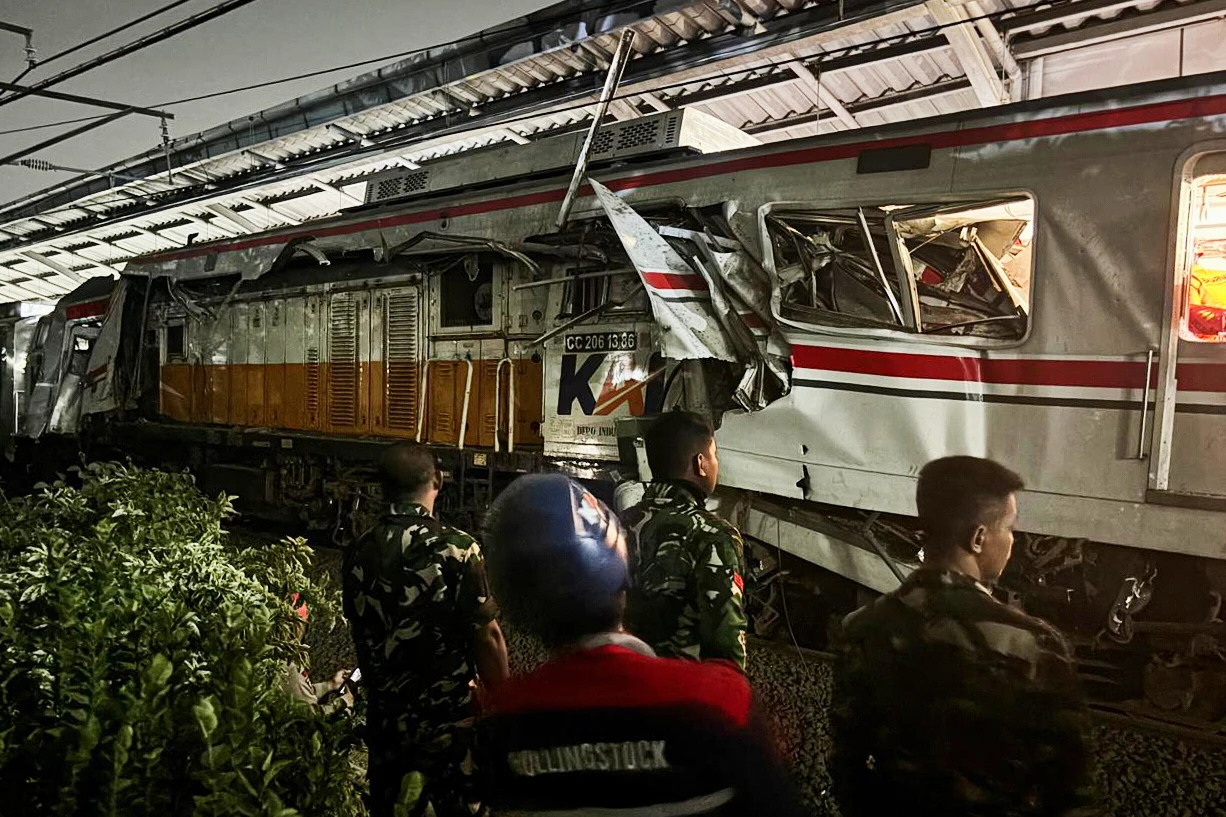
A passenger train collision near Indonesia’s capital Jakarta has left at least four people dead and several others injured, according to authorities cited in an Associated Press report. The incident occurred along a busy commuter rail corridor linking Jakarta with the industrial city of Bekasi, a route heavily used by daily commuters.
Officials have launched an investigation into the cause of the crash, which also caused significant disruption to rail services in one of Southeast Asia’s most densely populated urban transport networks.
Incident Overview
The collision took place on a commuter rail line east of Jakarta, involving trains operating along the Jakarta–Bekasi route. Preliminary information indicates the crash occurred during peak rail operations, although the exact circumstances remain under investigation.

Rail authorities have not yet confirmed whether the incident involved a head-on collision, rear-end impact, or signal failure, with further technical assessment expected from Indonesia’s transport safety investigators.
Emergency response teams were deployed to the site to evacuate passengers and secure the affected rail segment.
Casualties and Emergency Response
Authorities confirmed at least four fatalities in the crash, with additional passengers reported injured. The severity of injuries has not yet been fully disclosed, and rescue operations continued as emergency crews worked through damaged carriages.
Local transport officials said injured passengers were transported to nearby hospitals in Jakarta and Bekasi. Identification of victims is ongoing as authorities coordinate with railway operators and emergency services.
Investigation and Regulatory Review
Indonesia’s transport safety authorities have begun a formal investigation into the cause of the collision. Key areas of focus include signaling systems, train scheduling coordination, and operational compliance on the commuter line.

According to transport officials, both mechanical failure and human error remain under consideration, though no preliminary conclusion has been issued.
The railway operator is expected to submit operational data logs, including speed, communication records, and signal status, as part of the inquiry.
Rail Network Disruption and Operational Impact
The Jakarta–Bekasi corridor is among Indonesia’s busiest commuter rail routes, serving tens of thousands of passengers daily. Following the crash, several train services were delayed or suspended, creating congestion across surrounding stations.
Transport analysts note that disruptions on this corridor often have wider ripple effects across Jakarta’s integrated commuter rail network, which connects suburban areas to the capital’s central business districts.
Authorities are working to restore partial service while ensuring safety inspections are completed before full operations resume.
Safety Context and Infrastructure Pressure
Indonesia’s rail network has undergone gradual modernization in recent years, but high passenger density and aging infrastructure continue to present operational challenges.
Transport data and previous safety reports have highlighted the need for continued investment in signaling upgrades, rail monitoring systems, and congestion management on commuter lines serving the Greater Jakarta area.
The latest collision is expected to renew policy discussions around rail safety oversight and infrastructure modernization priorities.
Source Attribution: Information in this report is based on reporting from the Associated Press and statements from Indonesian transport authorities.