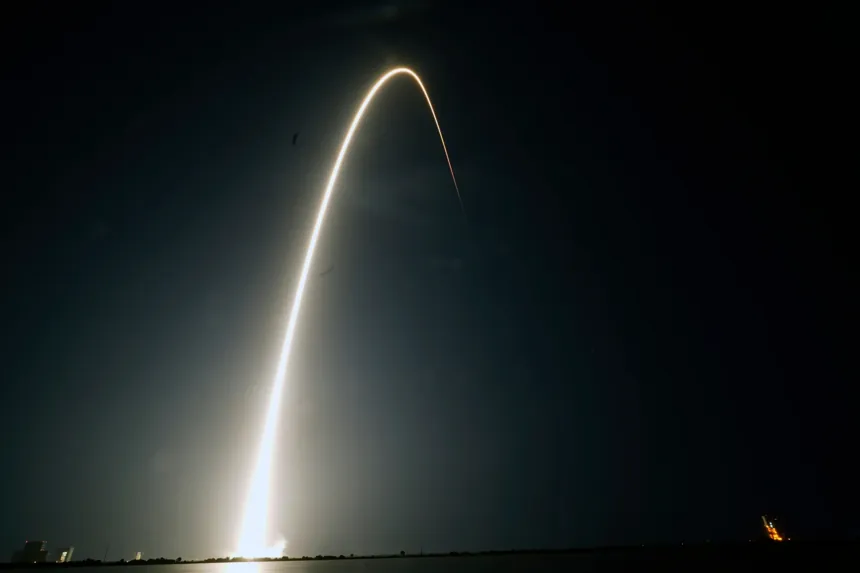
Russia may be developing a new anti-satellite capability aimed at disrupting Elon Musk’s Starlink network, according to intelligence assessments seen by The Associated Press, raising concerns over a potential shift in global space security and the risks to commercial and military satellite infrastructure.
The reported system—described as a “zone-effect” weapon—would allegedly deploy clouds of high-density pellets into low Earth orbit to disable multiple satellites simultaneously. The findings, attributed to two NATO-member intelligence services, suggest such a weapon could target Western satellite systems supporting Ukraine, while also posing risks to other space assets.
Officials familiar with the intelligence, speaking on condition of anonymity, told The Associated Press that the weapon is still in development and that its capabilities and timeline remain uncertain.

Strategic Stakes Rise in Orbit
The prospect of an orbital weapon capable of disabling multiple satellites has intensified concerns among defense analysts, particularly given the growing reliance on space-based infrastructure for communications, navigation, and military operations.
Russia has previously signaled that commercial satellite systems supporting Ukraine could be considered legitimate military targets. Starlink, operated by SpaceX, has played a critical role in maintaining communications for Ukrainian forces and civilians since Russia’s full-scale invasion in 2022.
According to reporting from The Associated Press, intelligence officials view the development of such systems as part of a broader effort to counter Western advantages in space-based technologies.
Technical Risks and Unpredictable Consequences
Space security experts warn that deploying clouds of orbital debris could create cascading damage beyond any intended target. Victoria Samson of the Secure World Foundation said she was skeptical about the practicality of such a system, noting the difficulty of controlling debris in orbit.
Military analysts interviewed by the Associated Press said that dispersing thousands of small pellets could threaten not only Starlink satellites but also other systems in similar orbits, potentially affecting global communications networks and scientific infrastructure.
■ Related News


The commander of Canada’s military Space Division, Brig. Gen. Christopher Horner, said the concept cannot be ruled out, though it would present significant operational risks, including unintended impacts on Russian and allied space assets.
Global Space Infrastructure at Risk
The potential for widespread orbital debris raises concerns about long-term space sustainability. Experts note that low Earth orbit hosts thousands of satellites operated by governments and private companies, including systems from Russia and China.
Analysts cited by the Associated Press emphasized that indiscriminate weapons could create uncontrolled debris fields, complicating space operations for all nations. Even small fragments can damage satellite components such as solar panels, potentially rendering systems inoperable.
Clayton Swope of the Center for Strategic and International Studies said that while small debris may be difficult to track, damage patterns could eventually reveal the source of an attack.
Broader Implications for Space Security
The emergence of such technology, if confirmed, would mark a significant escalation in counterspace capabilities and could prompt a new phase of strategic competition in orbit.
Analysts say the possibility of a “weapon of fear”—designed more for deterrence than actual deployment—could influence geopolitical calculations. However, the risks of widespread orbital contamination may also act as a deterrent against its use.
Russia has not publicly responded to the reported intelligence findings. Kremlin spokesperson Dmitry Peskov did not comment, according to The Associated Press, though Moscow has previously denied plans to deploy nuclear weapons in space and has called for international restrictions on orbital weaponization.
Uncertain Path Ahead for Orbital Arms Control
The reports come amid growing global concern over the militarization of space, as major powers continue to expand both defensive and offensive capabilities in orbit. International discussions on regulating space-based weapons remain ongoing, but enforcement mechanisms are limited.
Experts say that if such a system were ever deployed or tested, it could trigger a broader reassessment of space security strategies among global powers, particularly as reliance on satellite networks continues to expand across military and civilian domains.