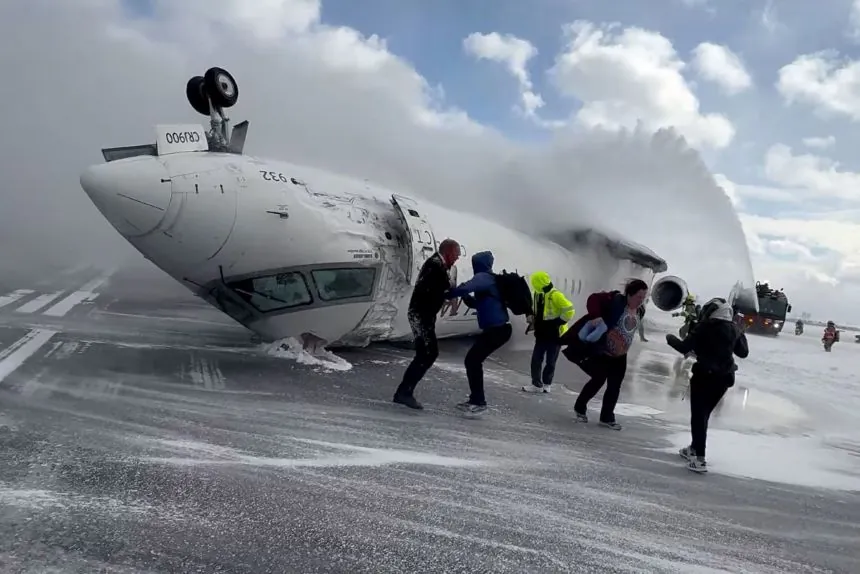
A survivable but severe aviation incident involving Delta Air Lines regional flight 4819 in Toronto has renewed scrutiny on aircraft landing systems and crash survivability standards. The February incident, in which a regional jet overturned on landing, left all passengers alive despite structural failure and fire risk, according to preliminary accounts and industry reporting.
The ongoing investigation, led by the Transportation Safety Board of Canada, is focusing on landing gear performance, structural break-up, and emergency response timelines—key variables in determining both cause and survivability outcomes.
Incident Overview and Aircraft Damage
Flight 4819, operated by Delta’s regional partner Endeavor Air, experienced a landing gear failure during final approach to Toronto, resulting in a runway impact that caused the aircraft to skid, lose structural components, and come to rest inverted.

Preliminary details indicate that one wing separated on impact and the tail section detached, while approximately 6,000 pounds (about 2,700 kilograms) of jet fuel remained onboard at the time of the incident. Despite the presence of fuel and visible fire during initial impact, all passengers and crew evacuated the aircraft.
Such full survivability in a rollover scenario is rare and highlights the role of modern aircraft cabin integrity standards and restraint systems. Industry analysts note that certification requirements for seat strength and emergency exits have significantly improved passenger survival rates in high-impact events.
Safety and Certification Context
The investigation is expected to assess whether the landing gear failure stemmed from mechanical fatigue, maintenance issues, or operational factors such as landing speed and runway conditions.
Landing gear systems are subject to strict certification standards under regulators such as the Federal Aviation Administration and Transport Canada, requiring redundancy and load tolerance during high-stress landings. However, failures—while statistically rare—remain a critical safety risk due to their role in energy absorption during touchdown.
The TSB has not yet released a final report, and officials have stated that findings will be withheld until analysis of flight data recorders, maintenance logs, and crew procedures is complete.
■ Related News

Emergency Response and Evacuation Performance
Passenger accounts suggest that evacuation occurred within minutes despite the aircraft being inverted and partially filled with fuel vapors. Emergency exits remained accessible, and cabin crew procedures were executed under high-stress conditions.
From an operational perspective, evacuation success in this case aligns with regulatory benchmarks requiring full aircraft evacuation within 90 seconds under certification testing. Analysts note that real-world conditions—such as inversion and debris—often complicate these scenarios, making the Toronto incident a notable case study in emergency response effectiveness.
Market and Legal Implications
Delta has confirmed it is cooperating fully with investigators but has declined to comment further pending the final report. The airline has offered compensation to passengers, while legal proceedings are underway involving multiple claimants against both the carrier and operator.
In the broader aviation market, such incidents can influence insurance costs, maintenance protocols, and regulatory oversight, particularly for regional carriers operating high-frequency short-haul routes. Industry data from the International Air Transport Association (IATA) shows that while accident rates remain historically low, mechanical failure incidents continue to drive incremental regulatory updates.
Industry Analysis and Outlook
The Toronto crash underscores the importance of continuous monitoring of aircraft structural components, especially in regional fleets where utilization rates are high. It also reinforces the role of safety engineering in mitigating fatal outcomes, even in severe structural failures.
The final findings from the TSB investigation will likely inform future regulatory guidance on landing gear inspection intervals, pilot training for unstable approaches, and cabin safety design enhancements.