WASHINGTON — A partial government shutdown is exposing mounting strain within the United States’ aviation security system, as the administration moves to redeploy immigration enforcement personnel into airport operations traditionally handled by specialized screeners.
As first reported by the Associated Press, the decision to assign immigration officers to assist airport security reflects a growing institutional effort to sustain basic operations amid funding lapses that have left tens of thousands of federal workers unpaid.
The move, ordered by President Donald Trump, comes as congestion intensifies at major travel hubs and workforce fatigue spreads across agencies responsible for national security.

Operational Gaps Begin to Surface Across Airport Network
The plan centers on deploying officers from U.S. Immigration and Customs Enforcement to support the Transportation Security Administration by taking on limited roles such as monitoring exit lanes or verifying passenger identification.
While framed by officials as a temporary measure, the shift signals widening operational gaps within airport security infrastructure. Screeners, many of whom have continued working without pay, are facing increasing absenteeism, contributing to extended wait times and bottlenecks at checkpoints.
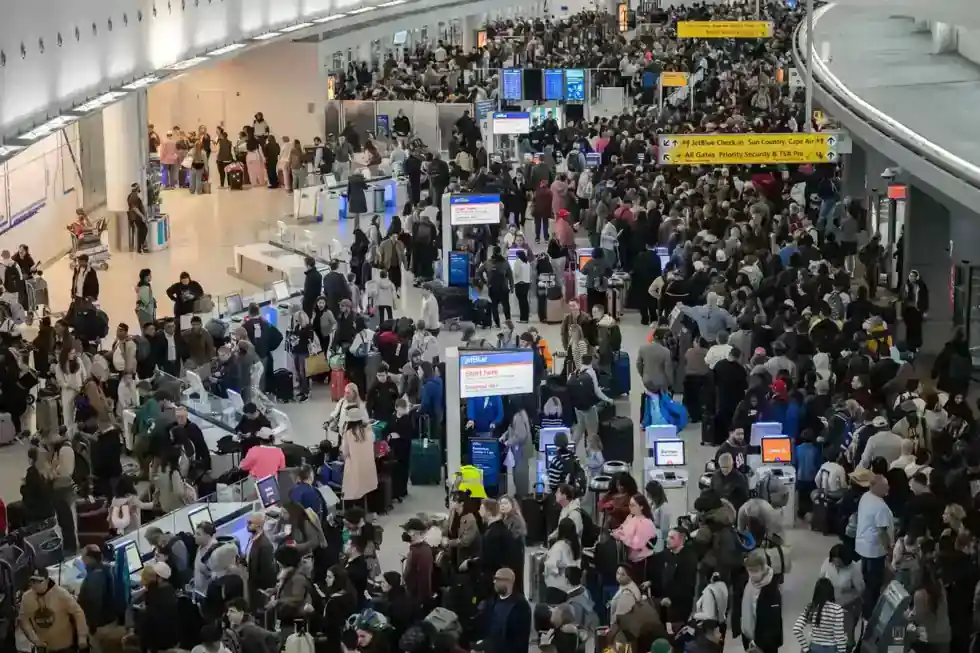
At major hubs including Hartsfield-Jackson Atlanta International Airport and John F. Kennedy International Airport, travelers encountered lines stretching for hours, with some missing scheduled departures as staffing shortages limited throughput.
Workforce Pressure Intensifies Amid Pay Disruptions
The strain on personnel is compounded by the financial uncertainty facing federal employees. Hundreds of thousands of workers across the Department of Homeland Security—including those in airport security roles—have gone without pay since funding expired.
Labor representatives warn that substituting trained aviation security staff with personnel lacking equivalent certification risks compounding operational challenges. Everett Kelley, president of the American Federation of Government Employees, criticized the approach, arguing that aviation security requires specialized training not easily replicated under emergency conditions.
■ Related News



The administration, however, has described the redeployment as a “force multiplier,” emphasizing that immigration officers will not perform technical screening tasks such as operating X-ray equipment.
Leadership Transition Adds to Institutional Uncertainty
The operational adjustments coincide with a leadership transition at the Department of Homeland Security, where the Senate has advanced the nomination of Markwayne Mullin to head the agency.
His potential confirmation follows a period of internal turbulence and arrives at a moment when the department is balancing both political pressure and operational demands. The leadership vacuum has further complicated coordination efforts as agencies attempt to respond to the shutdown’s cascading effects.
Meanwhile, White House-appointed border policy lead Tom Homan has taken charge of the airport support initiative, describing ongoing discussions with lawmakers as constructive but unresolved.
Political Deadlock Extends Operational Uncertainty
At the center of the disruption remains a budget impasse between the administration and congressional Democrats over immigration policy and broader Department of Homeland Security funding.
Republican lawmakers, including Senate Majority Leader John Thune, have acknowledged the urgency of resolving the standoff, while some within the party have expressed concern about escalating tensions at already strained airports.
Democrats, for their part, have indicated willingness to fund core security functions but continue to push for policy changes tied to immigration enforcement practices.
The result is a prolonged uncertainty that is now directly affecting public-facing systems, particularly in transportation security, where predictability and efficiency are critical.
Travel System Reliability Faces Broader Test
For passengers, the immediate consequence is a growing unpredictability in airport processing times. Officials have acknowledged that travelers are increasingly unable to gauge how early they must arrive to avoid disruptions, reflecting a broader erosion of system reliability.
Transportation authorities argue that supplemental staffing could stabilize operations in the short term. Yet the reliance on cross-agency personnel underscores deeper structural vulnerabilities exposed by the shutdown.
If the funding deadlock persists, aviation security may face continued pressure not only from staffing shortages but from the challenge of maintaining operational standards under improvised conditions—raising longer-term questions about resilience within one of the country’s most critical security systems.