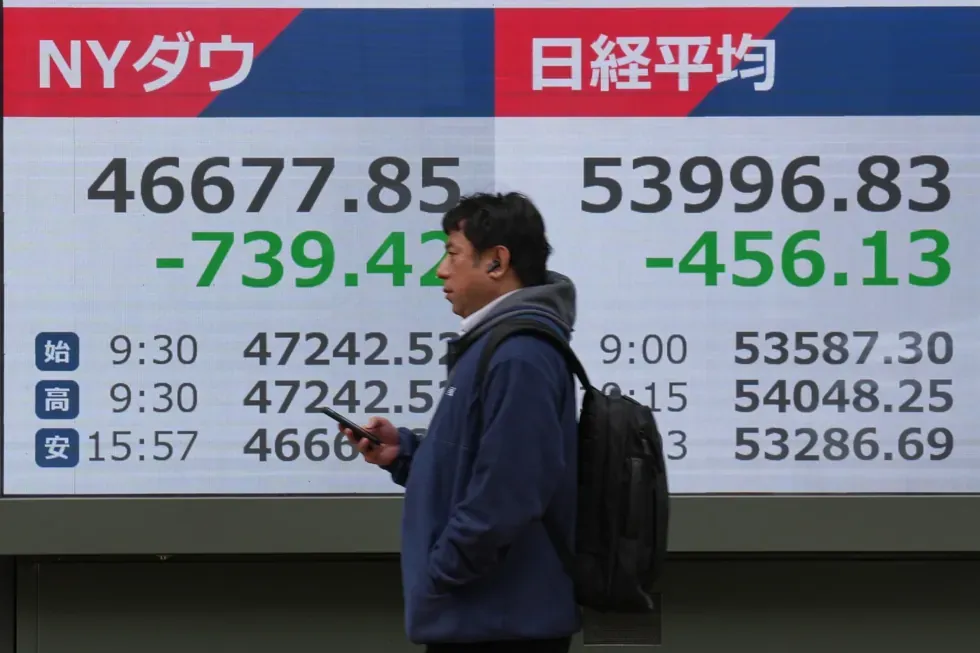
Global markets opened the final trading day of the week under pressure as Asian equities declined and crude oil prices remained close to $100 per barrel, reflecting ongoing uncertainty surrounding the conflict involving Mojtaba Khamenei and geopolitical tensions affecting the vital Strait of Hormuz.
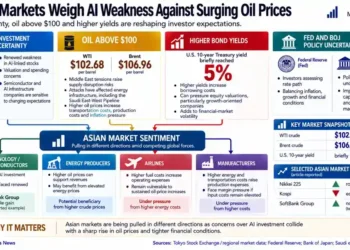
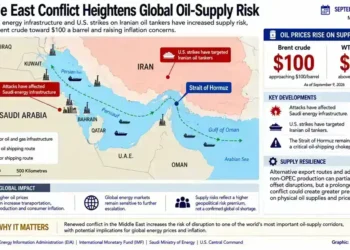
Oil market volatility linked to supply risks has become a dominant driver of investor sentiment across global markets. Brent crude traded near the $100 level after briefly approaching $120 earlier in the week, while U.S. benchmark crude futures remained below that threshold but continued to fluctuate.
Market participants are closely monitoring the implications of energy supply disruptions for global inflation and sector costs, particularly in industries heavily dependent on fuel.

Asian Equity Markets Track Global Risk Sentiment
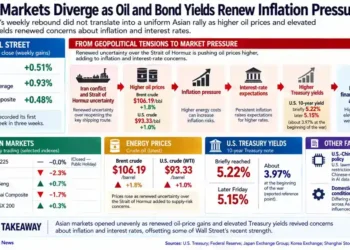
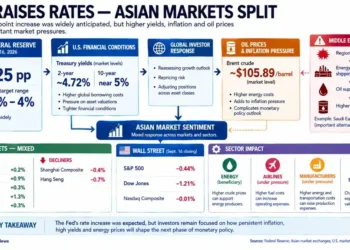
Major Asian benchmarks moved lower on Friday, following losses in U.S. markets overnight.
Japan’s Nikkei 225 declined 1.3% to 53,746.50, with technology stocks among the largest decliners. Shares of SoftBank Group fell 4.7%, reflecting broader weakness in growth-oriented sectors.
South Korea’s Kospi dropped 1.8% to 5,481.09, while Hong Kong’s Hang Seng Index fell 0.8% to 25,523.60.
On mainland China, the Shanghai Composite Index slipped 0.6% to 4,105.40.
Australia’s S&P/ASX 200 edged down 0.1% to 8,617.10, while Taiwan’s Taiex declined 0.5%. India’s BSE Sensex also moved lower, falling 0.9%.



Despite the regional declines, U.S. equity futures pointed modestly higher ahead of the next trading session. Futures linked to the S&P 500 rose 0.2%, while contracts tied to the Dow Jones Industrial Average gained 0.3%, according to market data compiled by Bloomberg.
Oil Market Volatility Reflects Supply Concerns
Crude oil markets have experienced sharp price swings since the escalation of hostilities involving Iran.
Brent crude hovered near $100 per barrel after briefly exceeding that level earlier in the week. Prices had surged toward $120 — the highest level since 2022 — as investors assessed the potential scale of supply disruption.
Meanwhile, West Texas Intermediate crude fell 0.7% to $95.02 per barrel in early trading.
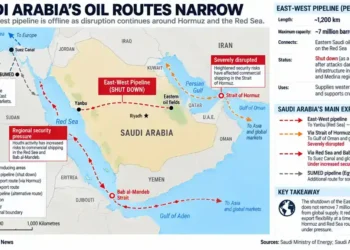
Analysts note that supply risk is closely tied to the security of the Strait of Hormuz, a maritime corridor through which roughly one-fifth of global oil shipments transit.
Industry analysts at Mizuho Bank said disruptions in the region have intensified concerns about shipping delays and the potential for sustained supply bottlenecks affecting global energy markets.
Strategic Oil Reserves Offer Limited Market Reassurance
Energy market stability is also being shaped by efforts from international agencies to mitigate supply shocks.
The International Energy Agency announced that member countries could release approximately 400 million barrels from emergency reserves — a record intervention intended to offset potential supply interruptions.
However, economists cited by financial media outlets say the measure may only partially stabilize markets if disruptions in the Persian Gulf continue.
Inflation Risks Rise as Energy Costs Increase
Higher crude prices could carry broader economic implications beyond the energy sector.
Rising fuel costs typically feed into transportation, manufacturing, and logistics expenses. Analysts note that industries such as semiconductor production and artificial intelligence infrastructure — both highly energy-intensive — may face increased operational costs if elevated oil prices persist.
Global inflation dynamics are also being monitored closely by central banks, as sustained increases in energy prices historically contribute to higher consumer price pressures.
Wall Street Declines Reflect Global Risk Repricing
U.S. equity markets closed lower Thursday amid volatile trading conditions tied to the geopolitical developments.
The S&P 500 declined 1.5% to 6,672.62, according to market data cited by Reuters. The Dow Jones Industrial Average fell 1.6% to 46,677.85, while the Nasdaq Composite dropped 1.8% to 22,311.98.
Companies with significant exposure to fuel costs experienced sharper declines. Shares of Carnival Corporation fell 7.9%, while United Airlines dropped 4.6%, reflecting investor concerns about rising operating expenses.
Currency and Commodity Markets Show Mixed Movement
In currency trading, the U.S. dollar strengthened modestly against the Japanese yen, rising to 159.39 yen. The euro traded at $1.1497, slightly weaker than the previous session.
Precious metals also moved lower. Gold prices fell 0.5% to $5,099.40 per ounce, while silver declined 2.3% to $83.16.