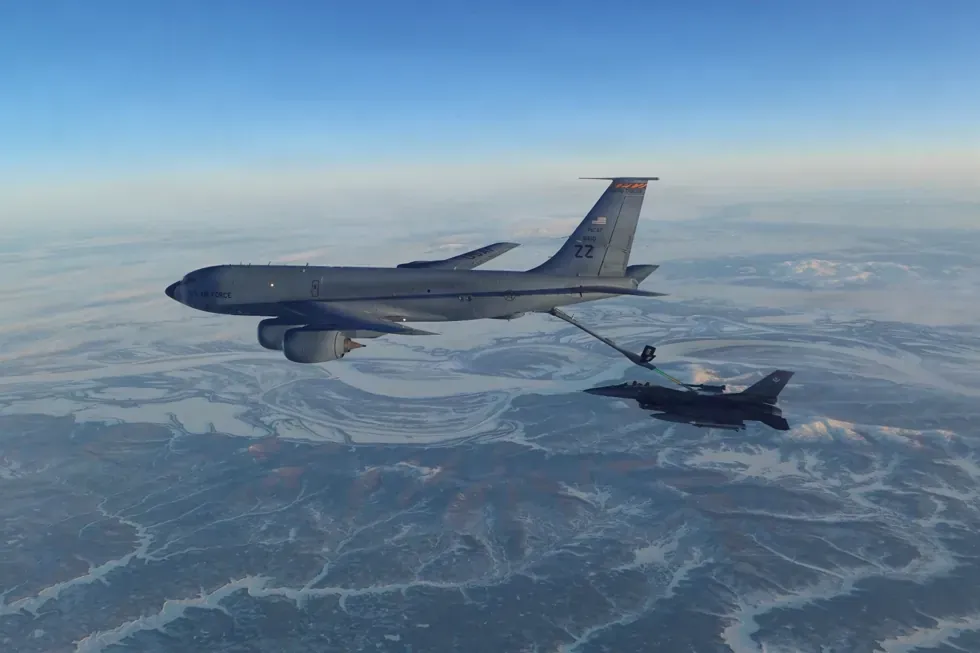
A U.S. military aerial refueling aircraft has crashed in western Iraq while supporting operations tied to the ongoing war with Iran, raising new questions about operational pressure on American air assets as the regional conflict deepens.
According to a statement from U.S. Central Command, the aircraft went down during a mission involving two refueling tankers. One aircraft landed safely while the other was declared a total loss. Rescue efforts were underway as military officials worked to determine the condition of the crew.
As first reported by The Associated Press, at least five crew members were believed to be aboard the aircraft when it crashed. Officials emphasized early assessments indicating the incident was not caused by hostile or friendly fire, suggesting a possible mechanical or operational failure during a period of heightened military tempo.

The downed aircraft was identified as a Boeing KC-135 Stratotanker, a platform that has served as the backbone of American aerial refueling capability for decades.
Operational Strain Surfaces in Intensifying Air Campaign
The crash occurs as U.S. forces sustain a high tempo of operations across the Middle East following the launch of a joint U.S.–Israeli military campaign against Iran earlier this year.
Aerial refueling tankers such as the KC-135 play a critical role in maintaining continuous combat air patrols, enabling fighter jets and surveillance aircraft to operate over extended distances. Any disruption to that network can complicate mission planning and strain operational logistics.
According to officials familiar with the mission, the aircraft was participating in a support role tied to ongoing strike and surveillance activities related to the regional conflict. The loss therefore comes at a moment when tanker availability is particularly vital for sustaining long-duration sorties across multiple theaters.
Military analysts note that refueling fleets often operate at the center of high-intensity air campaigns, frequently flying repeated missions in compressed timelines.



Series of Aircraft Incidents Raises Readiness Questions
The tanker crash marks the fourth publicly acknowledged aircraft loss tied to the current military campaign against Iran.
Earlier in the conflict, three American fighter aircraft were mistakenly shot down by Kuwaiti air defenses in a friendly-fire incident. The jets — F-15E Strike Eagle fighters — were operating in regional airspace when the incident occurred.
All six crew members aboard those aircraft successfully ejected and were later recovered in stable condition, according to U.S. military officials.
While the incidents have not yet been formally linked, the sequence highlights the operational complexity of conducting large-scale multinational air operations across congested regional airspace.
Combat Losses Add Pressure to Strategic Campaign
The aircraft crash comes amid a growing toll from the conflict itself.
According to the Pentagon, seven American service members have been killed in combat operations linked to the war with Iran, while approximately 140 U.S. personnel have been wounded. Eight of those injuries were classified as severe.
Six of the fatalities occurred when an Iranian drone struck an operations center located at a civilian port facility in Kuwait. The soldiers, members of the Army Reserve, were involved in logistics operations supporting deployed forces.
Another U.S. service member later died from wounds sustained during an attack on Prince Sultan Air Base.
The casualties underscore the expanding geographic footprint of the conflict, which has drawn retaliatory missile and drone strikes across several Gulf states hosting U.S. forces.
Aging Aircraft Fleet Faces Renewed Scrutiny
The aircraft involved in the crash belongs to a fleet of tankers whose design traces back more than six decades.
The KC-135 was developed from the same airframe lineage as the Boeing 707 and entered military service during the Cold War. Although the aircraft has undergone multiple upgrades and modernization programs, many remain among the oldest aircraft in active U.S. military service.
According to the Congressional Research Service, the U.S. Air Force maintained 376 KC-135 aircraft last year, distributed across active-duty forces, the Air National Guard, and reserve units.
The aircraft typically operates with a crew of three, though officials indicated additional personnel may have been aboard the mission that crashed in Iraq. The reasons for the expanded crew complement were not immediately clear.
Conflict Trajectory Suggests Continued Operational Risk
Senior U.S. officials have warned that the conflict with Iran may extend for an extended period and could continue to produce casualties and operational losses.
Both Donald Trump and Pete Hegseth have cautioned publicly that additional American lives could be lost before the military campaign concludes.
For military planners, the tanker crash adds another variable to an already complex operational environment, where sustaining air power across vast distances remains central to U.S. strategy.
Rescue teams continue to search the crash site in western Iraq while investigators begin the process of determining what caused the aircraft to go down. Until those answers emerge, the incident stands as another reminder of the risks surrounding a rapidly widening regional war.