NEW YORK (Journos News) – Global equity markets weakened Thursday after oil prices climbed to their highest levels since mid-2024, intensifying concerns that prolonged energy disruptions could weigh on economic growth and delay interest-rate cuts.
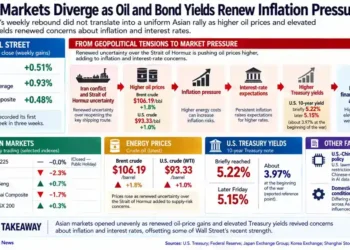
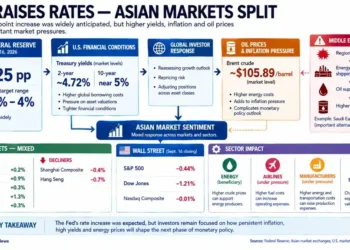
The S&P 500 fell 0.6% to close at 6,830.71, erasing its modest gains for the year. The Dow Jones Industrial Average dropped 784.67 points, or 1.6%, to 47,954.74 after earlier falling more than 1,100 points intraday. The Nasdaq Composite declined 0.3% to 22,748.99.
Market pressure followed a sharp rise in crude oil prices linked to escalating tensions involving Iran, which investors fear could disrupt global energy supply.

Oil Prices Drive Market Volatility
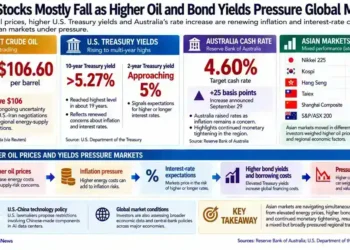
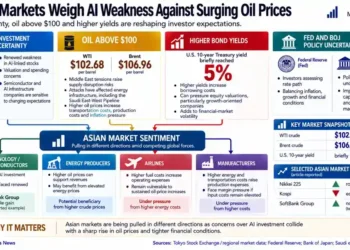
Benchmark West Texas Intermediate crude oil settled 8.5% higher at $81.01 per barrel, while Brent crude, the international benchmark, climbed 4.9% to $85.41 per barrel—both nearing their highest levels since the summer of 2024.
Energy markets moderated later in the session, trimming some earlier gains. However, analysts said sustained increases in oil prices could strain household spending, lift inflation, and complicate monetary policy decisions.
Much of the market’s focus remains on the Strait of Hormuz, a strategic shipping route off Iran’s coast through which roughly one-fifth of the world’s oil supply typically passes.
Gasoline prices in the United States have already reacted to the spike. According to the American Automobile Association, the national average price reached $3.25 per gallon, up 9% from $2.98 a week earlier.
Equity Markets React to Energy Risks
Energy-driven volatility has led to rapid swings in global financial markets this week as investors evaluate the potential economic impact of higher fuel costs.



Airline stocks were among the hardest hit, reflecting concerns about rising fuel expenses and travel disruptions across the Middle East.
Shares of American Airlines declined 5.4%, United Airlines fell 5%, and Delta Air Lines dropped 3.9%.
Smaller companies also underperformed. The Russell 2000, which tracks small-capitalization U.S. companies, fell 1.9%, reflecting investor caution toward economically sensitive sectors.
Technology Stocks Provide Partial Support
Losses in the broader market were partly offset by gains in the semiconductor sector.
Shares of Broadcom rose 4.8% after the company reported quarterly revenue and profit exceeding analyst expectations. Chief Executive Hock Tan said demand for artificial intelligence chips helped drive a 74% increase in related revenue.
Large technology companies have helped cushion broader market declines this week, according to market data.
Interest Rate Expectations Shift
In bond markets, yields moved higher as investors assessed the inflationary impact of rising energy costs.
The yield on the U.S. 10-year Treasury rose to 4.13%, compared with 4.09% late Wednesday and 3.97% before the conflict escalated.
Higher energy prices could complicate the outlook for the Federal Reserve, which had previously indicated it may resume interest-rate cuts later this year to support economic activity and employment.
Market participants have since pushed expectations for potential rate reductions further into the summer, according to trading data.
Global Markets Mixed
Equity markets in Asia rebounded following sharp losses earlier in the week. South Korea’s Kospi rose 9.6%, recovering much of the previous session’s 12.1% decline.
European markets moved lower as energy prices accelerated. France’s CAC 40 fell 1.5%, while Germany’s DAX declined 1.6%.
Analysts at Wells Fargo Investment Institute said geopolitical risks could temporarily increase investor caution but may not lead to prolonged market disruption unless oil prices remain elevated for an extended period.