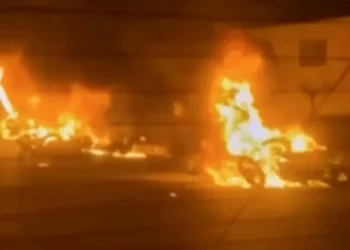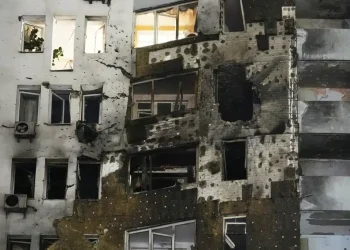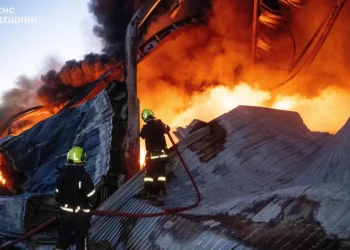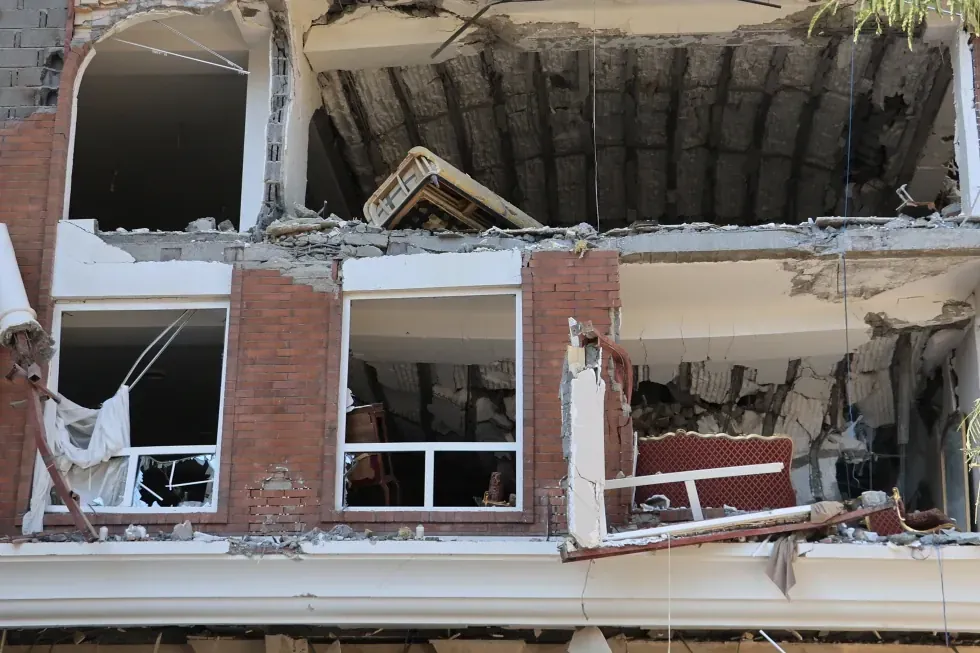
DUBAI, United Arab Emirates (JN) – A powerful explosion ripped through a residential building in Iran’s southern port city of Bandar Abbas on Saturday, killing a four-year-old girl and injuring at least 14 others, according to Iranian state media and local reporting. Authorities said the blast was caused by a gas leak, though footage from the scene showed rescuers carrying away what appeared to be a member of the security forces on a stretcher.
The incident occurred one day before Iran is scheduled to hold a naval drill in the nearby Strait of Hormuz, a strategic waterway through which roughly a fifth of the world’s traded oil passes. The timing drew attention as the United States has recently warned Iran against threatening commercial shipping or U.S. naval vessels operating in the area.
State television cited a local fire official who attributed the explosion to a gas leak inside the apartment building. Emergency teams were seen working through debris as residents gathered outside the damaged structure. Iranian media reported that at least 14 people were wounded in the blast and taken to nearby hospitals.
Footage aired by the local newspaper Sobh-e Sahel showed a correspondent reporting from outside the building. In one sequence, a man dressed in a green uniform associated with Iranian security forces was carried out by responders wearing a neck brace and appearing to be in visible pain. His left hand partly covered the insignia on his uniform. The newspaper did not refer to the man elsewhere in its coverage.
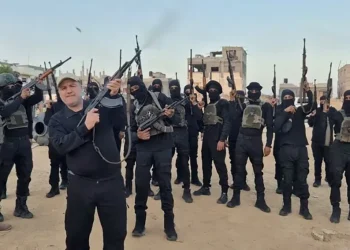
Iran’s paramilitary Revolutionary Guard did not provide details about the explosion, but it denied reports circulating online that a Guard navy commander had been injured in the incident.
Separate explosion in Ahvaz
In a separate incident on the same day, state media reported that another explosion blamed on a gas leak in the southwestern city of Ahvaz killed five people. Authorities did not indicate any connection between the two events.
Gas-related explosions are not uncommon in parts of Iran, where aging infrastructure and inconsistent safety enforcement have contributed to past residential accidents.
Strait of Hormuz drill draws scrutiny
Bandar Abbas sits along the Strait of Hormuz, a narrow maritime corridor linking the Persian Gulf to the Gulf of Oman and the Arabian Sea. The strait is one of the world’s most critical energy transit routes, carrying significant volumes of crude oil and liquefied natural gas to global markets.
Iran has announced plans to conduct naval exercises in the area, prompting renewed attention from regional observers and the United States, which maintains a naval presence in nearby waters to safeguard shipping lanes.
Washington has previously cautioned Tehran against actions that could disrupt commercial traffic or endanger naval vessels operating in international waters around the strait.
Diplomatic signals amid rising rhetoric
The explosion comes at a moment of heightened political rhetoric between Tehran and Washington.
U.S. President Donald Trump said on Saturday night that he had not yet decided on a course of action regarding Iran, amid international concern over Tehran’s response to domestic unrest and reports of a potential crackdown on protesters. Speaking to reporters while traveling to Florida, Trump declined to say whether the United States might consider military action.
“Some people think that. Some people don’t,” he said when asked whether Iran would feel emboldened if the U.S. refrained from launching strikes.
Trump also said that Iran should negotiate what he described as a “satisfactory” deal to prevent it from acquiring nuclear weapons, adding that Iranian officials were “seriously talking to us,” though no public evidence of direct talks has emerged.
Ali Larijani, a senior Iranian security official, wrote on social media late Saturday that “structural arrangements for negotiations are progressing.” Iran’s Supreme Leader Ayatollah Ali Khamenei has repeatedly ruled out direct negotiations with the United States.
Regional calls for de-escalation
Regional leaders have urged restraint and dialogue. Egypt’s President Abdel-Fattah el-Sissi called for de-escalation and said Cairo is working to encourage talks between the United States and Iran to achieve what he described as a peaceful resolution to the Iranian nuclear issue, according to a statement summarizing his phone call with Iranian President Masoud Pezeshkian.
Qatar also said its prime minister, Sheikh Mohammed bin Abdulrahman Al Thani, visited Tehran on Saturday and met with Larijani to discuss efforts to reduce regional tensions.
While Iranian authorities have attributed the Bandar Abbas explosion to a domestic gas leak, the proximity of the incident to planned naval activity in the Strait of Hormuz and the broader political climate has intensified scrutiny of events in the strategic port city.
This article was rewritten by JournosNews.com based on verified reporting from trusted sources. The content has been independently reviewed, fact-checked, and edited for accuracy, neutrality, tone, and global readability in accordance with Google News and AdSense standards.
All opinions, quotes, or statements from contributors, experts, or sourced organizations do not necessarily reflect the views of JournosNews.com. JournosNews.com maintains full editorial independence from any external funders, sponsors, or organizations.
Stay informed with JournosNews.com — your trusted source for verified global reporting and in-depth analysis. Follow us on Google News, BlueSky, and X for real-time updates.