France’s decision to expand its nuclear posture and extend deterrence cooperation to European partners marks more than a modernization effort. It signals a structural recalibration of Europe’s security order amid doubts about the durability of U.S.-anchored deterrence.
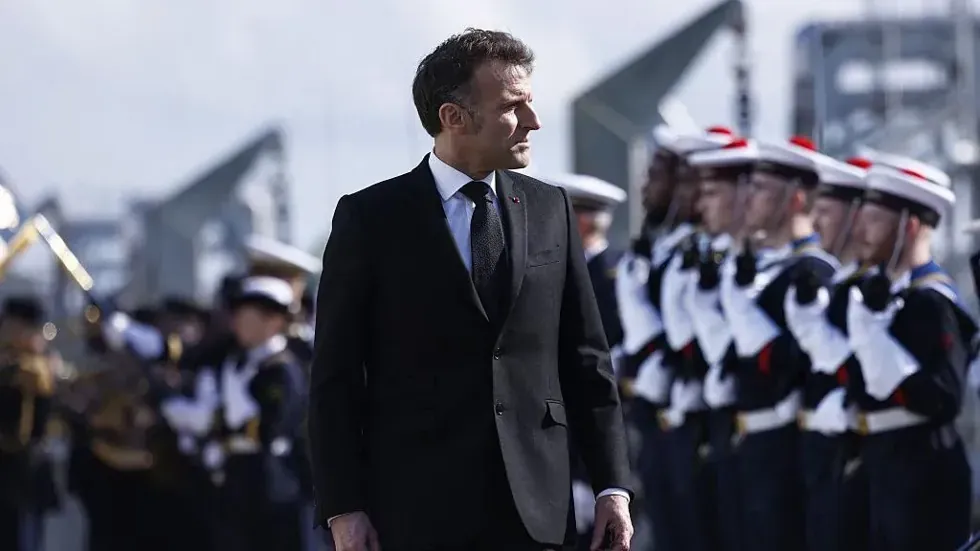
In a speech delivered at the Île Longue naval base near Brest, President Emmanuel Macron announced an increase in France’s nuclear arsenal and outlined a new “advanced deterrence” framework involving eight European countries. The move, described by French officials as the most consequential doctrinal shift since 1960, introduces a broader European dimension to Paris’s traditionally sovereign nuclear strategy.
“The next 50 years will be an era of nuclear weapons,” Macron said, speaking before naval officers and a ballistic missile submarine in western France. According to reporting by Reuters, France currently maintains roughly 300 nuclear warheads; Paris will now cease publicly disclosing precise figures.

The announcement places France at the center of a widening European effort to hedge against strategic uncertainty—without formally replacing NATO’s nuclear framework.
Strategic Depth Shrinks Across the Continent
The new doctrine would allow eight European states — the UK, Germany, Poland, the Netherlands, Belgium, Greece, Sweden and Denmark — to participate in French nuclear exercises and potentially host air bases for French nuclear-capable aircraft.
Macron said dispersing France’s Strategic Air Forces deeper across European territory would “complicate the calculations of our adversaries,” reinforcing deterrence by geographic diffusion rather than numerical expansion alone.
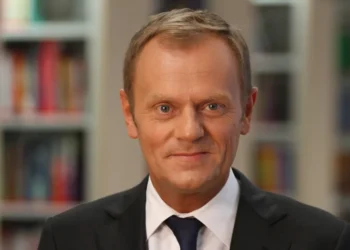
Polish Prime Minister Donald Tusk welcomed the initiative on X, writing: “We are arming up together with our friends so that our enemies will never dare to attack us.”
While Paris retains sole launch authority, the operational integration of partner states introduces a new layer of European interdependence—blurring the line between national deterrence and continental defense coordination.



The strategy does not provide an explicit nuclear guarantee to participating countries. Decision-making authority remains centralized in the French presidency, preserving the Gaullist principle of sovereign control.
A Gaullist Doctrine Reframed for a Fragmented Europe
France’s nuclear doctrine traces back to President Charles de Gaulle, who established the independent force de frappe during the Cold War to ensure autonomy from U.S. decision-making. The new framework retains that foundational logic: deterrence through ambiguity and centralized authority.
However, “advanced deterrence” introduces practical mechanisms for European participation—joint exercises, shared development of auxiliary capabilities, and potential basing arrangements—without surrendering French command prerogatives.
Macron confirmed the launch of a next-generation nuclear-armed submarine in 2036, to be named The Invincible, reinforcing the sea-based leg of France’s deterrent triad.
At the same time, France will no longer disclose the total number of warheads it possesses, reinforcing strategic opacity.
The historical continuity is deliberate. Yet the geopolitical environment is markedly different from 1960. Europe now confronts prolonged war on its eastern flank, heightened nuclear rhetoric from Moscow, and uncertainty over the long-term trajectory of U.S. security commitments.
European Nuclear Autonomy Gains Momentum
The initiative builds upon France’s existing cooperation with the United Kingdom, Europe’s only other nuclear-armed state. British officials recently participated for the first time in exercises conducted by France’s Strategic Air Forces.
Shortly after Macron’s address, France and Germany announced plans for closer nuclear cooperation. In a joint text signed by Macron and German Chancellor Friedrich Merz, the two governments confirmed that German personnel would participate in French nuclear exercises and that additional conventional capabilities would be developed with European partners.
The statement emphasized that the new framework would “complement, not replace, NATO’s nuclear deterrent.”
That distinction is critical. The architecture of NATO’s deterrence remains anchored in U.S. capabilities. France’s initiative does not formally alter alliance doctrine. Instead, it creates a parallel layer of European resilience within it.
Deterrence Without Guarantees
Despite the expanded framework, Macron stopped short of redefining France’s “vital interests” in explicit terms. Historically, Paris has maintained deliberate ambiguity about what would trigger a nuclear response.
In recent years, French officials have hinted that European interests could fall within that definition. The new doctrine gives that suggestion more structure, but it preserves ambiguity—consistent with deterrence theory, which relies on uncertainty to shape adversary calculations.
The result is a posture designed to signal commitment without codifying obligation.
Strategically, this reflects a Europe adjusting to contraction rather than expansion of security certainty. The U.S. nuclear umbrella remains intact, but European governments are investing in redundancy. France, possessing both capability and political will, is positioning itself as the nucleus of that adjustment.
A Continent Preparing for a Harder Decade
Macron’s announcement comes amid an era of heightened military spending, renewed emphasis on civil defense, and intensifying geopolitical rivalry across Europe’s periphery.
The expansion of French deterrence cooperation does not signal imminent confrontation. It signals preparation for a prolonged period of structural instability.
By retaining sole authority over nuclear use while broadening operational integration, Paris is attempting to balance sovereignty with solidarity.
Whether this recalibration strengthens European security or complicates alliance cohesion will depend on how Washington, Moscow, and European capitals interpret the shift.
For now, France’s “advanced deterrence” represents a clear message: Europe is no longer assuming that its nuclear security architecture will remain static.