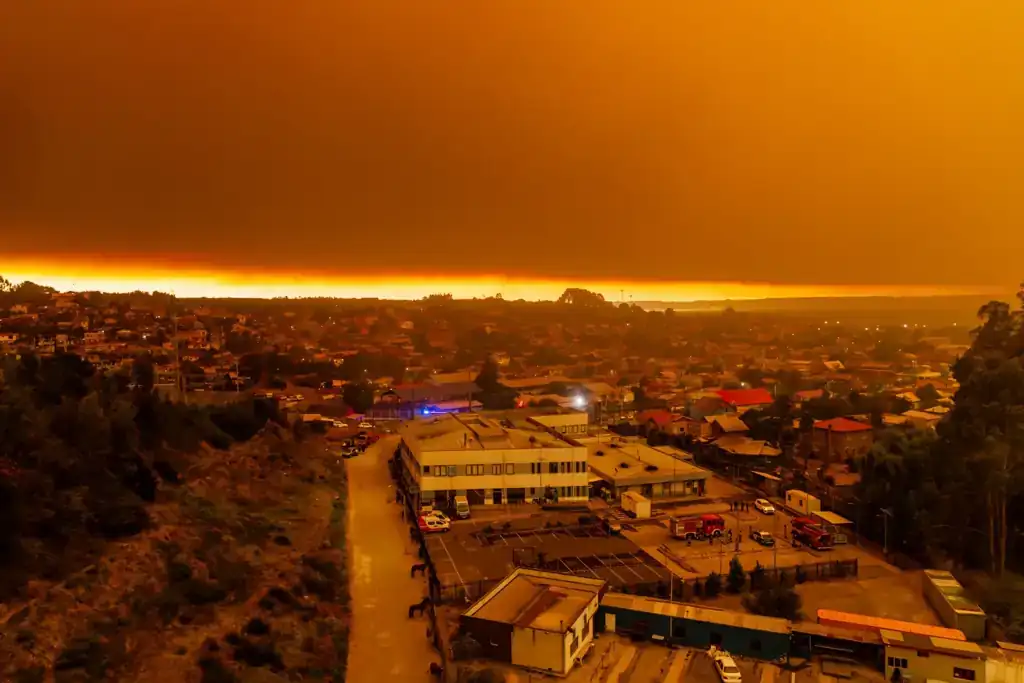
Chile is grappling with one of its most severe wildfire emergencies in recent years after fast-moving blazes tore through central and southern regions, killing at least 18 people and forcing tens of thousands from their homes, according to authorities.
The fires, driven by extreme heat and strong winds, have destroyed hundreds of houses and burned vast stretches of forested land. Officials warned the death toll and damage figures were likely to rise as emergency crews gain access to isolated and heavily affected areas.
President Gabriel Boric declared a state of catastrophe in the Biobío region and the neighboring Ñuble region, about 500 kilometers south of Santiago, enabling the government to deploy the military and mobilize additional resources to contain the disaster. The declaration came as firefighters struggled to control more than two dozen active fires amid some of the most challenging weather conditions of the summer.

A fast-moving crisis under extreme heat
Chile’s national forestry agency said the fires have already scorched about 8,500 hectares (21,000 acres). Temperatures climbed above 38 degrees Celsius (100 Fahrenheit) on Sunday, with forecasts indicating that extreme heat would persist, compounding the risks for both residents and emergency responders.
Speaking from the regional capital Concepción, Boric expressed condolences to victims’ families and acknowledged that initial assessments underestimated the scale of the destruction. While early figures pointed to about 300 homes destroyed, the president said the number of affected houses in Biobío alone was “certainly more than a thousand” so far.
Around 50,000 people were evacuated as flames advanced rapidly through hillsides and residential areas, in some cases reaching communities with little warning. Authorities imposed a nighttime curfew in parts of the affected zone to facilitate emergency operations and protect residents.
Communities caught off guard
Residents in several towns said the fires erupted overnight, leaving little time to escape. In the coastal town of Penco, flames swept down surrounding hills and into neighborhoods, engulfing cars, a school and a church, while thick smoke turned the sky orange.
“Many people didn’t evacuate. They stayed in their houses because they thought the fire would stop at the edge of the forest,” said John Guzmán, 55, who returned to survey the damage in Penco. “It was completely out of control. No one expected it.”
Others described fleeing in darkness with little more than what they could carry. “We fled running, with the kids, in the dark,” said Juan Lagos, 52, now sheltering in a makeshift emergency center with thousands of others.
Charred bodies were found in homes, fields, vehicles and along roads, underscoring the speed and intensity of the blaze. Local residents said many of the victims were well known in the tight-knit communities affected.
Strain on emergency response
Firefighters faced mounting challenges as strong winds fanned flames and shifting conditions made containment difficult. Interior Minister Álvaro Elizalde warned that weather forecasts offered little relief in the immediate term, with “extreme temperatures” expected to continue.
The scale of the emergency also prompted frustration among some local officials. Penco’s mayor, Rodrigo Vera, publicly criticized what he described as delays in government assistance during the critical early hours.
“For four hours, a community was burning and there was no government presence,” Vera said in a radio interview earlier on Sunday, appealing directly to the president for faster intervention. National authorities later said military units were being deployed to support firefighting and evacuation efforts.
A recurring summer threat
Wildfires are a recurring danger in central and southern Chile during the austral summer, typically peaking in February when high temperatures, dry vegetation and strong winds combine. The country has also been enduring a prolonged drought that has heightened fire risk across large areas.
The current disaster revives painful memories of 2024, when massive fires along Chile’s central coastline killed at least 130 people, marking the deadliest natural disaster since the 2010 earthquake and tsunami. Officials and scientists have repeatedly warned that climate change is increasing the frequency and intensity of extreme heat events in the region, exacerbating wildfire conditions.
Neighboring Argentina has also been battling significant wildfires in recent weeks, particularly in the southern Patagonia region, where hot and dry weather has allowed flames to consume thousands of acres of forest.
Ongoing assessments and aid efforts
As night fell, emergency crews continued battling active fire fronts while authorities worked to account for missing residents and assess structural damage. Temporary shelters were expanded to accommodate displaced families, and additional aid deliveries were planned for remote communities cut off by fire damage.
Government officials stressed that containment efforts remained the top priority but emphasized that longer-term recovery would require sustained support. “We cannot forget that there are human tragedies here, families who are suffering,” Boric said. “These are difficult times.”
For now, Chile remains on high alert as firefighters and soldiers race against heat, wind and terrain to prevent further loss of life.
This article was rewritten by JournosNews.com based on verified reporting from trusted sources. The content has been independently reviewed, fact-checked, and edited for accuracy, neutrality, tone, and global readability in accordance with Google News and AdSense standards.
All opinions, quotes, or statements from contributors, experts, or sourced organizations do not necessarily reflect the views of JournosNews.com. JournosNews.com maintains full editorial independence from any external funders, sponsors, or organizations.
Stay informed with JournosNews.com — your trusted source for verified global reporting and in-depth analysis. Follow us on Google News, BlueSky, and X for real-time updates.