Updated – February 23, 2026
The appearance of a U.S. Navy fighter jet over Venezuelan territory on flight-tracking platforms has drawn attention amid heightened tensions between Washington and Caracas. Open-source radar data indicated that at least one F/A-18 aircraft briefly appeared inside Venezuelan airspace late Friday, though U.S. authorities have not confirmed the reports.
The development follows recent remarks by U.S. President Donald Trump about expanding military operations tied to counter-narcotics efforts in the region. While flight-tracking information circulated widely online, aviation experts cautioned that such data can be unreliable, particularly in maritime zones where radar coverage is limited.

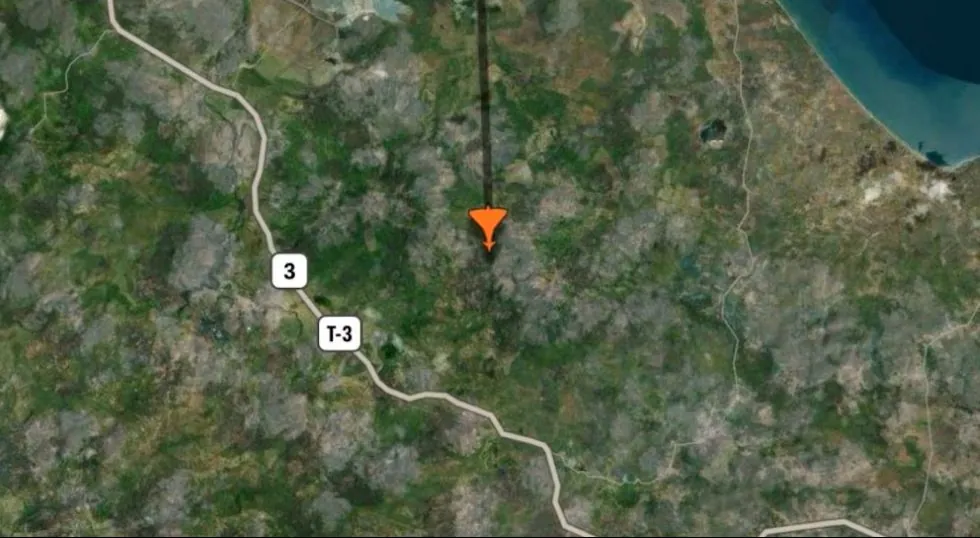
According to flight-monitoring platform Flightradar24, a U.S. Navy Boeing F/A-18E Super Hornet was tracked entering Venezuelan airspace late Friday night. The aircraft appeared under the call sign “RHINO61.” Shortly afterward, two additional Super Hornets, identified as “RHINO61” and “RHINO62,” were detected north of Aruba, off Venezuela’s Caribbean coast.
Monitoring systems also indicated the presence of four Boeing EA-18G Growler aircraft in the same area, along with a U.S. Marine Corps intelligence plane. The data, however, has not been independently verified by U.S. military authorities.
Tracking limitations and radar uncertainty
In a post on its X account, Flightradar24 noted that the RHINO61 aircraft was tracked using Multilateration (MLAT), a system that estimates aircraft positions based on signals received from multiple ground stations. The company emphasized that MLAT tracking, especially over water where receiver coverage may be sparse, can produce less accurate positioning.
The platform explained that if an aircraft’s signal is lost, its system estimates the flight path for up to 10 minutes based on last known direction and speed. These estimated routes are visually indicated by a black line on tracking maps.
Andrei Serbin, an international security analyst cited in regional media, said that radar representations of military aircraft should be interpreted cautiously. “Don’t rely on the positions shown by Flightradar24, especially when the track appears in black,” he said, noting that signal interference, transponder errors, or deliberate signal masking could distort positions. He added that during actual combat operations, military aircraft typically operate without publicly visible transponder signals.
■ Related News



No official statement had been issued by the U.S. Department of Defense or the White House at the time of publication.
Context: US military aircraft in the Caribbean
The F/A-18 Super Hornet serves as the primary multirole fighter of the U.S. Navy. According to the U.S. Department of Defense, the aircraft is designed for air-to-air and air-to-ground missions and is equipped with a 20mm cannon and multiple external hardpoints for missiles and precision-guided munitions.
The EA-18G Growler, a variant of the F/A-18 platform, specializes in electronic warfare. Its mission includes disrupting enemy radar systems and communications, enabling other aircraft to operate with reduced detection risk.
Open-source flight tracking also showed two Super Hornets flying north of Venezuela last Sunday under the call signs “RHINO11” and “RHINO12.” These movements coincided with the renewed regional deployment of the aircraft carrier USS Gerald R. Ford, the U.S. Navy’s most advanced carrier. The vessel had resumed operations in the broader Caribbean area as part of U.S. efforts to increase pressure on transnational criminal organizations.
Trump’s anti-drug strategy announcement
The radar sightings came hours after President Donald Trump stated that the United States would expand its counter-narcotics operations in the hemisphere. Speaking from the White House, Trump said the strategy would include direct actions aimed at individuals and groups responsible for drug trafficking to North America.
“This isn’t just about ground bombings in Venezuela,” Trump said, according to remarks released by the White House. He described the policy shift as targeting criminal networks rather than the Venezuelan population broadly.
Trump added that operations would “begin to happen,” though he did not provide specific operational details or timelines. He also indicated that aspects of U.S. plans related to Venezuelan oil policy would remain undisclosed.
Regional and diplomatic implications
The reported aircraft movements occur against a backdrop of long-standing tensions between Washington and Caracas. Venezuela has previously condemned U.S. military presence near its territory as a violation of sovereignty, while the United States has framed its regional deployments as part of broader security and anti-trafficking initiatives.
At this stage, the radar data alone does not confirm that U.S. aircraft conducted operations inside Venezuelan airspace. Aviation specialists note that public flight-tracking platforms rely on civilian receivers and voluntary transponder signals, which may not capture the full picture of military maneuvers.
Without confirmation from U.S. defense officials or Venezuelan authorities, the reported incursion remains unverified. The episode nonetheless highlights how open-source tracking tools increasingly shape public understanding of military movements, even as experts warn of their technical limitations.
Source: InfoBae – Monitoring sites reported a US FA-18 flying over Venezuelan territory