VERONA, Italy (Journos News) – The Milan Cortina Olympic cauldrons were extinguished on Sunday night, drawing the curtain on Italy’s widely dispersed 2026 Winter Games with a ceremony inside the ancient Arena in Verona. The twin flames — lit separately in Milan and Cortina d’Ampezzo — went dark simultaneously via video link, marking the formal end of what organizers described as the most geographically spread-out Winter Olympics to date.
Held over 17 days across mountain valleys, alpine towns and urban arenas, the Games combined historic venues with a decentralized model that Olympic officials say could influence future editions. The closing ceremony sought to reflect that blend of heritage and modernity, pairing operatic tributes with contemporary Italian pop and dance music.
Declaring the Games closed, International Olympic Committee President Kirsty Coventry praised the local organizing committee for delivering “a new kind of winter games” and setting a “very high standard for the future.” It was the first Winter Olympics overseen by Coventry in her role as IOC president.

A ceremony rooted in Italian culture
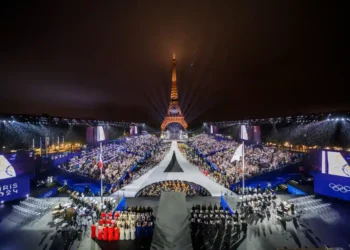
Staged inside the Roman-era Verona Arena, roughly midway between the various competition clusters, the 2½-hour ceremony leaned heavily into Italy’s artistic traditions. The production opened with a theatrical nod to lyric opera, long associated with the Arena’s summer festival, before transitioning into modern performances.
Characters from operas such as La Traviata, Aida and Rigoletto were theatrically “unpacked” from mirrored crates placed around the amphitheater. Seventeenth-century musicians performed “Libiamo ne’ lieti calici,” while costumed figures moved from the stage into the piazza outside, mingling with athletes carrying national flags.
Later segments featured ballet dancer Roberto Bolle in an aerial performance staged within a ring of light symbolizing the sun. He descended onto a set designed to resemble the Venetian lagoon, complete with gondolas, dancing to music by Italian singer Joan Thiele. The program culminated with DJ Gabry Ponte energizing athletes in the arena, followed by a final performance from Achille Lauro, who closed the night with the song “Incoscienti Giovani.”
Approximately 12,000 spectators attended the ceremony — a smaller gathering than the opening event in Milan’s San Siro stadium, which drew more than 60,000.
Record medal haul for Italy
A total of 116 medal events were contested across eight sports and 16 disciplines, including the Olympic debut of ski mountaineering. The final medals — in the 50-kilometer mass start cross-country skiing races — were awarded just hours before the closing event.
■ Related News




Host nation Italy achieved its strongest Winter Olympic performance, collecting 30 medals: 10 gold, six silver and 14 bronze. The tally surpassed its previous record of 20 medals set at the 1994 Lillehammer Games.
Giovanni Malagò, president of the Milan Cortina Foundation, credited Italian athletes with uniting the country and contributing significantly to the Games’ overall success. Many of the medalists were present in the arena, wearing white headbands emblazoned with “Italia.”
The Olympic flame, encased in a Venetian glass vessel, was carried into the Arena by Italian gold medalists from the 1994 Lillehammer Winter Games. Illuminated Olympic rings appeared on the stone steps behind the stage as the flame was raised in the center of the amphitheater.
A new geographic model
The Italy-hosted Games spanned approximately 22,000 square kilometers (8,500 square miles), stretching from ice events in Milan to alpine skiing and snowboarding in Valtellina near the Swiss border, biathlon in Anterselva near Austria, and cross-country skiing in Val di Fiemme north of Verona. Sliding sports, curling and women’s downhill competitions took place in Cortina d’Ampezzo.
Organizers had argued that the decentralized format would reduce the need for new construction by relying largely on existing facilities. While that approach posed logistical challenges, IOC officials suggested it may serve as a template for future Winter Games in regions with established winter sports infrastructure.
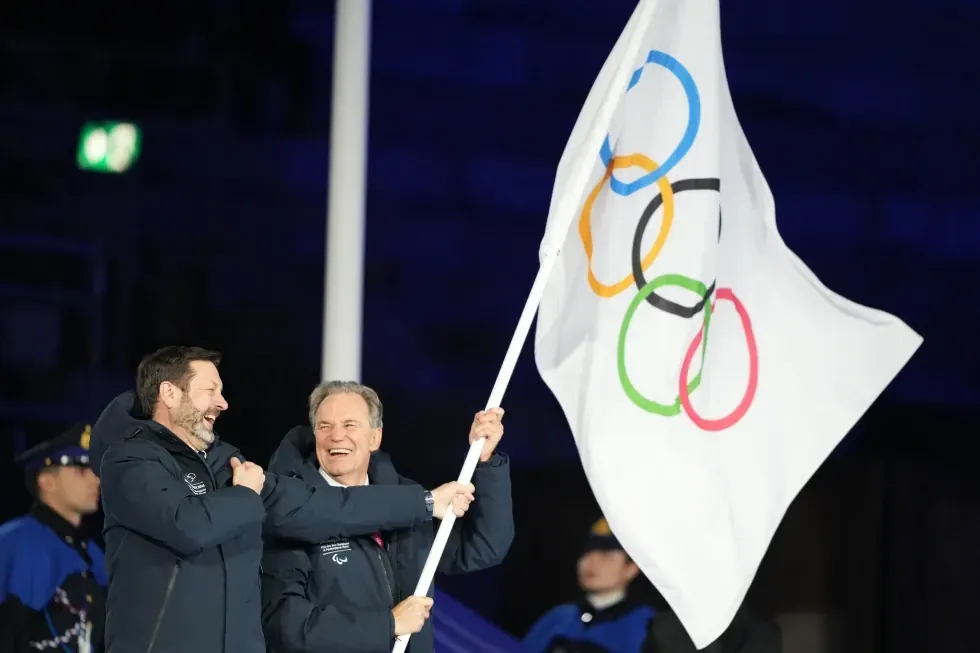
Following tradition, the Olympic flag was handed to representatives of France, which will host the next Winter Games in 2030. French organizers plan to stage events across Alpine venues and the Mediterranean city of Nice, maintaining a similarly distributed structure. Speedskating is expected to be held either in Italy or the Netherlands, according to organizers.
Paralympics to follow in Verona
The Verona Arena will again serve as the ceremonial focal point when it hosts the opening of the Milan Cortina Paralympic Winter Games on March 6. The Paralympics will run through March 15, using many of the same competition sites.
The extinguishing of the Milan Cortina Olympic cauldrons — an unprecedented dual arrangement — was accompanied by a light show rather than fireworks, in line with local restrictions intended to avoid disturbing animals in and around Verona.
As the lights dimmed and athletes filed out, the ceremony underscored both the scale and the experimentation of Italy’s Winter Olympics. Whether the spread-out model becomes a long-term blueprint for the Olympic movement may depend on future hosts, but for now, the 2026 edition closes as a chapter that combined tradition, geography and adaptation in equal measure.
Source: AP News – Twin Milan and Cortina Olympic cauldrons are extinguished, signaling the end of Winter Games