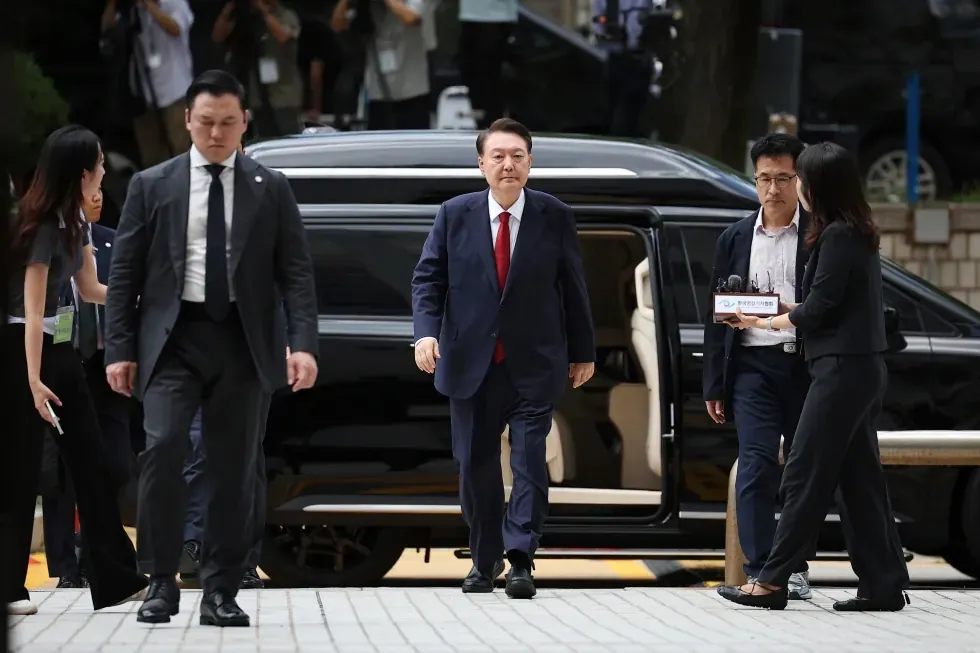
SEOUL, South Korea (Journos News) – Former South Korean President Yoon Suk Yeol has been sentenced to life in prison for imposing martial law in December 2024, a move that marked one of the country’s most significant political crises in decades. The court ruled that Yoon’s actions, including mobilizing troops around the National Assembly, constituted rebellion against the democratic process.
Yoon, who was removed from office following his impeachment, faced multiple criminal charges related to his six-hour declaration of martial law. The verdict underscores South Korea’s ongoing efforts to reconcile its modern democratic institutions with the memory of past authoritarian rule.
The Seoul Central District Court found that Yoon attempted to override an opposition-controlled legislature by sending military and police forces to the Assembly on Dec. 3, 2024. Judge Jee Kui-youn determined that Yoon intended to block lawmakers, arrest key officials, and establish unchecked power for a “considerable” period.

Martial Law Evokes Authoritarian Legacy
Yoon’s martial law proclamation, the first in more than four decades, drew immediate comparisons to South Korea’s military-backed governments of the late 20th century. During that era, emergency decrees allowed authorities to station soldiers and armored vehicles in public spaces and restrict civil liberties to suppress dissent.
The December 2024 measure suspended political activity, controlled media outlets, and allowed arrests without warrants. It was lifted after roughly six hours when lawmakers broke through a military blockade and unanimously voted to rescind the decree. Yoon was suspended from office on Dec. 14, 2024, and formally removed by the Constitutional Court in April 2025. He has been in custody since July 2025.
Defense Challenges Verdict
Yoon’s legal team criticized the ruling as a “predetermined verdict,” arguing that the court relied solely on prosecutors’ arguments. Lawyer Yoon Kap-keun said the team was considering an appeal. The former president told the court that the martial law measure was intended only to highlight legislative gridlock and that he would respect lawmakers’ decisions if they opposed the decree.
Prosecutors maintained that Yoon sought to paralyze the legislature and prevent lawful votes, exceeding his constitutional authority even under martial law. Judge Jee emphasized that the deployment of troops to the National Assembly was central to the court’s finding of rebellion.
“This court finds that the purpose of his actions was to block the Assembly and arrest key figures, preventing lawmakers from performing their duties,” Jee said. “It is sufficiently established that he intended to obstruct the Assembly’s activities for a considerable period of time.”
■ Related News

Protests and Public Reaction
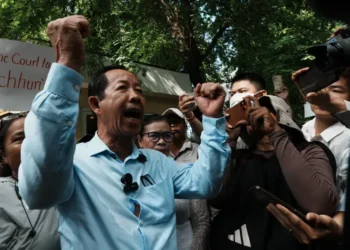
Hundreds of Yoon supporters gathered outside the court as he arrived, while critics demanded the harshest possible punishment. Police maintained order, and there were no immediate reports of clashes following the ruling.
A special prosecutor had sought the death penalty, citing threats to democratic governance, though analysts widely expected a life sentence given the brief duration of the martial law and absence of casualties. South Korea has not carried out an execution since 1997, reflecting a de facto moratorium on capital punishment.
Other Officials Also Convicted
Several former military and police officials involved in enforcing the decree were also sentenced. Former Defense Minister Kim Yong Hyun received a 30-year sentence for planning the measure and mobilizing troops. Yoon had previously been sentenced to five years for resisting arrest and bypassing the required Cabinet approval for the martial law decree.
Two Cabinet members, including former Prime Minister Han Duck-soo, were convicted in separate cases. Han received 23 years for attempting to legitimize the decree, falsifying records, and giving false testimony, and has appealed.
Yoon is the first former South Korean president to receive a life sentence since the country’s military-era leaders. Former dictator Chun Doo-hwan was sentenced to death in 1996 for a 1979 coup and the 1980 Gwangju crackdown but later had his sentence commuted to life and was pardoned in 1997. Chun died in 2021.
Source: AP News – Former South Korean President Yoon receives life sentence for imposing martial law