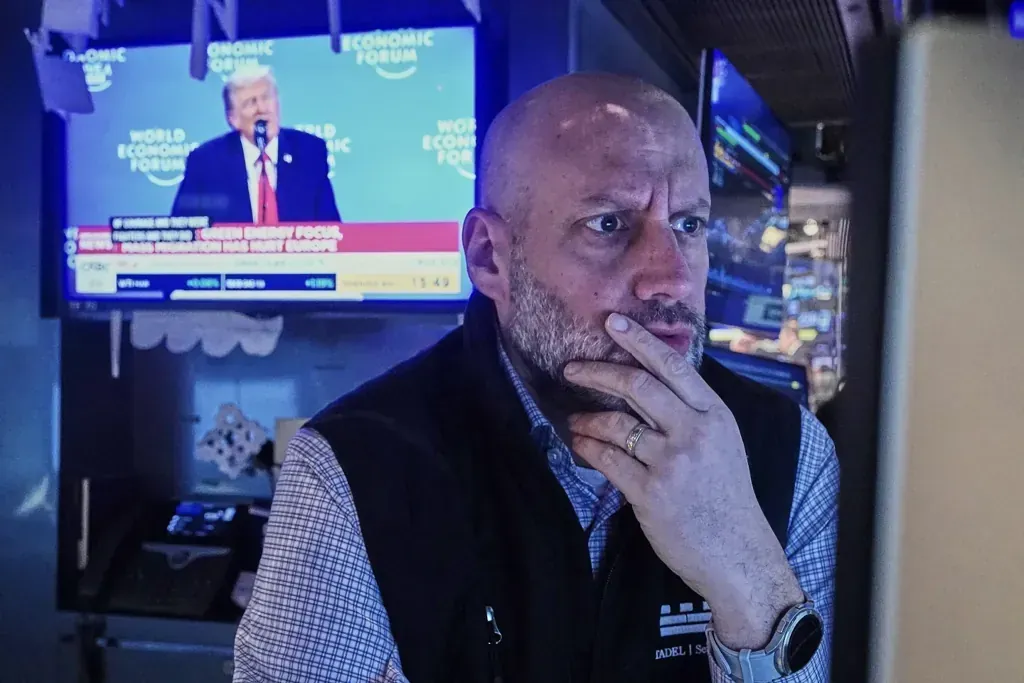
NEW YORK (JN) – U.S. stocks rebounded on Wednesday, recovering roughly half of the previous session’s sharp losses after President Donald Trump said he would not proceed with threatened tariffs tied to Greenland and described a potential framework for a deal involving the Arctic island.
The reversal eased investor anxiety after markets had fallen to their worst level since October, rattled by fears that a new round of transatlantic trade tensions could undercut growth and reignite inflation pressures. Trump’s softer tone helped restore some stability across equities, bonds and currencies.
The episode underscored how closely global markets remain tethered to political signals from Washington, particularly when trade and geopolitics intersect with already-fragile investor sentiment.
Wall Street recovers after steep sell-off
The S&P 500 rose 1.2%, clawing back just over half of its 2.1% decline from the day before and moving closer to the record high it set earlier this month. The Dow Jones Industrial Average gained 588 points, or 1.2%, while the Nasdaq composite also advanced 1.2%.
Markets turned higher shortly after Trump said he had reached a framework for an agreement related to Greenland and confirmed that tariffs he had threatened against several European countries would not move forward. He told business and government leaders in Europe that he would not use force to take what he described as “the piece of ice,” a remark that further signaled de-escalation.
Trump later acknowledged that markets had fallen because of his Greenland stance but dismissed the drop as “peanuts” compared with gains since the start of his second term, adding that he expected stocks to rise further.
Tariff fears ease, bond markets calm
The pullback in tariff rhetoric helped reduce demand for safe-haven assets. In the U.S. bond market, the yield on the benchmark 10-year Treasury note eased to 4.25% from 4.30% late Tuesday, nearly returning to levels seen before the tariff threat emerged.
The U.S. dollar, which had weakened a day earlier, recovered some ground against major currencies. Investors also took comfort from calmer conditions in Japan’s bond market, which had added to global volatility earlier in the week.
Trump had previously threatened to impose 10% tariffs on Denmark, Norway, Sweden, Germany, France, the United Kingdom, the Netherlands and Finland over opposition to U.S. control of Greenland. Those levies would have come on top of a separate 15% tariff outlined in a yet-to-be-ratified trade agreement with the European Union.
A familiar market pattern
Market participants noted that the episode fit a broader pattern seen during Trump’s presidency. Sharp policy threats have often triggered abrupt market sell-offs, followed by partial reversals once negotiations or compromises appear possible.
That dynamic has given rise to the market shorthand “TACO,” meaning “Trump Always Chickens Out,” though supporters point out that several of his most aggressive opening positions have ultimately led to trade deals previously viewed as unlikely. Trump’s earlier “Liberation Day” tariff announcement, which preceded a series of agreements with major economies, is often cited as an example.
For investors, the uncertainty itself remains a central risk, with sudden policy shifts capable of moving markets rapidly even when long-term outcomes remain unclear.
Corporate earnings shape trading
Individual stocks reflected a mix of earnings-driven moves beneath the broader rebound.
Halliburton shares rose 4.1% after the oilfield services company reported quarterly profits that exceeded analysts’ expectations, benefiting from steady demand in the energy sector.
United Airlines gained 2.2% after posting stronger-than-expected results for the final quarter of 2025. Chief executive Scott Kirby said the airline’s revenue momentum was continuing into 2026, reinforcing optimism about travel demand.
Those gains helped offset declines elsewhere. Netflix fell 2.2% despite beating profit expectations, as investors focused on slowing subscriber growth and a weaker-than-forecast outlook for the current quarter.
Kraft Heinz shares dropped 5.7% after Berkshire Hathaway warned it may consider selling its roughly 325 million-share stake in the food company. Berkshire took a $3.76 billion write-down on the investment last summer, and Warren Buffett has previously expressed disappointment with Kraft Heinz’s strategy, including plans to split the business in two.
Global markets mixed
Outside the United States, stock markets were mixed across Europe and Asia, with movements generally modest as investors assessed the implications of the U.S. policy shift.
Japan’s Nikkei 225 fell 0.4%. Attention there remained on domestic politics after Prime Minister Sanae Takaichi called a snap election for Feb. 8, a move that had earlier pushed long-term Japanese government bond yields to record highs.
Expectations that Takaichi could pursue tax cuts and higher spending have raised concerns about Japan’s already heavy public debt load. After surging to 4.22% on Tuesday, the yield on Japan’s 40-year government bond eased back to 4.05% on Wednesday, helping stabilize global bond markets.
This article was rewritten by JournosNews.com based on verified reporting from trusted sources. The content has been independently reviewed, fact-checked, and edited for accuracy, neutrality, tone, and global readability in accordance with Google News and AdSense standards.
All opinions, quotes, or statements from contributors, experts, or sourced organizations do not necessarily reflect the views of JournosNews.com. JournosNews.com maintains full editorial independence from any external funders, sponsors, or organizations.
Stay informed with JournosNews.com — your trusted source for verified global reporting and in-depth analysis. Follow us on Google News, BlueSky, and X for real-time updates.