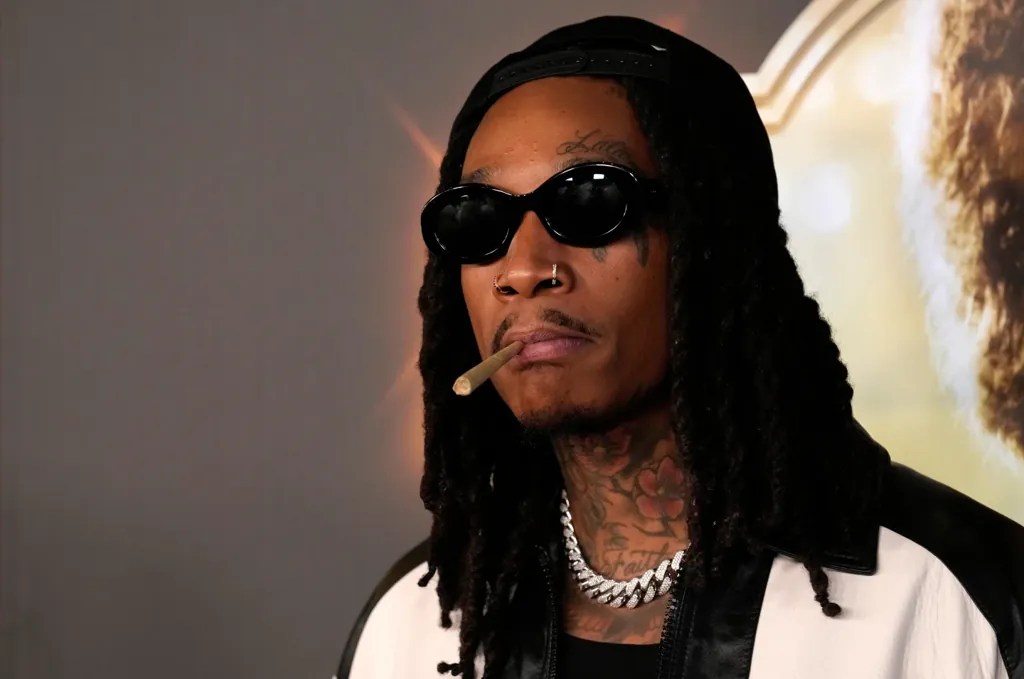
A Romanian court has sentenced American rapper Wiz Khalifa to nine months in prison for cannabis possession, more than a year after authorities said he consumed marijuana while performing at a major summer music festival on the country’s Black Sea coast.
The ruling, issued Thursday by the Constanța Court of Appeal, is final and replaces a lower court decision that had imposed only a fine. Prosecutors had challenged that earlier sentence, arguing it did not reflect the seriousness of the offense under Romanian law.
According to Romania’s national news agency Agerpres, the court convicted Khalifa of “possession of dangerous drugs, without right, for personal consumption,” after finding that he was in possession of more than 18 grams of cannabis and had used the drug publicly during his performance.
The case stems from an incident in July 2024, when Khalifa, whose legal name is Cameron Jibril Thomaz, appeared at the Beach, Please! Festival in Costinești, a seaside resort in Constanța County. Romanian police said he was stopped after his set, during which he was seen smoking what authorities later identified as cannabis.
Romania enforces strict penalties for cannabis possession
Romania has some of the toughest drug laws in the European Union, particularly regarding cannabis. Possession of marijuana for personal use remains a criminal offense, punishable by prison terms ranging from three months to two years or a criminal fine, depending on the quantity involved and the circumstances of the case.
Public consumption, especially in high-profile settings, can weigh heavily in sentencing decisions, legal experts in Romania have noted in past cases. Authorities have repeatedly said the law makes no distinction between foreign visitors and Romanian citizens when it comes to drug-related offenses.
The Constanța Court of Appeal overturned a decision issued in April by a lower court in the county, which had fined Khalifa 3,600 lei (about $830) for illegal possession. Prosecutors appealed that ruling, seeking a custodial sentence instead, arguing that the offense involved both possession and use in a public setting.
The appeals court agreed and imposed the nine-month prison sentence. Court documents cited by Agerpres indicate that the judges considered both the quantity of cannabis and the public nature of the incident.
Legal implications remain unclear
It is not immediately clear whether Romanian authorities will seek to enforce the prison sentence through an extradition request. Khalifa is a U.S. citizen and does not reside in Romania, and Romanian officials have not publicly commented on whether further legal steps are planned.
Extradition in such cases can be complex, often depending on bilateral treaties, the nature of the offense, and whether the sentence meets legal thresholds in both countries. Romanian prosecutors have not disclosed whether they intend to pursue enforcement abroad.
Khalifa and his representatives did not publicly comment on the ruling as of Thursday. U.S. embassy officials in Bucharest also declined to comment on individual legal cases involving American citizens.
Festival incident drew widespread attention
The case attracted international attention shortly after the festival in 2024, when videos circulated online showing the rapper smoking a large, hand-rolled cigarette on stage while performing his hit song “Young, Wild & Free.” Romanian authorities later confirmed that the substance had tested positive for cannabis.
Festival organizers said at the time that they cooperate fully with local authorities and reminded attendees that Romanian law prohibits drug use, regardless of an artist’s status or nationality.
Romanian police have, in recent years, increased enforcement efforts at large music festivals, particularly along the Black Sea coast, which draws tens of thousands of visitors each summer from across Europe.
Career background
Now 38, Khalifa rose to prominence in the late 2000s with his breakout mixtape Kush + Orange Juice, which helped establish him as a leading figure in contemporary hip-hop. He later achieved global commercial success with singles such as “Black and Yellow” and “See You Again,” the latter becoming one of the best-selling songs of the 2010s.
While cannabis use is widely legal or decriminalized in parts of the United States and Western Europe, Khalifa has previously acknowledged that he tailors his behavior when traveling abroad. The Romanian case underscores the risks artists face when performing in countries with stricter drug policies.
Broader legal context
Romania has resisted broader European trends toward cannabis decriminalization. While some EU countries have softened penalties or allowed limited personal use, Romanian lawmakers and law enforcement officials have consistently argued that strict enforcement is necessary to deter drug use, particularly among young people.
Courts have occasionally issued suspended sentences or fines in small-scale possession cases, but custodial sentences remain possible, especially when aggravating factors are present.
With the appeals court decision now final, Khalifa’s case is likely to be cited in future discussions about drug enforcement and high-profile defendants in Romania, even as questions remain about how — or whether — the sentence will ultimately be enforced.
This article was rewritten by JournosNews.com based on verified reporting from trusted sources. The content has been independently reviewed, fact-checked, and edited for accuracy, neutrality, tone, and global readability in accordance with Google News and AdSense standards.
All opinions, quotes, or statements from contributors, experts, or sourced organizations do not necessarily reflect the views of JournosNews.com. JournosNews.com maintains full editorial independence from any external funders, sponsors, or organizations.
Stay informed with JournosNews.com — your trusted source for verified global reporting and in-depth analysis. Follow us on Google News, BlueSky, and X for real-time updates.