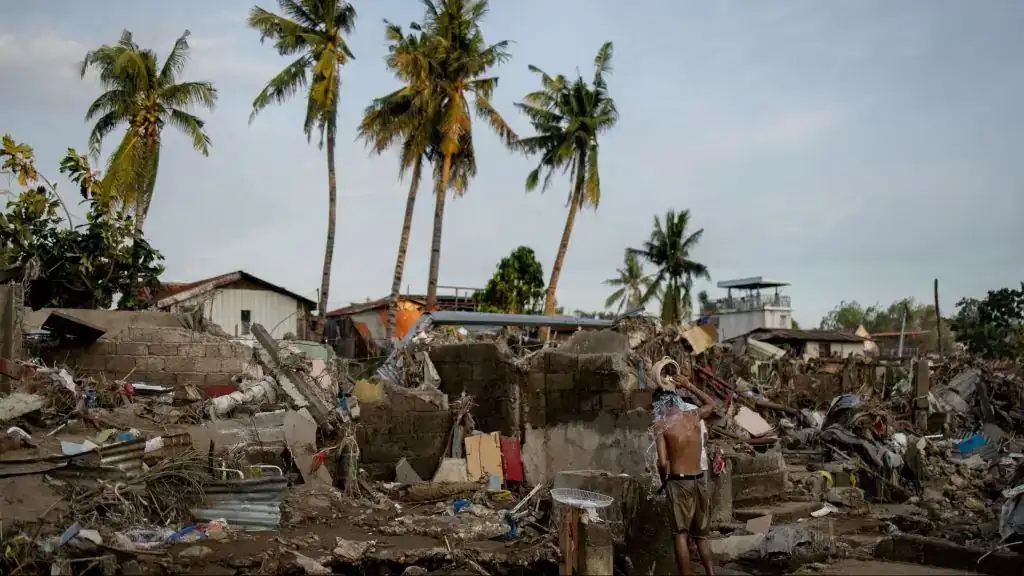
Manila, Philippines (Journos News) – Flash floods triggered by Typhoon Kalmaegi tore through parts of the Philippines in November, killing hundreds and devastating communities. Later investigations and government admissions revealed that billions of pesos meant for flood control had been lost to corruption, leaving residents dangerously exposed.
Ace Aguirre first noticed something was wrong as he ate breakfast in his home in Cotcot, a village in Cebu province. Mud crept across his living room floor. Moments later, floodwaters surged inside, lifting furniture and trapping his family.
The water rose quickly. Aguirre fought to open the front door as his son prayed. His daughter, who cannot swim, climbed onto a concrete pillar. Outside, cars drifted past their home as water rushed through the street.
“I don’t know how we were able to survive,” Aguirre said later. “One small change, and many of us could have died.”
A deadly storm overwhelms Cebu
Typhoon Kalmaegi dumped more than a month’s worth of rain in a single day. Rivers swelled. Drainage systems failed. Flash floods spread across several regions of the country.
More than 230 people died nationwide, according to official figures. In Aguirre’s neighborhood, one of the victims was a mother of two. She drowned after becoming trapped in her kitchen. Aguirre tried to help but could not reach her in time.
Flooding is a familiar threat in the Philippines, which faces about 20 typhoons each year. The country sits in one of the world’s most disaster-prone regions. What shocked many Filipinos this time was not the storm itself, but what followed.
Warnings before the floods
Concerns about flood control in Cebu existed long before the November disaster. A local citizens’ group had called for an audit of projects along the Cotcot River, upstream from Aguirre’s home. Local media reported those warnings months earlier.
After the floods, residents saw clear signs of failure. Waterways overflowed. Drainage systems clogged. Structures meant to protect communities did not work as intended.
Government admits widespread corruption
National attention intensified in July when President Ferdinand Marcos Jr. acknowledged serious problems in the country’s flood control program. He said an internal audit found widespread corruption in projects worth more than 545 billion pesos, or about $9.2 billion.
The audit reviewed roughly 10,000 projects approved since Marcos took office in 2022. Inspectors found that many used substandard materials. Others were never built at all.
Marcos described several of the projects as “ghost projects.” Funds had been released, he said, despite little or no construction.
Cebu projects under investigation
In Cebu province, officials said about 26 billion pesos ($443 million) had been allocated for flood control works. Authorities acknowledged that many of these projects should have been operational when Typhoon Kalmaegi struck.
After the flooding, Cebu Governor Pamela Baricuatro called for a formal investigation. She demanded answers about where the money went and why protections failed.
Investigators later said the scandal involved dozens of lawmakers, local officials, and contractors. Authorities allege that kickbacks were paid in exchange for contract approvals. Many cases remain under review.
Public anger grows
The revelations have shaken trust in the government’s disaster preparedness. For many Filipinos, flood control projects are not abstract policies. They shape daily life, especially in low-lying and urban areas.
When these systems fail, the consequences arrive without warning. Homes flood. Families scramble to escape. Death can follow within minutes.
Public anger has grown, especially among young Filipinos. Youth-led protests against corruption and political elites have spread in recent months. Demonstrators have linked the flood control scandal to broader concerns about inequality and governance.
Promises and skepticism
In response, President Marcos visited flood-hit areas in Cebu. He promised to clear waterways, unclog drainage systems, and complete repairs before the next rainy season.
Government agencies also pledged tighter oversight and faster investigations. Officials said they would hold those responsible to account.
Critics, however, remain cautious. Similar promises followed past disasters, with limited lasting reform. The Philippines has invested in flood control for decades, even as climate change intensifies rainfall and raises sea levels.
International agencies have repeatedly warned that strong governance matters as much as infrastructure. Without accountability, even large investments can fail.
A personal cost
For Aguirre, the issue is no longer distant politics. He followed the scandal on television from his home in Cebu. Before the flood, it felt removed from daily life. Afterward, it felt personal.
“All of a sudden you become a direct victim,” he said. “It hits different.”
As investigations continue, the November floods stand as a reminder of what is at stake. Corruption in public works is not only a financial crime. In a country exposed to extreme weather, it can decide who lives and who does not.
This article was rewritten by JournosNews.com based on verified reporting from trusted sources. The content has been independently reviewed, fact-checked, and edited for accuracy, neutrality, tone, and global readability in accordance with Google News and AdSense standards.
All opinions, quotes, or statements from contributors, experts, or sourced organizations do not necessarily reflect the views of JournosNews.com. JournosNews.com maintains full editorial independence from any external funders, sponsors, or organizations.
Stay informed with JournosNews.com — your trusted source for verified global reporting and in-depth analysis. Follow us on Google News, BlueSky, and X for real-time updates.