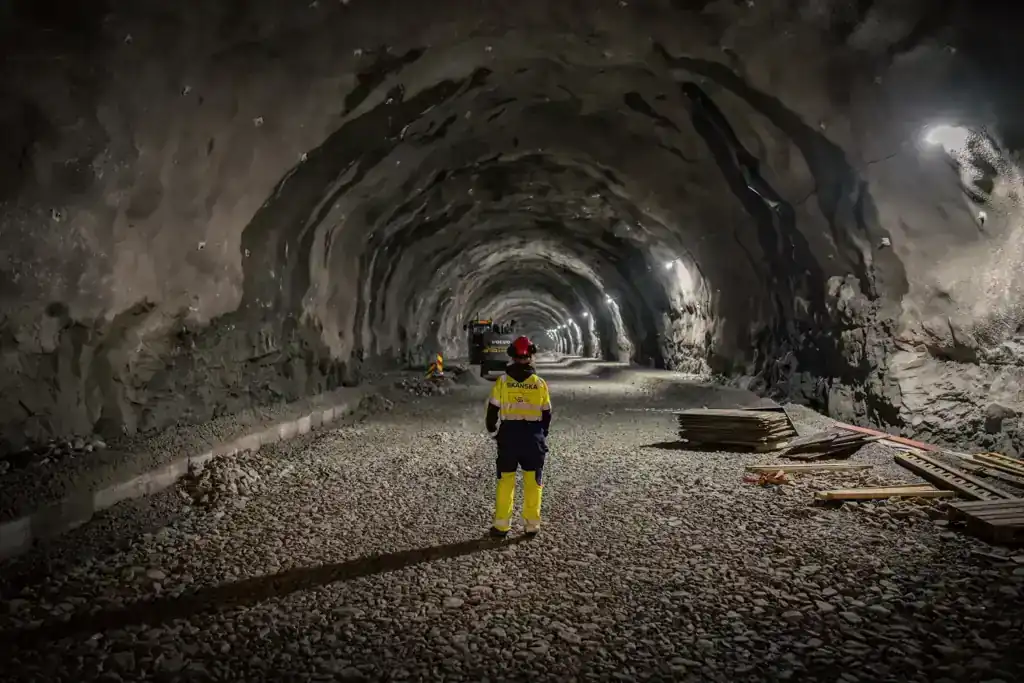
The world’s longest and deepest undersea road tunnel is taking shape beneath the Norwegian coast, marking one of the most ambitious infrastructure efforts underway in Europe. Known as Rogfast, the massive link will form a key part of a wider national push to replace ferries with permanent, weather-resilient road connections.
Norwegian authorities say the 27-kilometer tunnel will cut long travel times, strengthen regional mobility, and help modernize an aging highway corridor that is vital for the country’s economy. The multibillion-kroner development also represents a significant leap in tunneling technology, requiring precision engineering and advanced digital tools to overcome harsh environmental pressures far below the seabed.
Transforming Travel Along Norway’s West Coast
The Rogfast project has been designed as a fixed road link between the Stavanger and Haugesund regions, two major population hubs on the country’s rugged western coastline. Once completed, the structure will plunge as deep as 392 meters below sea level, making it the deepest road tunnel ever built.

Construction began in 2018 but was suspended a year later amid concerns about rising costs. After a complete restructuring, work resumed in late 2021, and the tunnel is now scheduled for completion in 2033. Authorities estimate the final cost at around 25 billion Norwegian kroner, roughly equivalent to $2.4 billion.
Project managers say the long-term benefits will outweigh the decade of engineering challenges. The new tunnel will eliminate local ferry crossings, reducing travel time between Stavanger and Bergen by around 40 minutes. For residents, the route will provide a dependable alternative during winter storms, when ferries are often canceled.
Skanska, the multinational construction group overseeing the northern portion of the development, has emphasized the project’s role in strengthening economic ties between communities that rely heavily on reliable transport links. The region is home to industries ranging from offshore energy to fisheries, and transport bottlenecks have long been a concern for local planners.
An Unusual Design With a High-Tech Backbone
Rogfast will consist of two separate roadway tubes, each carrying two lanes of traffic. Midway through the system, engineers are constructing a rare underground double roundabout at a depth of roughly 260 meters. This will connect to a linkage tunnel running to Kvitsøy, Norway’s smallest municipality, offering the island’s residents a permanent road connection for the first time.
Like many of Norway’s modern infrastructure projects, Rogfast depends on sophisticated digital tools that allow engineers to meet extremely tight tolerances. The tunnel is being excavated from both ends simultaneously. When the two teams meet, the margin of error must be no greater than 5 centimeters.
Hexagon, the company responsible for providing measurement technology, uses a spinning laser scanner capable of collecting two million data points each second. These readings generate a digital twin of each newly excavated section, allowing teams to confirm alignment and identify any deviations from the design.
Such precision is crucial. Even small errors can lead to expensive adjustments that would require removing hundreds of tons of rock and re-excavating sections of the tunnel. Engineers say the accuracy also reduces construction waste and lowers emissions by avoiding the need for repeated heavy truck movements.
Addressing Environmental and Structural Challenges
Working hundreds of meters below sea level brings unique risks, including saltwater intrusion. Skanska engineers have already encountered significant leaks at around 300 meters below the seabed, forcing teams to refine their grouting methods to protect workers and maintain structural integrity.
Ventilation is another critical element of the design. The tunnel will use a longitudinal ventilation system supported by shafts extending to Kvitsøy, ensuring clean air circulation along the tunnel’s long interior. Safety features include real-time alerts for breakdowns, congestion, or other incidents, supported by cameras and radar systems monitoring vehicle flow.
While the closure of ferry routes will eventually reduce local maritime jobs, the government says the broader economic effects will be positive. By lowering transport and logistics costs, particularly for the seafood sector, Rogfast is expected to open new commercial opportunities and improve access to education, health services, and employment for isolated communities along the coast.
Part of a Much Larger National Vision
Rogfast is one component of an even larger transformation effort: Norway’s plan to overhaul the E39 coastal highway. The road stretches more than 1,000 kilometers from Trondheim to Kristiansand and requires seven ferry crossings today. Authorities aim to eliminate those by constructing tunnels and bridges along the length of the route, ultimately cutting travel time by about half.
The full E39 upgrade is not expected to be completed before 2050, but Rogfast is among the most technically demanding of the early phases. Its completion will place Norway alongside countries like Japan and France in achieving some of the world’s most advanced undersea tunnel systems.
For now, the Seikan Tunnel in Japan remains the world’s longest tunnel with an undersea section, while the Channel Tunnel features the longest undersea portion. Rogfast will surpass both in depth, setting a new benchmark for road tunnel engineering.
This article was rewritten by JournosNews.com based on verified reporting from trusted sources. The content has been independently reviewed, fact-checked, and edited for accuracy, neutrality, tone, and global readability in accordance with Google News and AdSense standards.
All opinions, quotes, or statements from contributors, experts, or sourced organizations do not necessarily reflect the views of JournosNews.com. JournosNews.com maintains full editorial independence from any external funders, sponsors, or organizations.
Stay informed with JournosNews.com — your trusted source for verified global reporting and in-depth analysis. Follow us on Google News, BlueSky, and X for real-time updates.