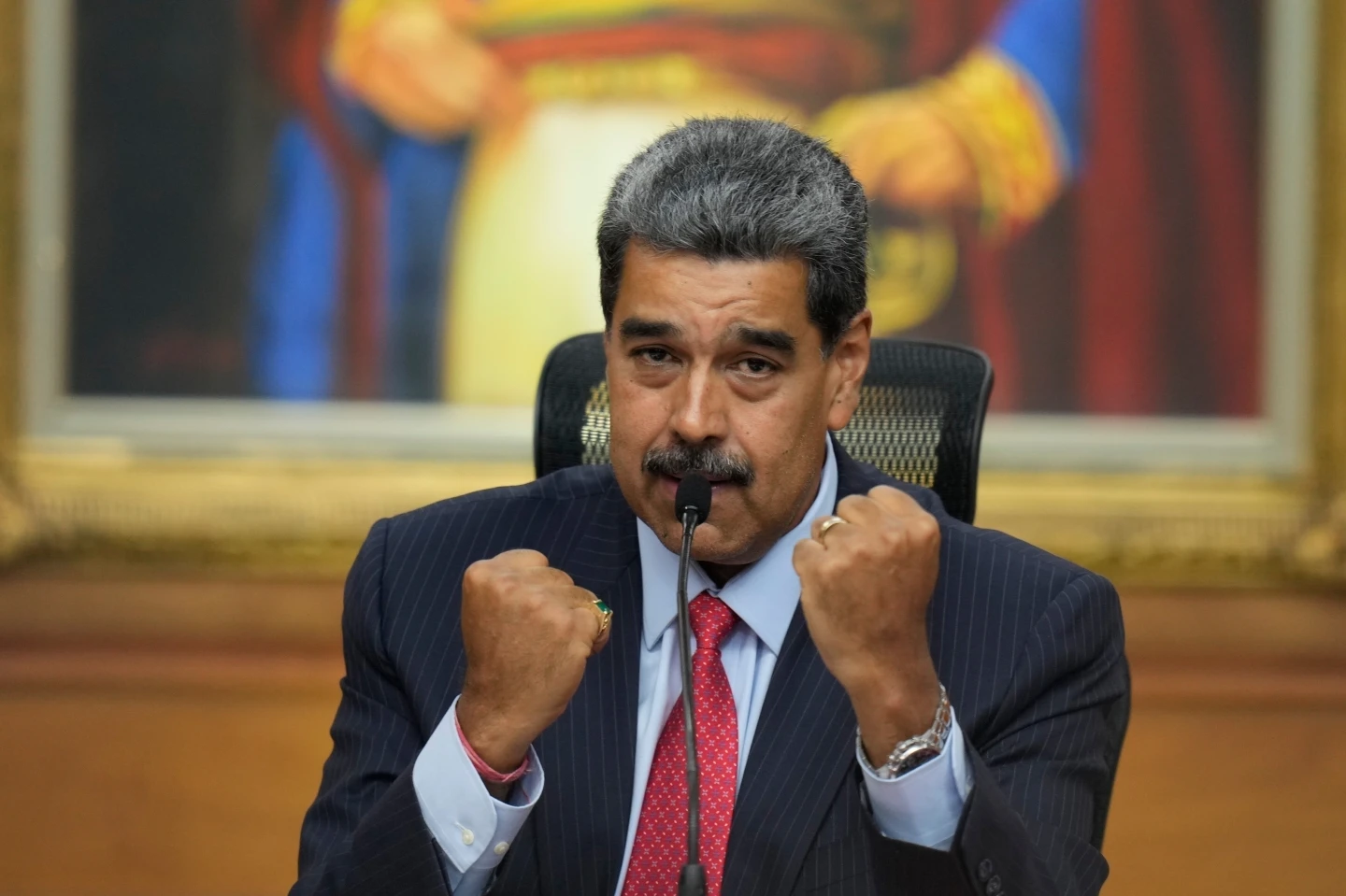
A legal dispute has emerged in a U.S. federal court over who is authorized to represent former Venezuelan leader Nicolás Maduro, days after his arraignment on drug trafficking charges in New York. The disagreement centers on whether a second lawyer has standing to join the defense team in a case that carries major legal and diplomatic implications.
Disagreement surfaces after court appearance
The dispute became public in Manhattan federal court this week after defense attorney Barry Pollack asked a judge to remove another lawyer, Bruce Fein, from the official court docket. Pollack said Fein had attempted to enter the case without Maduro’s knowledge or consent.
Pollack represented Maduro during his arraignment earlier this week, where the former Venezuelan leader and his wife, Cilia Flores, pleaded not guilty to charges alleging involvement in large-scale cocaine trafficking destined for the United States. The case is being heard by U.S. District Judge Alvin K. Hellerstein.

According to Pollack, he was the sole authorized attorney present when Maduro appeared in court. He said any suggestion that Fein was part of the legal team was incorrect and unsupported by communication with his client.
Competing claims of authorization
Fein, a former associate deputy U.S. attorney general during the Reagan administration, told the court that he had been contacted by individuals he described as credibly connected to Maduro’s inner circle or family. In a letter submitted to Judge Hellerstein, Fein said those intermediaries sought his assistance in helping Maduro navigate what he characterized as extraordinary circumstances surrounding the arrest and prosecution.
Fein acknowledged that he had not spoken directly with Maduro by phone, video link, or other means. He said Maduro was being held at a federal detention facility in Brooklyn and that communication restrictions may have complicated direct contact.
In his filing, Fein wrote that Maduro had nevertheless expressed a desire for his involvement through intermediaries, a claim Pollack disputes.
Court asked to clarify Maduro’s representation wishes
Pollack formally objected to Fein’s involvement after discovering that Fein had filed paperwork indicating he was representing Maduro. In a written declaration, Pollack said he attempted to reach Fein by phone and email to ask what authority he had to appear in the case, but received no response.
Pollack told the judge that he later spoke directly with Maduro by phone and confirmed that Maduro did not know Fein, had not communicated with him, and had not authorized him to act as his lawyer. Based on that conversation, Pollack said Maduro instructed him to ask the court to amend the docket to remove Fein’s name as counsel.
“He has not responded,” Pollack wrote of Fein, referring to his unanswered attempts to seek clarification.
Fein does not dispute Pollack’s account
In a response filed Friday, Fein said he did not challenge the accuracy of Pollack’s statements regarding their conversation or Maduro’s current understanding. Instead, Fein proposed that the judge resolve the matter by speaking directly with Maduro in private to confirm his wishes.
Fein suggested that such a discussion would eliminate confusion and ensure that Maduro’s right to counsel of choice is respected. He said the unusual conditions of Maduro’s arrest, detention, and immediate exposure to a foreign legal system could have contributed to misunderstandings.
In his filing, Fein described the situation as involving restricted communications, detention in a foreign country, and immersion in a legal process conducted in a different language, all of which he said heightened the risk of miscommunication.
Procedural issue with high stakes
Disputes over legal representation are not uncommon in complex criminal cases, particularly those involving detained defendants and international elements. Courts typically resolve such disagreements by confirming a defendant’s preferences directly, either in open court or through sealed proceedings.
Judge Hellerstein has not yet ruled on Pollack’s request to remove Fein from the docket or on Fein’s suggestion that the court question Maduro privately. Until the issue is resolved, Pollack remains the only attorney formally recognized as representing Maduro in the case.
The underlying criminal proceedings are expected to continue while the court determines who, if anyone, will be added to Maduro’s defense team.
This article was rewritten by JournosNews.com based on verified reporting from trusted sources. The content has been independently reviewed, fact-checked, and edited for accuracy, neutrality, tone, and global readability in accordance with Google News and AdSense standards.
All opinions, quotes, or statements from contributors, experts, or sourced organizations do not necessarily reflect the views of JournosNews.com. JournosNews.com maintains full editorial independence from any external funders, sponsors, or organizations.
Stay informed with JournosNews.com — your trusted source for verified global reporting and in-depth analysis. Follow us on Google News, BlueSky, and X for real-time updates.