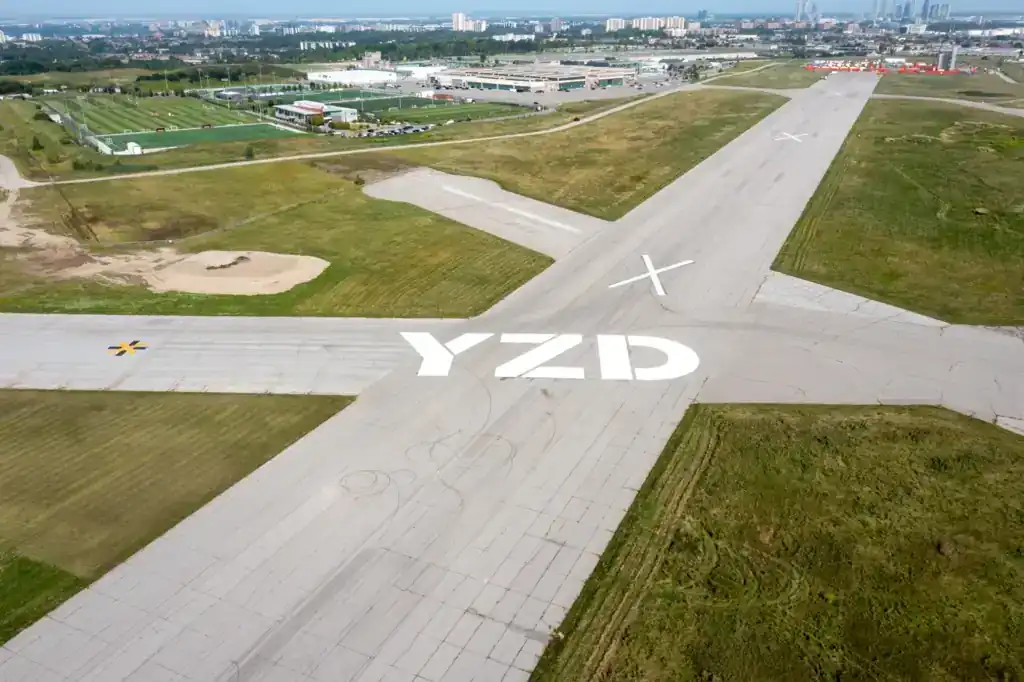
A long-shuttered airport in northwest Toronto is poised for one of the most ambitious urban redevelopments in North America. The 370-acre former Downsview Airport is being reimagined as a $30 billion sustainable city designed to house more than 50,000 residents while preserving its aviation heritage and prioritizing climate resilience.
For nearly a century, the Downsview site played a quiet but influential role in Canada’s aviation history. From its beginnings as a modest airfield surrounded by farmland to its years as a wartime production hub and later a corporate aerospace campus, the land has repeatedly adapted to shifting national needs. Now, after the airport’s closure in 2024, it is preparing for its most dramatic evolution yet.
Construction is scheduled to begin in early 2026 on a development known as YZD, a nod to the site’s former airport code. Over the next three decades, the project aims to transform the decommissioned runway and surrounding industrial buildings into a mixed-use urban district anchored by green space, public transit, and low-carbon design.
From Aviation Landmark to Urban Experiment
The story of Downsview mirrors broader patterns in 20th-century industrial development. Established roughly a century ago, the site became home to De Havilland Canada, one of the country’s most significant aviation manufacturers. During World War II, the area was repurposed for military aircraft production, embedding it deeply in Canada’s industrial and defense history.
In the early 1990s, the airfield was acquired by Bombardier, which operated it until relocating operations and closing the airport in 2024. Rather than allowing the vast site to remain dormant, planners saw an opportunity to address Toronto’s growing housing pressures while experimenting with a more sustainable model of city building.
Northcrest Developments, which is leading the project, envisions YZD as a complete urban district rather than a single master-planned neighborhood. The goal is to integrate new housing, jobs, schools, and services into an area already well connected to the city’s transit network.
The Runway as the City’s Spine
At the heart of the plan is the airport’s two-kilometer runway, long a symbol of movement and connection. Instead of erasing it, developers plan to convert the strip into a pedestrianized linear park that will link seven distinct neighborhoods.
Each neighborhood will have its own mix of housing, community centers, schools, libraries, and shops. The former runway will function as shared public space and connective tissue, tying the districts together while preserving a visible reminder of the site’s past.
Derek Goring, chief executive of Northcrest Developments, said retaining recognizable elements of the airport helps avoid a sense of placelessness common in large-scale redevelopments. Drawing on existing structures and layouts, he argued, gives the project a stronger identity and grounds it in Toronto’s history rather than creating what could feel like a generic new district.
Sustainability Built on What Already Exists
The environmental strategy behind YZD leans heavily on reuse rather than wholesale replacement. Many of the site’s expansive hangars, built between the 1950s and 1990s, will be preserved and adapted for new uses, including film studios, light manufacturing, and clean technology businesses.
Retaining these structures reduces what planners refer to as “embedded carbon,” the emissions already expended to construct them. Demolishing and rebuilding on such a large scale would significantly increase the project’s carbon footprint.
The hangars’ roofs will be converted into planted surfaces designed to absorb rainwater, reduce flood risk, and support urban biodiversity. Materials from the dismantled runway will be reused as aggregate for roads and pavements, further limiting waste.
Developers have acknowledged the environmental risks associated with former industrial and military sites, including potential contamination. Northcrest said specialized environmental consultants have been engaged to assess and mitigate legacy conditions in coordination with local authorities.
Re-Naturalizing a Suppressed Landscape
Landscape architecture firm Michael van Valkenburgh Associates (MVVA) is responsible for reimagining the runway park. The firm won an international design competition for the project and has focused on restoring ecological systems that predate the airport itself.
Before aviation and agriculture reshaped the area, the land formed part of southern Ontario’s Carolinian forest ecosystem. MVVA’s design aims to reintroduce native plant species and recreate habitats that can support birds and other wildlife.
During its years as an active airfield, natural growth had to be controlled to ensure aviation safety, particularly given the site’s location along the Atlantic Flyway, a major migratory bird route. Reversing that suppression is central to the new vision.
The landscape strategy also addresses water management. Positioned at one of Toronto’s highest points between major watersheds, the site plays a role in regional hydrology. Through extensive planting and bioswales, vegetated channels that filter and absorb stormwater, designers aim to capture as much rainwater as possible and reduce flood risks downstream.
Planning for Climate and Mobility
The scale and timeline of YZD demand long-term thinking about climate resilience. With construction expected to span 30 years, planners are designing for more extreme weather conditions and changing environmental realities.
Northcrest has worked with Danish landscape firm SLA, known for integrating large-scale green infrastructure into dense cities, on a concept described as “City Nature.” The approach emphasizes abundant green space as essential urban infrastructure, not a luxury, improving health, cooling neighborhoods, and enhancing daily life.
Transportation planning reflects similar priorities. The site is already surrounded by subway and commuter rail stations, and the development will lean heavily on existing transit. Wide cycling routes, pedestrian-focused streets, and a last-mile bus system are intended to make car-free travel the most convenient option.
While cars will not be eliminated entirely, the former runway will be largely vehicle-free, reinforcing its role as a shared public realm.
A Global Trend with Local Stakes
Repurposing obsolete airports into public space and housing is part of a broader international trend. Projects such as Berlin’s Tempelhofer Feld and Athens’ Ellinikon redevelopment have demonstrated how former airfields can be re-integrated into cities.
YZD differs, Goring said, because of its location within the geographic center of Canada’s largest metropolitan area and its immediate access to transit. Rather than functioning primarily as a park, the project is intended to actively extend Toronto’s urban fabric.
The first phase, known as the Hangar District, will cover 100 acres and deliver about 3,000 homes. Construction is expected to begin next year, with completion targeted for 2031.
Financing such a vast undertaking will require phased investment. Northcrest plans to develop each district sequentially, reinvesting returns over time rather than relying on upfront funding for the full $30 billion cost.
Over three decades, designs and priorities are expected to evolve. The development team has deliberately avoided locking in overly rigid plans, acknowledging that cities, technologies, and social needs will change.
The ultimate aim, Goring said, is to create a place that feels authentically part of Toronto, offering a high quality of life while demonstrating how large-scale urban redevelopment can balance growth, history, and environmental responsibility.
This article was rewritten by JournosNews.com based on verified reporting from trusted sources. The content has been independently reviewed, fact-checked, and edited for accuracy, neutrality, tone, and global readability in accordance with Google News and AdSense standards.
All opinions, quotes, or statements from contributors, experts, or sourced organizations do not necessarily reflect the views of JournosNews.com. JournosNews.com maintains full editorial independence from any external funders, sponsors, or organizations.
Stay informed with JournosNews.com — your trusted source for verified global reporting and in-depth analysis. Follow us on Google News, BlueSky, and X for real-time updates.