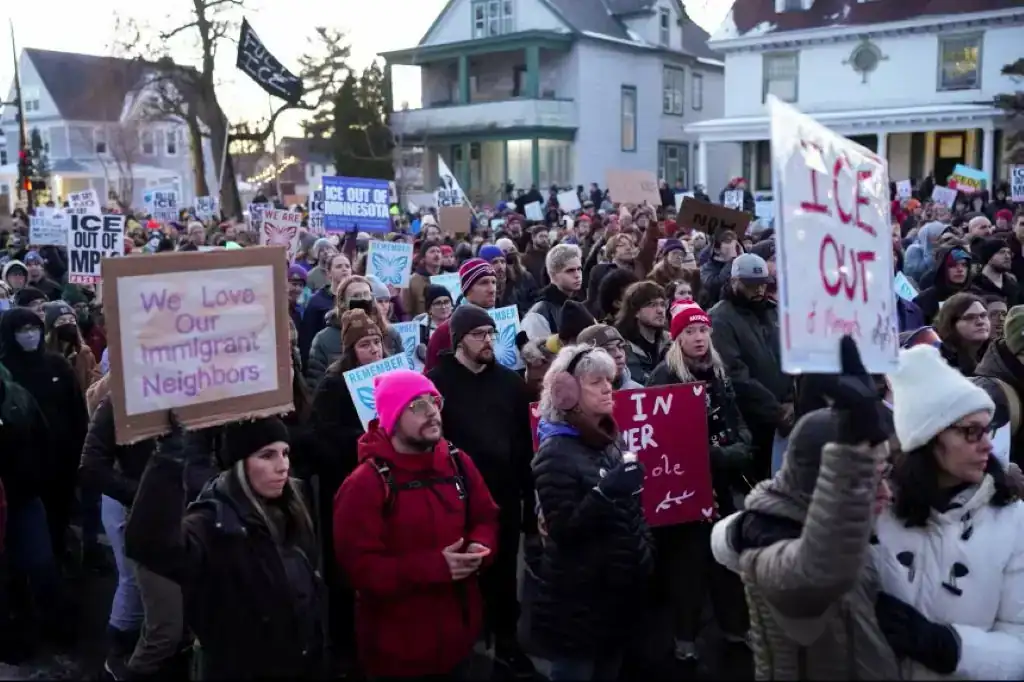
The fatal shooting of a 37-year-old U.S. citizen by an Immigration and Customs Enforcement officer in Minneapolis has triggered national scrutiny of federal immigration enforcement tactics under President Donald Trump. The incident occurred amid what the Department of Homeland Security describes as its largest-ever immigration operation, prompting strong backlash from state and local officials who had warned of heightened risks to public safety.
Renee Nicole Good was shot while seated in her vehicle during an ICE operation on Wednesday. Federal officials initially described her as a violent rioter who attempted to use her car against officers, but video footage reviewed by multiple outlets has raised questions about the sequence of events and the use of force.
A fatal encounter during a major ICE operation
The shooting took place during “Operation Metro Surge,” a Department of Homeland Security initiative that deployed up to 2,000 immigration enforcement officers to the Minneapolis–St. Paul area by January. DHS has described the effort as its largest operation to date, part of a broader push targeting major U.S. cities, many of them led by Democratic officials.

According to DHS, the Minneapolis operation resulted in the arrest of hundreds of immigrants and was aimed at individuals with violent criminal records. The agency said it would remain in the city “until the problem is solved,” a message posted on social media before the shooting.
Local leaders, however, had publicly raised concerns about the influx of federal agents. Minnesota Governor Tim Walz said he had warned for weeks that expanded ICE operations posed a threat to public safety. Minneapolis Mayor Jacob Frey condemned the shooting in unusually blunt terms, calling on federal immigration authorities to leave the city.
The Minneapolis surge followed similar enforcement actions in cities including Chicago, Los Angeles, Portland, and Washington, D.C. Reporting by CNN and other outlets has shown that past operations have sometimes resulted in the detention of U.S. citizens or individuals without criminal records, as well as confrontations with protesters.
What video footage shows
At least three videos captured portions of the encounter that ended in Good’s death. One widely circulated clip shows her maroon Honda Pilot stopped perpendicular to traffic in the middle of a street as several unmarked law enforcement vehicles converge.
Two officers are seen approaching the driver’s side of the vehicle, repeatedly ordering Good to exit the car. As one officer reaches toward the driver’s door handle, the vehicle begins to reverse, then briefly stops before moving forward.
A third officer, positioned near the front of the vehicle and appearing to film the scene, draws his handgun and points it toward the driver while stepping backward. A separate, grainy video from another angle appears to show the vehicle making contact with that officer as it turns away from the others.
The officer then fires one shot, followed by two more as he moves out of the vehicle’s path. Good’s car accelerates forward and crashes into a parked vehicle. Bystanders are seen rushing to assist as the officer who fired the shots approaches briefly, then walks away and instructs others to call emergency services.
Immediate federal response and investigation
Within hours of the shooting, DHS described Good as a participant in violent unrest. In public statements, officials said officers were attempting to move vehicles when a woman allegedly attacked them and attempted to run them over.
Homeland Security Secretary Kristi Noem said the officer involved acted according to training and “saved his own life and that of his fellow officers.” DHS referred to Good as a “rioter” and initially characterized the incident as an act of domestic terrorism, before a full public accounting of the evidence had emerged.
A senior Homeland Security official told CNN that the officer, who has not been publicly identified, has approximately 10 years of experience in ICE enforcement and removal operations. DHS said the shooting would be investigated under standard use-of-force protocols, as is required in all such incidents.
Despite the backlash, Noem said she was not opposed to deploying additional immigration authorities to Minneapolis if deemed necessary.
Local outrage and political fallout
The killing intensified tensions between federal authorities and local leaders in Minnesota. Walz and Frey both said the incident underscored the dangers they had anticipated when federal immigration resources were rapidly expanded in the Twin Cities.
Community members and civil rights advocates questioned why immigration enforcement operations were being conducted in ways that placed residents at risk. The shooting quickly became a focal point for broader criticism of the administration’s immigration strategy, particularly in cities with large immigrant communities.
Minneapolis is home to the largest Somali diaspora in the United States. The federal operation followed months of heated rhetoric from President Trump targeting immigrants and minority communities, as well as a viral video by a conservative content creator alleging widespread fraud in local daycare centers.
Who Renee Nicole Good was
Good’s family described her as a compassionate and devoted parent whose death has left three children without their mother. According to the Associated Press and the Minnesota Star Tribune, she was a poet, a partner, and a mother of three.
Two of her children, aged 15 and 12, were from a previous marriage. She also had a six-year-old child whose father, a military veteran, died in 2023. Born in Colorado, Good spent most of her life there before moving to Minnesota last year with her partner.
After her husband’s death, she briefly lived in Kansas with her parents before relocating to the Twin Cities. Family members told the Washington Post and the AP that she was a devoted Christian and had participated in youth mission trips to Northern Ireland earlier in her life.
“She was one of the kindest people I’ve ever known,” her mother, Donna Ganger, told the Star Tribune. “She was extremely compassionate and spent her life taking care of others.”
Community response and ongoing questions
By Wednesday evening, the site where Good was killed had become a vigil, with residents gathering to mourn and demand accountability. Flowers, candles, and handwritten messages lined the street where the shooting occurred.
As investigators review the footage and witness accounts, questions remain about the circumstances that led to the use of lethal force and the broader implications for federal immigration enforcement in U.S. cities. For local officials and residents, the incident has become a stark symbol of the risks associated with aggressive immigration operations conducted in densely populated communities.
This article was rewritten by JournosNews.com based on verified reporting from trusted sources. The content has been independently reviewed, fact-checked, and edited for accuracy, neutrality, tone, and global readability in accordance with Google News and AdSense standards.
All opinions, quotes, or statements from contributors, experts, or sourced organizations do not necessarily reflect the views of JournosNews.com. JournosNews.com maintains full editorial independence from any external funders, sponsors, or organizations.
Stay informed with JournosNews.com — your trusted source for verified global reporting and in-depth analysis. Follow us on Google News, BlueSky, and X for real-time updates.