Journos News - Breaking News, World News, Top Stories, Todays Headlines and Flash Reports
Wednesday, July 15, 2026
  • Login
  • Home
  • World
    • Africa
    • Americas
    • Asia
    • Europe
    • Middle East
    • Oceania
  • Politics
  • Business
  • Technology
  • Health
  • Science
  • Sports
  • Entertainment
  • Culture
No Result
View All Result
  • Home
  • World
    • Africa
    • Americas
    • Asia
    • Europe
    • Middle East
    • Oceania
  • Politics
  • Business
  • Technology
  • Health
  • Science
  • Sports
  • Entertainment
  • Culture
No Result
View All Result
Journos News - Breaking News, World News, Top Stories, Todays Headlines and Flash Reports
No Result
View All Result
Home In Depth

How Language Shapes the Hidden Internet You Don’t See

Cultural and linguistic differences are creating distinct online worlds beyond the English internet.

The Daily Desk by The Daily Desk
June 14, 2026
in In Depth
0
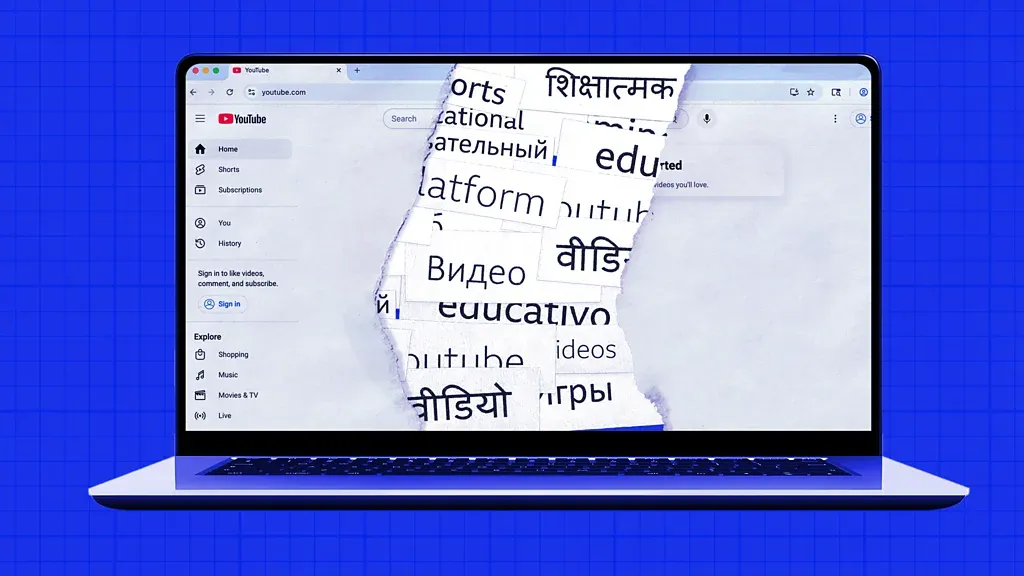
The Real Internet You Don’t See: Language Barriers Create Distinct Digital Cultures Across YouTube, Social Media, and Online Content - Serenity Strull/ Getty Images/BBC

Beyond English: How Linguistic Differences Reveal Parallel Internets and Diverse Online Communities Around the World - Serenity Strull/ Getty Images/BBC

How Language Is Hiding the Real Internet From View

Published Time: 08-15-2025, 14:45

The internet may seem like a single, global space, but language profoundly shapes how people access and interact with online content. Research shows that platforms like YouTube function differently across languages, revealing distinct digital cultures and patterns of engagement. Understanding these differences challenges assumptions about online behavior and the reach of popular platforms.

The Language Filter on the Internet

While users often assume they are seeing the full internet, the reality is much narrower. Social media interactions, search queries, and algorithmic recommendations are largely limited to the language users speak and understand. As a result, much of the web remains inaccessible, hidden behind linguistic barriers.

Most internet activity is concentrated on a handful of dominant platforms. From an English-language perspective, it may appear that global online behavior is uniform. However, cultural differences in music, literature, and media suggest that online interactions vary significantly across communities.

A team at the University of Massachusetts Amherst’s Initiative for Digital Public Infrastructure recently examined these variations. Their findings highlight how linguistic differences influence online participation and suggest that our current understanding of the web may be incomplete.

RELATED POSTS

What Iran and the United States Stand to Gain From the Reported Interim Deal

What Iran and the United States Stand to Gain From a Reported Deal — And Why It Matters Now

Jensen Huang’s Call for ‘New Social Norms’ Reflects a Growing Debate Over AI’s Place in Society

What We Know — and Still Don’t Know — About the Emerging Deal to End the Iran War

The Differences — and Similarities — in the Trump and Putin Visits to China

What to Know About the Bundibugyo Virus and Congo’s Latest Ebola Outbreak

A Historical Perspective

Historical examples reveal how language shapes digital spaces. For instance, the Russian social media platform LiveJournal was known in English-speaking communities as a site for youth culture and fandom. In Russia, however, LiveJournal served as a forum for political discourse and public intellectualism, hosting voices often excluded from mainstream media.

With many leading tech companies based in the U.S., research and commentary about platforms such as YouTube often focus on English-language content, creating a cultural blind spot. Studies tend to overrepresent English-speaking users, while non-English digital activity remains underexplored.

Challenges in Studying Global Platforms

Analyzing global platforms is complex. While textual data can be processed at scale, video content poses challenges for large-scale analysis. Platforms like YouTube do not provide tools for researchers to generate fully representative samples, making it difficult to assess how different linguistic communities use the site.

Consequently, popular discourse about YouTube often reflects a limited, English-biased view. The most visible content—trending videos, top creators—is only a small slice of the platform’s total activity. As noted by Thomas Germain, much of the YouTube ecosystem remains unseen, hidden beneath algorithmic and linguistic filters.

Innovative Approaches to Hidden Content

To study YouTube more comprehensively, researchers employed a novel method: randomly generating video URLs to capture a broad and representative sample. This approach, conducted over trillions of attempts, allowed the team to compare trends across languages, video categories, and engagement metrics.

The study focused on English, Hindi, Russian, and Spanish YouTube. Native speakers helped validate language detection tools, ensuring accurate insights into language-specific patterns and behaviors.

Linguistic Differences in YouTube Usage

The research revealed significant differences across languages. Hindi YouTube emerged as a particularly distinct ecosystem. Key findings included:

  • Video Length: Spanish videos averaged 2.5 minutes, English nearly 2 minutes, Russian 1 minute 38 seconds, while Hindi videos were just 29 seconds.
  • Platform Growth: More than half of all Hindi YouTube videos were uploaded in 2023 alone, reflecting explosive growth.
  • Category Preferences: Hindi content prioritized Entertainment and Education, whereas English-language videos included fewer political topics despite widespread discourse.

These differences reflect India’s unique internet history. Following India’s ban on TikTok in 2020, YouTube Shorts became a primary medium for short-form content, capturing the audience left without TikTok access. As a result, Hindi YouTube is heavily dominated by Shorts, comprising 58% of videos compared to 25–31% in other languages.

Attention and Engagement Patterns

Hindi YouTube also demonstrated unusual engagement dynamics. While a small fraction of videos garnered most views—0.1% accounted for 79%—less popular videos were disproportionately likely to receive likes. This suggests that Hindi users engage meaningfully even with content that has limited visibility, using YouTube as a form of social communication and community interaction.

These patterns point to a different type of attention economy, one that prioritizes small, meaningful engagement over mass reach. Researchers suggest this reflects a more intimate, human-centered approach to digital interaction.

Implications for Digital Understanding

The findings underscore how language shapes online experiences. English-centric research, policies, and platform design can overlook entire digital cultures. Platforms like YouTube are not monolithic; they function differently across linguistic and cultural contexts.

For businesses, journalists, and policymakers, this means assumptions based on English-language content may be misleading. Understanding the diverse, culturally specific ways users engage online is critical for effective outreach, regulation, and platform design.

Looking Ahead

Language doesn’t just filter content—it defines how digital communities form, interact, and express themselves. From short-form videos in India to political discourse in Russia, linguistic and cultural factors create parallel internets that challenge assumptions about global online behavior.

As the research evolves, it is increasingly clear that the “visible” internet is only a fraction of what exists. Broadening perspectives to include multiple languages and communities is essential for building a truly global understanding of the digital world.

Source: BBC – How language is hiding the real internet from you

Tags: #CrossCulturalEngagement#CulturalTechDifferences#DigitalBehavior#GlobalDigitalCulture#HiddenInternet#HindiYouTube#InternetResearch#LanguageAndTech#OnlineCommunities#ParallelInternets#VideoContentTrends#YouTubeTrends
The Daily Desk

The Daily Desk

The Daily Desk is a contributor at JournosNews.com covering politics, media, governance, and the evolving dynamics of public discourse. Stories published under this byline are produced in accordance with JournosNews' editorial standards, with an emphasis on verified reporting, accuracy, context, and impartiality.

Related Posts

What Iran and the United States Stand to Gain From the Reported Interim Deal

by The Daily Desk
June 22, 2026
0
Iranian and American diplomacy linked to oil and nuclear talks - Amirhosein Khorgooi/ISNA via AP

According to an Associated Press report, the United States and Iran have reached an interim agreement intended to end hostilities...

Read moreDetails

What Iran and the United States Stand to Gain From a Reported Deal — And Why It Matters Now

by The Daily Desk
June 18, 2026
0
Diplomacy talks between Iran and United States officials - Pakistan Prime Minister Office via AP

A reported understanding between the United States and Iran has renewed global attention on one of the world’s most sensitive...

Read moreDetails

Jensen Huang’s Call for ‘New Social Norms’ Reflects a Growing Debate Over AI’s Place in Society

by The Daily Desk
June 17, 2026
0
Jensen Huang discussing artificial intelligence and society's future - AP Photo/Jeffrey McWhorter

The Nvidia chief argues that artificial intelligence should be embraced rather than feared. His comments arrive as governments, businesses and...

Read moreDetails

What We Know — and Still Don’t Know — About the Emerging Deal to End the Iran War

by The Daily Desk
May 25, 2026
0
Diplomatic negotiations over an emerging Iran war agreement continue internationally - AP Photo/Vahid Salemi

The emerging diplomatic effort aimed at ending the current Iran war has triggered cautious international attention, but many aspects of...

Read moreDetails

The Differences — and Similarities — in the Trump and Putin Visits to China

by The Daily Desk
May 22, 2026
0
Donald Trump and Vladimir Putin during separate diplomatic visits to China - Alexander Kazakov, Sputnik, Kremlin/(Evan Vucci/Pool Photo via AP, File

The visits by former U.S. President Donald Trump and Russian President Vladimir Putin to China took place under very different...

Read moreDetails

What to Know About the Bundibugyo Virus and Congo’s Latest Ebola Outbreak

by The Daily Desk
May 19, 2026
0
Health workers responding to Ebola outbreak in eastern Congo - AP Photo/ Hajarah Nalwadda

The Bundibugyo virus, one of several species of Ebola, has resurfaced in the Democratic Republic of Congo during a new...

Read moreDetails

Understanding a rare but serious zoonotic disease and its transmission pathways

by The Daily Desk
May 9, 2026
0
Rodent carrier spreading hantavirus in enclosed contaminated environment- AP Photo/Misper Apawu

Hantavirus refers to a group of viruses primarily carried by rodents and transmitted to humans through environmental exposure. While infections...

Read moreDetails

Pope Leo XIV and Donald Trump: Religion, Power and the Politics of Modern Conservatism

by The Daily Desk
May 6, 2026
0
Pope Leo XIV and Donald Trump during political and religious discussions - AP Photo/Gregoria Borgia/Jacquelyn Martin

The emergence of Pope Leo XIV alongside the political influence of President Donald Trump represents two powerful institutions navigating a...

Read moreDetails

White House Dinner Shooting: Security, Risk, and the Limits of Protection at High-Level Events

by The Daily Desk
April 27, 2026
0
White House exterior with security presence during official evening event - Andrew Harnik/Getty Images

The phrase “White House dinner shooting” evokes a scenario that is both highly unusual and deeply consequential. While incidents involving...

Read moreDetails
Load More
Next Post
Heavy Rain and Flash Floods in Indian Kashmir Devastate Chashoti, Trigger Large-Scale Rescue Operations - Asian News International/Reuters

Sudden Cloudburst in Kashmir Kills Dozens, Leaves Hundreds Missing

Why do some holidaymakers like to dress to impress?

Alaska Summit Between Trump and Putin Concludes Without Breakthrough on Ukraine War Despite U.S. Push for Diplomatic Progress - AP Photo/Julia Demaree Nikhinson

Trump Leaves Alaska Summit with Putin Without Ukraine Peace Deal

JournosNews logo

Journos News delivers globally neutral, fact-based journalism that meets international media standards — clear, credible, and made for a connected world.

  • Categories
  • World News
  • Politics
  • Business & Markets
  • Technology
  • Health
  • Science
  • Sports
  • Arts & Culture
  • Resources
  • Editorial Standards
  • Submit a Story
  • Advertise with Us
  • Syndication & Partnerships
  • Site Map
  • Press & Media Kit
  • Editorial Team
  • Careers

Join thousands of readers receiving the latest updates, tips, and exclusive insights straight to their inbox. Never miss an important story again.

  • About Us
  • Editorial & Trust Center
  • Contact Us
  • Privacy Policy
  • Terms of Use & Copyright Notice

© JournosNews.com All rights reserved.

Welcome Back!

Login to your account below

Forgotten Password?

Retrieve your password

Please enter your username or email address to reset your password.

Log In
JournosNews

Independent Journalism.
Verified Facts.

You're about to read a professionally edited article from JournosNews.com.

Every article is produced in accordance with our editorial standards, emphasizing factual accuracy, transparent attribution, fairness, editorial independence, and meaningful context.

Editorial Standards
No Result
View All Result
  • Home
  • World
    • Africa
    • Americas
    • Asia
    • Europe
    • Middle East
    • Oceania
  • Politics
  • Business
  • Technology
  • Health
  • Science
  • Sports
  • Entertainment
  • Culture

© JournosNews.com All rights reserved.

This website uses cookies. By continuing to use this website you are giving consent to cookies being used. Visit our Privacy and Cookie Policy.