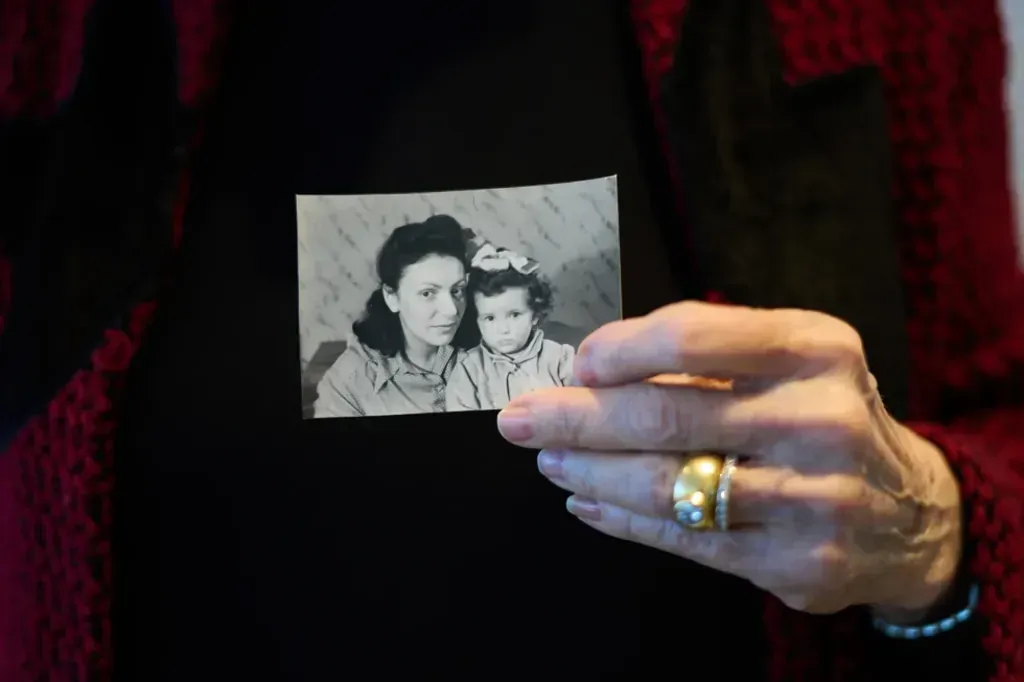
TEL AVIV, Israel (JN) – She entered the world inside a concentration camp, during the final, chaotic weeks of Nazi rule in Europe. Born in Bergen-Belsen in March 1945, just weeks before liberation, Ilana Kantorowicz Shalem survived a moment when survival itself was almost inconceivable.
Now 81, Shalem is speaking publicly for the first time about her birth and her mother’s experience, aware that the generation of Holocaust survivors is rapidly disappearing. Her account adds a rare, human record to the final chapter of the Holocaust — one shaped by silence, loss, and an unlikely beginning.
International Holocaust Remembrance Day, observed on January 27, marks the liberation of Auschwitz-Birkenau and commemorates the six million Jews and millions of others murdered by Nazi Germany and its collaborators. As remembrance continues more than eight decades later, stories like Shalem’s are increasingly scarce.
A birth in the final days of war
Ilana Kantorowicz was born on March 19, 1945, at Bergen-Belsen, a concentration camp in northern Germany that had descended into collapse as Allied forces advanced. Starvation, disease, and mass death defined the camp’s final months.
Her mother, Lola Kantorowicz, had concealed her pregnancy throughout her imprisonment. Extended starvation caused many prisoners’ bodies to swell, allowing her condition to go unnoticed. Discovery would almost certainly have meant death.
Shalem survived, historians say, largely because the Nazi system was unraveling. Within 30 days of her birth, British troops liberated Bergen-Belsen, finding tens of thousands of unburied corpses and survivors suffering from typhus, malnutrition, and extreme neglect.
Yad Vashem archivist Sima Velkovich, who researched Shalem’s case, described the circumstances as almost unimaginable. In March 1945, Bergen-Belsen had effectively ceased to function as an organized camp, becoming a site of mass death rather than systematic control.
Love and loss before the camps
Shalem’s parents met as teenagers in the Tomaszów Mazowiecki Ghetto in occupied Poland. Lola Rosenblum was from the town; Hersz (Zvi) Abraham Kantorowicz had been deported there from Łódź.
Despite forced labor, overcrowding, and the loss of family members, the two formed a relationship that continued as they were transferred between labor camps. Friends helped arrange secret meetings, and the couple married informally while still imprisoned.
Shalem recalls her mother describing moments of tenderness amid brutality — brief walks, conversations, and shared hope. Those memories, she said, stood in sharp contrast to the violence surrounding them.
In 1944, the couple was separated. Hersz Kantorowicz later died during a death march, just days before the war ended. Lola was deported to Auschwitz, then to the Hindenburg labor camp, and finally forced on a death march to Bergen-Belsen while pregnant.
Survival against probability
Shalem has no clear explanation for how her mother survived long enough to give birth — or how the newborn survived her first weeks. After liberation, mother and child remained in Bergen-Belsen for about a month before being transferred to a displaced persons camp, where they stayed for nearly two years.
In those camps, Ilana became a symbol of renewal. With few children present, she was cared for collectively by women who had lost families of their own. Photographs from the period show a smiling infant surrounded by adults, many of whom had endured years of imprisonment.
Yad Vashem has documented more than 2,000 babies born in the Bergen-Belsen displaced persons camp after liberation, between 1945 and 1950. Shalem believes she may be the only known survivor born inside the concentration camp itself. German camp records confirm the date and hour of her birth, documentation now preserved at Yad Vashem.
Silence after survival
After the war, Lola and Ilana moved to what would soon become Israel, where Hersz Kantorowicz’s parents had settled before the Holocaust. Lola held onto hope for years that her husband had survived. She never remarried and had no other children.
Like many survivors, she spoke little about her experiences. In Israel during the 1950s and 1960s, public discussion of Holocaust trauma was limited, and survivors often encountered disbelief or discomfort.
Shalem, who later studied social work, began asking her mother questions while attending university. By then, psychological understanding of trauma was still developing, and many survivors preferred silence as a coping mechanism.
Her mother occasionally shared memories with close friends who were also survivors, but rarely with strangers. Over time, even those conversations faded.
Fewer voices remain
Shalem’s decision to speak publicly came after she completed a genealogy course at Yad Vashem and confronted the reality of how few survivors remain.
According to the Conference on Jewish Material Claims Against Germany, approximately 196,600 Holocaust survivors are alive today. Nearly half live in Israel. About 25,000 survivors died last year alone, and the median age of survivors is now 87.
Most survivors were children during the war. Shalem, born in 1945, is among the youngest.
She has two daughters of her own and recalls sharing her pregnancies with her mother, reflecting on the physical and emotional endurance required to survive such conditions.
Her mother once told her that hope played a decisive role — hope that her husband might live to meet their child. Had she known he was already dead, she said, she might not have fought as hard to survive.
This article was rewritten by JournosNews.com based on verified reporting from trusted sources. The content has been independently reviewed, fact-checked, and edited for accuracy, neutrality, tone, and global readability in accordance with Google News and AdSense standards.
All opinions, quotes, or statements from contributors, experts, or sourced organizations do not necessarily reflect the views of JournosNews.com. JournosNews.com maintains full editorial independence from any external funders, sponsors, or organizations.
Stay informed with JournosNews.com — your trusted source for verified global reporting and in-depth analysis. Follow us on Google News, BlueSky, and X for real-time updates.