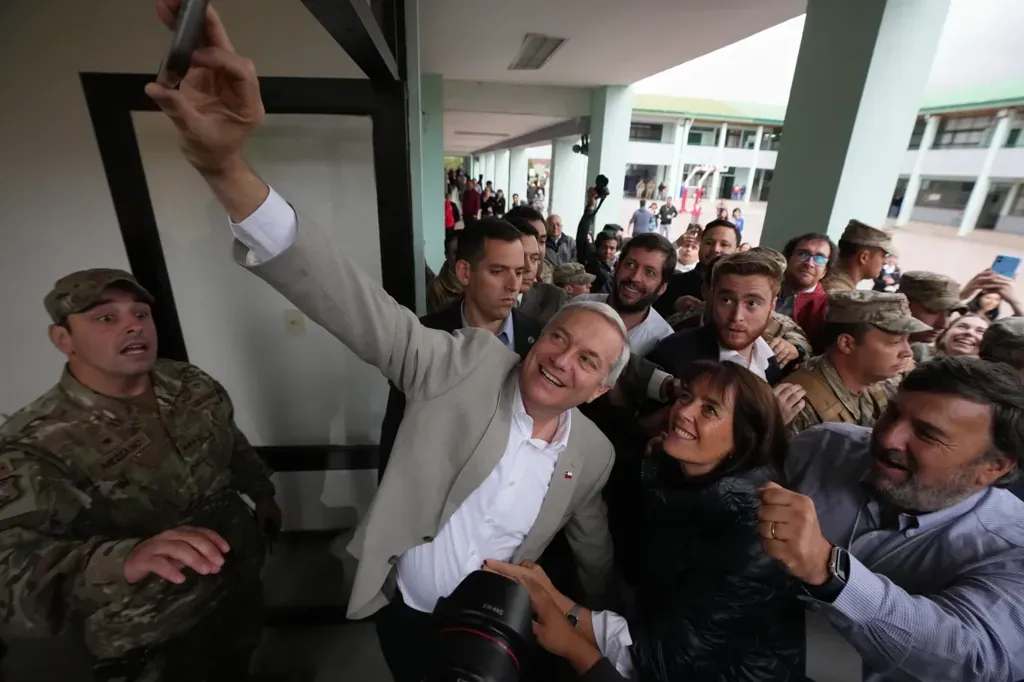
Chile (Journos News) – Chile has elected far-right politician José Antonio Kast as its next president, delivering a clear mandate that underscores the country’s growing political polarization. With most ballots counted, Kast defeated left-wing candidate Jeannette Jara by a wide margin, setting the stage for a significant change in policy direction when he takes office in March 2026.
A clear victory after a polarized campaign
With more than 99% of polling stations counted, José Antonio Kast secured 58.18% of the vote, compared with 41.82% for Jeannette Jara, the governing coalition’s candidate. The results were released by Chile’s Electoral Service late on Sunday, confirming a decisive win that went beyond the narrow margins seen in previous elections.
Kast, a 59-year-old lawyer and leader of the Republican Party, will succeed outgoing President Gabriel Boric, whose leftist administration has faced persistent challenges related to inflation, public security, and stalled reforms. Kast is due to assume office on March 11, 2026, for a four-year term.
The outcome represents a notable departure from Chile’s post-dictatorship political pattern. Since the return to democracy in 1990, power has largely alternated between center-left and center-right coalitions, with broad consensus around market economics and gradual social reform. This election, by contrast, highlighted a widening ideological divide, with voters choosing between sharply opposed visions for the country.
Who is José Antonio Kast
Kast is a longtime figure in Chilean conservative politics. A father of nine and trained lawyer, he founded the Republican Party after breaking from the traditional right, arguing that mainstream conservatives had become too accommodating on social and cultural issues.
His political positions emphasize law and order, reduced government spending, strict immigration controls, and a rollback of what he describes as ideological excesses in education and public institutions. Kast has frequently drawn comparisons to other right-wing leaders in the region and beyond, including Brazil’s former president Jair Bolsonaro, Argentina’s President Javier Milei, and former U.S. President Donald Trump, though he has framed his agenda primarily around Chilean domestic concerns.
This was Kast’s third presidential bid. He came close to winning in 2021 but lost the runoff to Boric. Throughout the latest campaign, he often repeated the phrase “the third time’s the charm,” presenting himself as a more experienced and disciplined candidate than in previous races.
Jara concedes and calls for democratic respect
Jeannette Jara, a former labor minister and member of the Communist Party, conceded defeat shortly after the results became clear. Speaking to supporters in central Santiago, she acknowledged the setback while urging calm and democratic respect.
“Democracy has spoken loud and clear,” Jara said, confirming that she had called Kast to congratulate him and wish him success “for the good of Chile.” She added that while her coalition would move into opposition, it would do so responsibly and without encouraging division.
Jara secured just over 41% of the vote, a result that reflects both a solid base of left-wing support and the difficulties faced by Boric’s government in maintaining broad public confidence. Rising concerns over crime, economic uncertainty, and slow progress on structural reforms weighed heavily on the campaign.
Domestic and international reactions
Outgoing President Gabriel Boric personally congratulated Kast by telephone in a conversation broadcast on local television. Boric acknowledged the clarity of the result and emphasized the responsibility that comes with governing a deeply divided country.
“You have been elected president of the Republic of Chile, and therefore of all Chileans,” Boric said, urging humility and care in the exercise of power. Kast responded by thanking the president and expressing confidence in a “very orderly and respectful transition.”
Former president Michelle Bachelet, who led Chile from 2006 to 2010 and again from 2014 to 2018, also contacted Kast to offer congratulations. According to a statement from Kast’s campaign, the two discussed Chile’s future challenges within a framework of institutional respect.
International reactions were swift. Argentine President Javier Milei and Paraguayan President Santiago Peña publicly congratulated Kast, as did Ecuadorian President Daniel Noboa, who wrote that a “new stage is beginning for Chile and the region.”
In Washington, U.S. Secretary of State Marco Rubio issued a statement congratulating the president-elect and signaling Washington’s interest in continued cooperation. Rubio said the United States looked forward to working with Kast’s administration on shared priorities such as public safety, migration, and trade.
A turning point for Chilean politics
Kast’s victory reflects broader trends seen across Latin America and other regions, where voters have increasingly turned to anti-establishment or hardline candidates amid frustration with economic pressures, crime, and political gridlock. In Chile, concerns over public security and irregular migration featured prominently in the campaign, particularly in urban areas and northern regions.
Chile remains one of South America’s most stable economies, but growth has slowed in recent years, and inequality continues to shape political debate. Efforts to replace the country’s dictatorship-era constitution have also faltered, contributing to voter fatigue and skepticism toward traditional political actors.
Analysts note that while Kast won decisively, he will face constraints in office. Chile’s Congress is fragmented, and any major legislative changes will require negotiation with opposition parties. How Kast balances his campaign promises with institutional realities will be closely watched at home and abroad.
Looking ahead
In his initial remarks as president-elect, Kast emphasized national unity and the need to restore public confidence in state institutions. He pledged to focus on security, economic stability, and what he described as a return to common sense in public policy.
The transition period leading up to March 2026 is expected to be closely managed, with Boric’s administration signaling its willingness to cooperate to ensure continuity and stability. Markets and international partners will also be watching for early signals about Kast’s economic and foreign policy priorities.
For Chile, the election marks not just a change in leadership, but a moment of reflection about the direction of its democracy. Whether Kast’s presidency deepens political divides or reshapes them into a new consensus remains one of the central questions facing the country as it enters a new political chapter.
This article was rewritten by JournosNews.com based on verified reporting from trusted sources. The content has been independently reviewed, fact-checked, and edited for accuracy, neutrality, tone, and global readability in accordance with Google News and AdSense standards.
All opinions, quotes, or statements from contributors, experts, or sourced organizations do not necessarily reflect the views of JournosNews.com. JournosNews.com maintains full editorial independence from any external funders, sponsors, or organizations.
Stay informed with JournosNews.com — your trusted source for verified global reporting and in-depth analysis. Follow us on Google News, BlueSky, and X for real-time updates.