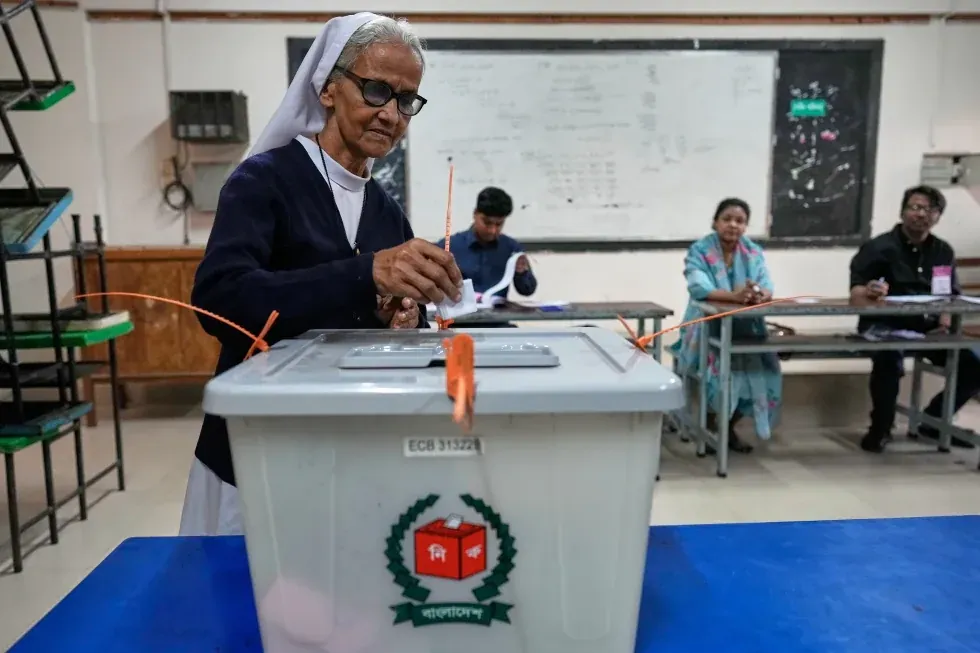
DHAKA, Bangladesh (JN) – Bangladeshis voted on Thursday in the country’s first parliamentary election since a wave of mass protests in 2024 forced then-Prime Minister Sheikh Hasina from power, setting the stage for a pivotal test of public trust in the country’s democratic institutions.
Polling began slowly but gathered pace by midmorning in the capital Dhaka and other districts, with authorities expecting turnout to rise through the day. Results are due on Friday. More than 127 million people are eligible to vote.
The election unfolds under an interim administration led by Nobel Peace Prize laureate Muhammad Yunus, which has pledged to oversee a transparent and credible process after years of political tension, allegations of electoral manipulation and unrest that followed Hasina’s departure. Around 500 international observers and foreign journalists, including delegations from the European Union and the Commonwealth, are monitoring the vote.

This is the first time voters are returning to ballot boxes since the protests widely described by young participants as a “Gen Z uprising” led to the collapse of Hasina’s government. Her Awami League party is barred from contesting, and Hasina remains in exile in India.
A reshaped political field
With the Awami League absent, the contest is dominated by the Bangladesh Nationalist Party (BNP) and an 11-party alliance led by Jamaat-e-Islami, once banned under Hasina but now re-emerging as a major political force.
Tarique Rahman, acting leader of the BNP and son of former Prime Minister Khaleda Zia, returned to Bangladesh in December after 17 years in self-exile in London. Rahman has campaigned on promises to rebuild democratic institutions, restore the rule of law and stabilize an economy strained by political disruption and inflation.
Opposing the BNP is the Jamaat-led alliance. The conservative Islamist party has gained visibility since the political shift in 2024, drawing both supporters and critics. Some women’s groups and minority communities have voiced concern that expanded Islamist influence could place social freedoms under pressure. Bangladesh’s population is more than 90% Muslim, with Hindus forming the largest minority at around 8%.
After casting his ballot, Jamaat-e-Islami chief Shafiqur Rahman described the vote as a decisive moment.
“It is a turning point,” he told The Associated Press. “People demand change. They desire change. We also desire the change.”
A vote under international scrutiny
The interim government has framed the election as an opportunity to restore confidence after a turbulent period marked by mob violence, attacks on Hindu communities and journalists, and concerns about weakening rule of law.
Bangladesh’s Parliament consists of 350 seats — 300 elected directly from single-member constituencies and 50 reserved for women. Lawmakers serve five-year terms and are elected by plurality. The Election Commission postponed voting in one constituency following the death of a candidate.
Observers say young voters could play an influential role. About 5 million first-time voters are eligible to participate, many of them part of the generation that mobilized during last year’s protests.
“I think it is a very crucial election because this is the first time we can show our opinion with freedom,” said Ikram ul Haque, 28, after voting in Dhaka. He said previous elections had not felt fully fair.
“We are celebrating the election. It is like a festival here,” he added. “I hope Bangladesh will have exponential change.”
Referendum tied to reform agenda
Alongside choosing lawmakers, voters are also participating in a referendum linked to a reform charter signed last year by major political parties. The proposals aim to reshape parts of Bangladesh’s constitutional framework following the political upheaval.
If endorsed by a majority, the newly elected Parliament could establish a constitutional reform council within 180 working days of its first session. Among the proposals are the creation of new constitutional bodies and a shift from a single-chamber legislature to a bicameral system, with an upper house empowered to amend the constitution by majority vote.
Both the BNP and Jamaat-e-Islami signed the charter after initial reservations. The Awami League and some of its former allies were excluded from the discussions, and critics argue that the referendum limits the range of options presented to voters.
A test of democratic recovery
Bangladesh’s political history since independence from Pakistan in 1971 has been shaped by rivalry between major parties, periods of military rule and recurring allegations of vote rigging. Thursday’s election is widely viewed as a measure of whether the country can move beyond that pattern.
For many voters, the act of casting a ballot carries symbolic weight after months of uncertainty and upheaval. For political leaders, the outcome may determine how quickly institutions regain stability and whether proposed reforms will gain legitimacy.
As ballots are counted, attention will turn not only to who forms the next government, but to whether the process itself restores confidence in Bangladesh’s democratic trajectory.
This article was rewritten by JournosNews.com based on verified reporting from trusted sources. The content has been independently reviewed, fact-checked, and edited for accuracy, neutrality, tone, and global readability in accordance with Google News and AdSense standards.
All opinions, quotes, or statements from contributors, experts, or sourced organizations do not necessarily reflect the views of JournosNews.com. JournosNews.com maintains full editorial independence from any external funders, sponsors, or organizations.
Stay informed with JournosNews.com — your trusted source for verified global reporting and in-depth analysis. Follow us on Google News, BlueSky, and X for real-time updates.