WASHINGTON, United States – US airlines are facing several days of operational disruption after the Federal Aviation Administration (FAA) imposed a nationwide ground stop on departing flights on Friday, November 13, following communications failures across multiple air traffic control centers.
The FAA lifted the restriction at approximately 8:15 p.m. Eastern Time, allowing departures to resume gradually. However, the disruption continued into Saturday as airlines struggled to reposition aircraft, restore crew schedules and accommodate stranded passengers. More than 2,500 flights were cancelled in the United States on November 14, according to flight-tracking data reported by the Associated Press.
Communications failure triggers nationwide shutdown
The FAA announced the ground stop after communications problems affected multiple Air Route Traffic Control Centers, which coordinate aircraft movements across large sections of US airspace.

The agency initially described the situation as an extraordinary circumstance requiring a nationwide safety measure. Departing flights were held at airports while technicians investigated the problem.
Transportation Secretary Sean Duffy said the disruption began at approximately 3:36 p.m. Eastern Time when air traffic control facilities experienced instability involving radar and communications systems.
He explained that switches and routers in the ageing infrastructure became overloaded with data, producing inconsistencies in information used by controllers. Authorities decided to halt departures because they could not guarantee the reliability of communications and aircraft tracking.
Flights resume, but cancellations continue
The ground stop lasted approximately five hours before the FAA authorized departures to resume.
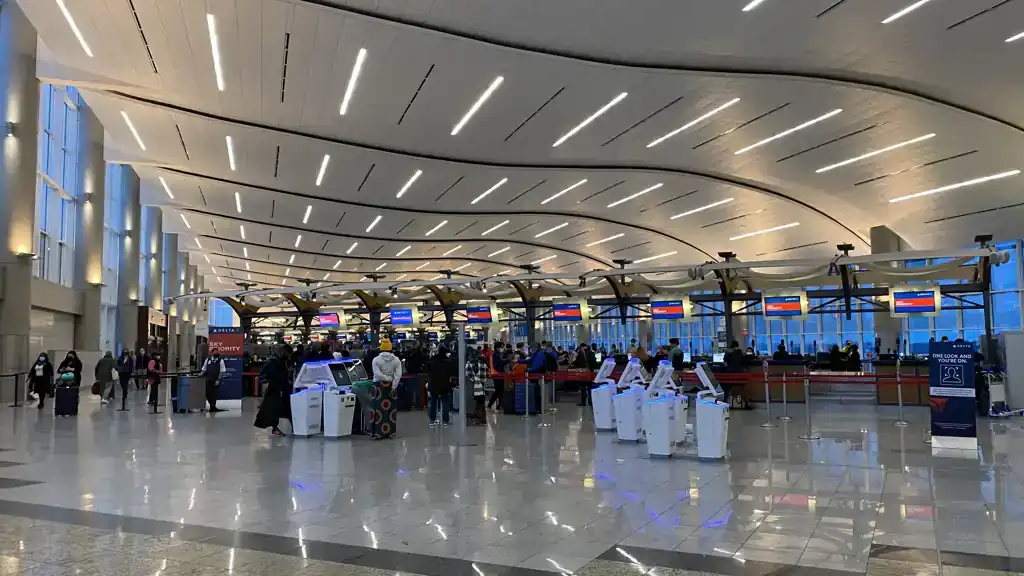
The shutdown affected thousands of flights across the country, leaving passengers stranded at major airports and forcing airlines to cancel or delay services. Some passengers remained aboard aircraft for extended periods while waiting for departure clearance or available gates.
■ Related News



By late Friday, flight-tracking data showed nearly 10,000 cancellations, alongside thousands of delays. More than 2,500 additional cancellations were reported on Saturday as carriers continued working through the backlog.
The disruption extended beyond the original shutdown because aircraft and crews were no longer positioned according to their normal schedules. Airlines needed to coordinate available pilots, flight attendants, aircraft and airport capacity before they could restore regular operations.
Duffy warned that recovery would be gradual, depending partly on whether airlines had sufficient crews available to operate their scheduled services.
Ageing air traffic infrastructure faces scrutiny
The outage has renewed concerns about the condition of the US air traffic control system, which relies on legacy communications equipment and infrastructure undergoing modernization.
Duffy said newer technology and equipment being introduced into the existing system had contributed to the overload. He argued that piecemeal upgrades were insufficient and called for a broader replacement of outdated infrastructure.
The transportation secretary urged Congress to provide approximately $50 billion for modernization. The administration had previously sought $30.1 billion for aviation infrastructure improvements.
The incident also raised questions about the risks of integrating newer technology with older systems. Officials said the immediate problem had been addressed, but Duffy acknowledged that further disruptions could occur while the broader infrastructure remained in service.
Officials investigate possible causes
Homeland Security Secretary Markwayne Mullin said investigators had found no evidence indicating that a cyberattack or rogue artificial intelligence system caused the disruption.
He described the incident as apparently mechanical but said the investigation was continuing. The National Security Agency was assisting federal authorities with the examination.
The administration also distinguished the incident from the FAA’s recently introduced AI-powered air traffic management technology. Officials said the failure involved older communications infrastructure rather than the new system.
The precise technical sequence that caused the network overload remains subject to investigation.
Airlines and passengers face prolonged recovery
Airlines have been working to restore operations while managing aircraft shortages at some airports, crew scheduling problems and the accumulation of delayed passengers.
The effects have also reached international travelers, with some flights delayed or diverted as the US air traffic network recovered. Sports teams and other groups travelling for scheduled events sought alternative arrangements, including chartered buses.
The disruption has also affected airline stocks. Shares of American Airlines, United Airlines and Delta Air Lines declined in after-hours trading following the shutdown, reflecting investor concerns about the financial impact of cancellations and operational disruption.
The FAA has restored permission for departures, but the end of the ground stop does not mean the national flight network has returned to normal. The immediate challenge is clearing the backlog while maintaining safe operations and preventing further interruptions.
Primary Sources: Federal Aviation Administration, “FAA Statement on Nationwide Ground Stop,” November 13, 2026, confirming that a nationwide ground stop was issued for all US airports following communications problems affecting multiple Air Route Traffic Control Centers; FAA Air Traffic Control System Command Center, Advisory 120, November 13–14, 2026, identifying a nationwide ground stop affecting all destinations and facilities and specifying communications failure as the stated reason; US Department of Transportation, Secretary Sean Duffy’s White House briefing, November 13, 2026, explaining that instability in radar and communications systems followed an overload involving switches and routers and confirming the gradual resumption of departures. The complete official briefing transcript was not independently retrieved; the technical explanation is attributed to the secretary’s publicly reported remarks.