EINDHOVEN, Netherlands – ASML has begun construction of a major new manufacturing campus in the Netherlands as demand for advanced semiconductor equipment accelerates alongside investment in artificial intelligence infrastructure.
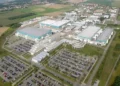
The project, known as BIC North, covers about 35 hectares near Eindhoven Airport and is designed to expand ASML’s manufacturing and logistics capacity. The development is expected to accommodate as many as 20,000 additional workers as the company expands its operations in the region.
The expansion comes as chipmakers increase spending on advanced logic and memory production. ASML, the world’s leading supplier of extreme ultraviolet lithography equipment, has said its customers are accelerating capacity expansion plans because of sustained demand linked to AI and other high-performance computing applications.

ASML expands capacity near Eindhoven
BIC North is being developed close to ASML’s existing headquarters and manufacturing operations in Veldhoven. The first phase is planned to include offices, logistics facilities and cleanrooms for assembling advanced lithography systems.
The new campus is intended to support a larger manufacturing operation while keeping ASML’s most important activities concentrated in the Eindhoven region, one of Europe’s major semiconductor and high-technology clusters.
ASML Chief Executive Christophe Fouquet said the expansion reflects continuing investment required to meet growing demand from the semiconductor industry.
The project also has broader implications for the Netherlands, where ASML’s expansion is closely tied to the country’s position in the global semiconductor equipment supply chain.
AI demand drives semiconductor investment
The expansion follows a sharp increase in demand for advanced chips used in AI systems and data centers.
■ Related News


ASML reported €9.3 billion in second-quarter 2026 net sales and €2.9 billion in net income. The company raised its full-year sales outlook to between €43 billion and €45 billion and said its order intake remained extremely strong during the first half of the year.
The company said AI-related investment and continued advances in AI technologies are driving demand for advanced logic and memory chips. Its customers are responding by accelerating capacity expansion, increasing the need for ASML’s lithography systems.
ASML plans to increase its 2026 low-numerical-aperture EUV capacity by about 30% in 2027 and is examining a further 30% increase for 2028. It is pursuing a similar expansion in DUV immersion capacity.
High-NA EUV enters a new phase
ASML is also advancing the next generation of EUV lithography as chipmakers prepare for increasingly demanding manufacturing processes.
In July, ASML said Intel had entered high-volume manufacturing for a subset of its Core Ultra Series 3 processors using ASML’s High-NA EUV technology on Intel’s 18A process. The milestone provided production data for further development of the technology and its wider adoption.
High-NA EUV is designed to provide greater resolution and process control for advanced semiconductor manufacturing. Its wider deployment is expected to become increasingly important as chipmakers develop smaller and more complex process nodes.
ASML and Taiwan Semiconductor Manufacturing Co. announced another major development on Sept. 8, establishing an industry initiative to move toward 12-inch photomasks for High-NA EUV systems. The companies said the initiative aims to establish a pilot line by 2031 and support full lithography-system readiness for advanced-node production by 2033.
Expansion reflects longer-term chip demand
ASML’s manufacturing expansion is therefore tied not only to current AI demand but also to the semiconductor industry’s longer-term capacity plans.
The company said in its second-quarter results that customers in both advanced logic and DRAM were pursuing aggressive capacity additions. In logic, investment is supporting additional 3-nanometer capacity for AI accelerators, while customers are also preparing for 2-nanometer and future 1.4-nanometer technologies.
That demand gives ASML greater visibility into future equipment requirements while increasing pressure on the company to expand its own production capabilities.
The BIC North project represents one of the clearest physical signs of that expansion. Rather than simply increasing output from existing facilities, ASML is building additional infrastructure to support the next phase of semiconductor manufacturing growth.
Semiconductor supply chain becomes more strategic
ASML’s position makes its expansion significant beyond the Netherlands.
The company is a critical supplier to the world’s leading chipmakers because its EUV systems are required for manufacturing some of the most advanced semiconductors. Demand for those systems has consequently become closely linked to investment in AI, data centers, advanced computing and next-generation mobile technologies.
The concentration of advanced chipmaking equipment in a small number of specialized suppliers also gives ASML a strategically important role in the global semiconductor supply chain.
For now, the company’s expansion reflects a combination of strong current orders, customer capacity commitments and expectations for continued growth in advanced-chip demand. The new Eindhoven-area facilities are intended to give ASML the manufacturing capacity needed to respond as those investments move forward.
Reporting Credit: ASML Holding N.V. – Sept. 2026 manufacturing expansion and BIC North development; ASML – second-quarter 2026 financial results, capacity plans and management assessment of AI-driven semiconductor demand; ASML and Taiwan Semiconductor Manufacturing Co. – Sept. 8, 2026 initiative on larger-format photomasks for High-NA EUV; ASML and Intel – High-NA EUV production milestone on Intel’s 18A process.