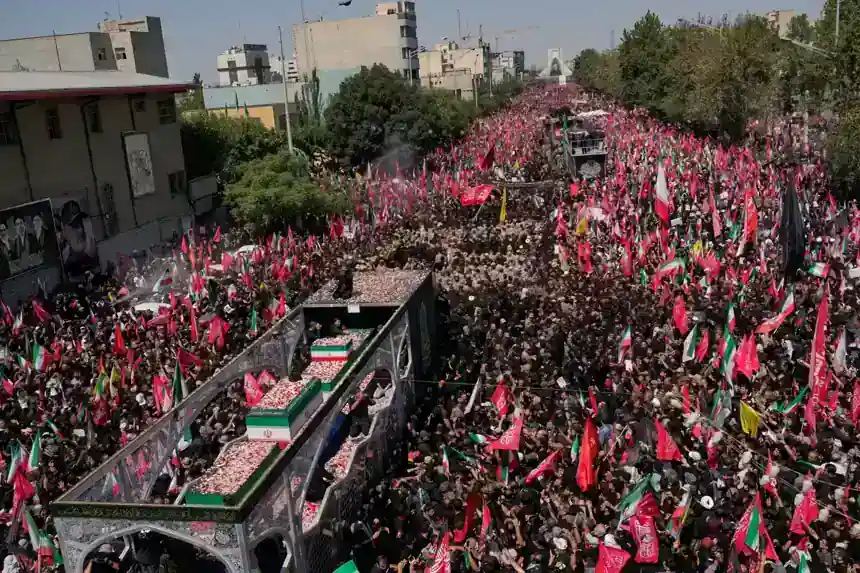
TEHRAN, Iran – Thousands of mourners filled the streets of Tehran on Monday for the funeral procession of Iran’s late Supreme Leader, Ayatollah Ali Khamenei, in one of the largest public gatherings the country has seen in recent years. The ceremony unfolded as Iran sought to project national unity following its recent war with Israel and the United States while negotiations with Washington over a permanent settlement remained suspended.
Khamenei’s flag-draped coffin, accompanied by those of family members killed in a Feb. 28 airstrike at the start of the conflict, was transported through the Iranian capital aboard a truck decorated to resemble the ornate latticework surrounding the shrine of a Shiite imam. State television broadcast aerial images showing crowds stretching for kilometers along Tehran’s Azadi, or Freedom, Street.
Iranian authorities did not immediately release an official estimate of attendance, though state media suggested the turnout surpassed the massive funeral procession held in 2020 for Revolutionary Guard Gen. Qassem Soleimani.

Large Procession Marks National Mourning
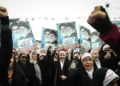
Mourners dressed largely in black lined the procession route, with many reaching toward the vehicle carrying the coffins or handing attendants scarves and personal items to touch against the casket, a practice in Iran believed by some to convey blessings.
Officials deployed loudspeakers urging participants to move carefully, avoid pushing and remain along the sides of the road as the procession advanced slowly through the capital. Firefighters positioned on ladder trucks sprayed mist over sections of the crowd to help alleviate the summer heat.
The procession continued for roughly 12 hours before the coffins were taken to Mehrabad International Airport. Iranian state television reported that Khamenei’s coffin was flown later Monday to the holy city of Qom, where ceremonies are scheduled to continue Tuesday.
The nationwide mourning period began Saturday and is expected to conclude Thursday with Khamenei’s burial at the Imam Reza shrine in Mashhad, his birthplace. He was 86.
“This is the last time I am seeing him,” mourner Maryam Alizadeh said through tears. “Our generation lived with him for decades.”
■ Related News

Anti-U.S. and Anti-Israel Slogans Heard During Ceremony
Many participants chanted slogans directed at the United States and Israel during the procession, with some carrying banners and placards calling for the deaths of U.S. President Donald Trump and Israeli Prime Minister Benjamin Netanyahu. An effigy depicting Trump hanging from a noose was also visible along the procession route.
“Today that we are here for the funeral for our leader, it’s a very tough day,” mourner Fatima Hassan said. “We are not here to say goodbye to him. We are here for revenge. And we will take revenge.”
Another participant, Sahar Zaraatgar, said those attending the funeral intended to continue Khamenei’s path and seek revenge against the United States and Israel.
U.S. authorities have monitored Iranian threats against Trump and other current and former officials for several years following Trump’s order that led to the killing of Soleimani in 2020. Iran has repeatedly denied plotting to assassinate Trump, although hard-line propaganda has frequently portrayed him as a target.
During the recent conflict, Trump also issued public threats against Iran, including warnings about destroying the country’s civilization.
Diplomacy Remains Frozen After Conflict
The funeral ceremonies are unfolding as diplomatic efforts between Tehran and Washington remain stalled.
The United States has expressed interest in resuming negotiations aimed at reopening the Strait of Hormuz, addressing Iran’s disputed nuclear program and reaching a permanent end to the conflict. According to the report, discussions are expected to remain paused until after Khamenei’s burial.
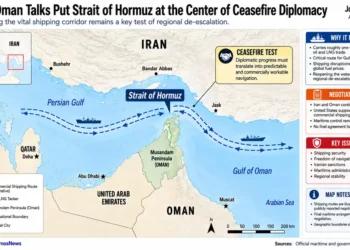
The Strait of Hormuz remains a central issue in the negotiations. Iran shut the strategic waterway during the conflict and continues to seek a degree of control over maritime access, while the United States has rejected those demands. Other unresolved issues include Tehran’s nuclear activities and the conflict involving the Iran-backed militant group Hezbollah in Lebanon.
Leadership Transition Continues
Iran’s new supreme leader, Ayatollah Mojtaba Khamenei, has not appeared publicly during the funeral ceremonies, which are taking place over several days.
According to the report, he is believed to be in hiding after reportedly being wounded in the airstrike that killed his father. During the war, Israel targeted senior Iranian officials and, in some cases, reportedly used public appearances to determine their locations. Israeli officials have also threatened the younger Khamenei.
The funeral procession is expected to continue through multiple cities before concluding with burial ceremonies later this week, as Iran’s leadership faces the challenge of managing both a political transition and renewed diplomatic tensions following the recent conflict.
Article Topics: Iran | Ayatollah Ali Khamenei | Tehran | Middle East | U.S.-Iran Relations | Israel | Funeral Procession | Diplomacy
This report is based on reporting by The Associated Press.