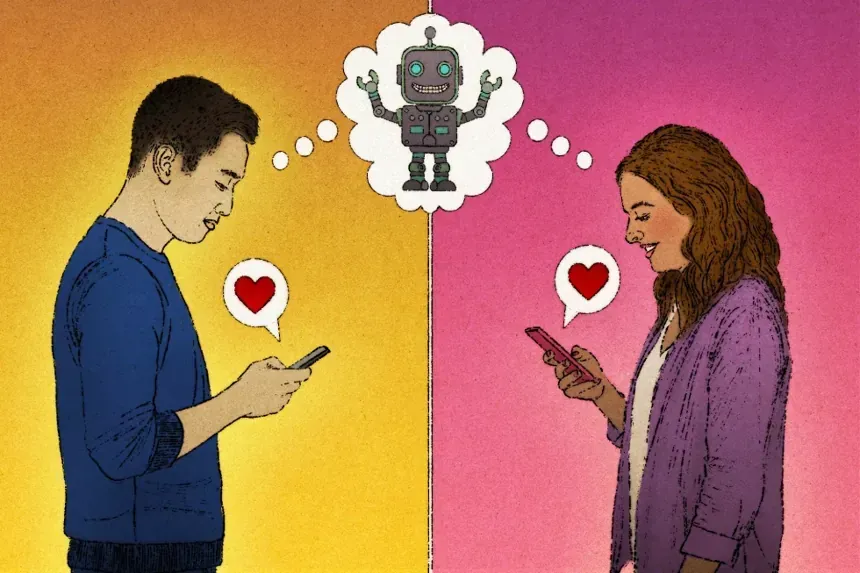
Artificial intelligence is taking on a growing role in modern dating, with many singles turning to AI-powered chatbots for help navigating conversations, building dating profiles, and even interpreting messages from potential partners.
While the technology promises to make dating more efficient, many users remain uncertain whether algorithms can truly replace the emotional instincts and authentic connections that define successful relationships.
Marie Lansley, 36, recently relocated to San Francisco for a new job while also searching for a romantic partner. As she explored various dating platforms, she began using AI chatbots to assist with starting conversations, an aspect of online dating she finds more difficult than meeting people face-to-face.

Lansley regularly alternates between OpenAI’s ChatGPT and Anthropic’s Claude to help generate conversation starters. Although she appreciates the convenience, she believes technology has clear limitations.
“AI is great at making dating more efficient,” Lansley said. “But the chemistry — that’s always going to be analog.”
AI Expands Its Role in Digital Dating
Consumers are increasingly adopting artificial intelligence across different stages of the dating process. Some rely on AI-powered matchmaking services, while others use chatbots to improve dating profiles or draft responses to potential matches.
Among the most common uses is asking AI to write opening messages, suggest replies during conversations, or explain confusing interactions with prospective partners.
In addition to ChatGPT and Claude, some users are experimenting with Google’s Gemini, Elon Musk’s Grok, and other generative AI assistants. Dating platforms and AI developers have also embraced the trend by publishing examples on social media demonstrating personalized dating advice generated by their systems.



Dating coach Carey Gaynes compared today’s AI assistants to the literary character Cyrano de Bergerac, who famously helped another man express romantic feelings through carefully crafted words.
She acknowledged that AI can be useful but cautioned that relying too heavily on technology risks replacing a person’s authentic voice during the early stages of a relationship.
Dating Apps Continue Integrating AI Features
Artificial intelligence has already become deeply integrated into several major dating platforms.
Lansley said she was impressed by the conversational depth displayed by an AI matchmaker during an onboarding session with the dating app Known. She felt the chatbot asked more thoughtful questions than many traditional dating services, although the first suggested match ultimately was not an ideal fit.
Other users view AI as a helpful assistant during the often awkward opening exchanges.
Mason Naung, a 25-year-old student in Los Angeles, said AI-generated suggestions could make it easier to create initial icebreakers on dating platforms such as Hinge. However, he believes continuing entire conversations with AI-written messages could become a warning sign.
Artificial intelligence is also being used to help end relationships more respectfully.
Dani Cohen, a business owner in San Diego, said she would rather receive a thoughtfully written AI-assisted message explaining someone’s decision to stop dating than experience being “ghosted” without any explanation.
She argued that if AI encourages clearer and kinder communication, it may offer practical value despite concerns about authenticity.
Questions Over Authenticity Remain
Despite increasing adoption, many users remain skeptical about allowing artificial intelligence to play a significant role in their personal relationships.
Several people interviewed said they have established personal boundaries regarding when AI assistance becomes inappropriate, particularly once conversations move beyond initial introductions.
Clara Sullivan, a student in Los Angeles, said she would be reluctant to continue communicating with someone if she discovered their messages were primarily written by AI.
She expressed concern that growing dependence on chatbots could reduce people’s willingness to think creatively and communicate independently.
Public opinion reflects similar concerns.
According to a 2025 survey by the Pew Research Center cited in the report, 53% of U.S. adults believe artificial intelligence will reduce people’s ability to think creatively, while half believe it could weaken the ability to build meaningful relationships.
Dating Industry Bets on Artificial Intelligence
Despite reservations, the online dating industry continues investing heavily in AI-powered features.
Dating platforms have introduced tools designed to recommend compatible profiles, generate conversation starters, and provide profile-writing assistance.
Tinder offers an AI-powered feature called Chemistry that recommends profiles based on users’ interests, while Hinge has introduced AI tools aimed at improving conversations and profile quality.
Bumble is also preparing broader AI-driven matchmaking capabilities. Founder and Chief Executive Officer Whitney Wolfe Herd recently said the company plans to move away from its well-known swipe interface in favor of artificial intelligence designed to make finding compatible partners more personalized.
Following criticism of the announcement, Herd said the company’s objective is to ensure technology makes relationships “feel more human, not less.”
Balancing Convenience With Human Connection
Some users continue to question whether AI can offer meaningful guidance in matters of romance.
Mohammed Nizami, 23, said he uses artificial intelligence in other areas of his life but intentionally avoids relying on it for dating. He believes authentic emotional connection requires direct communication without technological filters.
He also questioned whether AI systems always provide balanced advice, noting that chatbots often prioritize supportive responses that may not necessarily be the most helpful.
Jake Clay, a content creator in New York City, described the growing use of AI in dating as both helpful and concerning.
Although he appreciates receiving fewer requests from friends to interpret dating messages because many now consult AI instead, he believes outsourcing such personal interactions reflects broader changes in how people approach relationships.
For many singles, artificial intelligence may become another tool in the search for love. Yet even as technology reshapes modern dating, many users continue to believe genuine chemistry and emotional connection remain qualities that no chatbot can fully replicate.
Tags: Artificial Intelligence, AI Chatbots, Online Dating, Dating Apps, ChatGPT, Claude AI, Bumble, Tinder, Digital Relationships, Generative AI