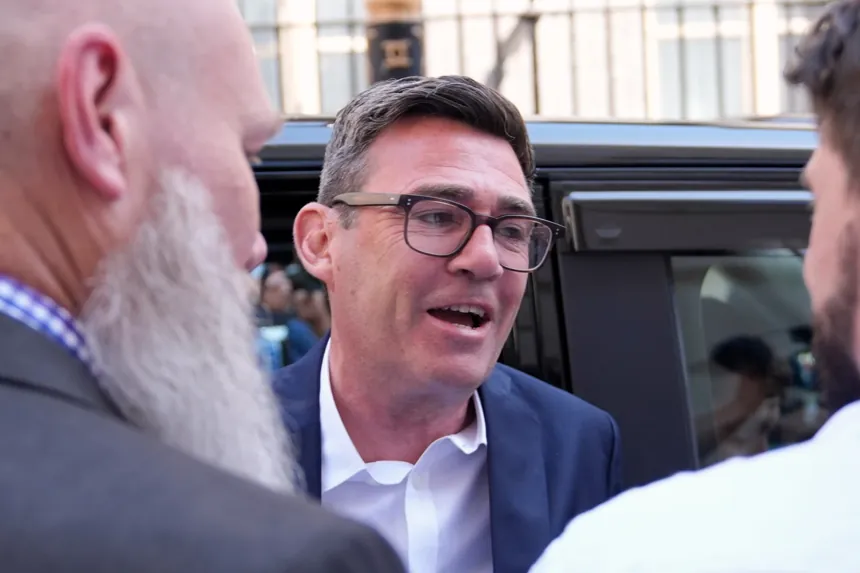
LONDON — Andy Burnham moved closer to becoming Britain’s next prime minister on Wednesday after a prominent potential challenger ruled himself out of the Labour Party leadership race, accelerating the transition following Prime Minister Keir Starmer’s resignation announcement.
The development comes as the governing Labour Party prepares to select a new leader within weeks, a process that could determine not only the party’s future direction but also the next occupant of Downing Street. With no major rival currently emerging, Burnham appears increasingly likely to inherit leadership of both the party and government.
Prime Minister Keir Starmer, who announced earlier this week that he would step down, defended his record during his final appearances in Parliament while continuing diplomatic engagements with European partners focused on Ukraine, European security and tensions in the Middle East.

Leadership Race Narrows
The prospect of a contested Labour leadership election diminished after Cabinet minister Darren Jones confirmed he would not seek the party leadership.
Jones, considered by some Labour figures as a possible alternative candidate, told Sky News that running for the leadership was not something he intended to pursue.
His decision removes one of the few figures viewed as capable of mounting a challenge to Burnham, the Greater Manchester mayor who recently returned to Parliament after winning a special election and quickly positioned himself as a candidate for the party leadership.
Former Health Secretary Wes Streeting has also indicated support for Burnham, further strengthening the mayor’s position ahead of the nomination process.
Labour is scheduled to open nominations on July 9, with submissions closing one week later. If Burnham remains unopposed, he could assume office before Parliament’s summer recess. A contested race would extend the process until lawmakers return in September.
■ Related News



Economic Direction Under Scrutiny
Although Burnham has not formally outlined a full economic platform, attention is already turning to the policy direction a future government under his leadership might take.
Jones cautioned against moving too far from the political center on economic issues, emphasizing the importance of maintaining confidence among financial markets, trade unions and Labour lawmakers.
Burnham is expected to present key elements of his economic agenda in a speech next week. Observers within the party are also watching closely for decisions regarding senior economic appointments, particularly following speculation about changes to Treasury leadership.
The debate reflects broader questions within Labour about balancing economic growth, public spending and market confidence after years of political and economic uncertainty.
Starmer Defends His Record
During Prime Minister’s Questions, Conservative Party leader Kemi Badenoch criticized Starmer’s tenure, accusing Labour of abandoning the prime minister and rallying behind Burnham.
Starmer rejected the criticism and argued that his government had helped reverse the effects of years of Conservative-led austerity policies.
“The test for every prime minister is handing over this country in better shape than you found it,” Starmer told Parliament. “I know I can do that.”
The outgoing prime minister has pledged to oversee what he described to Cabinet ministers as an orderly transfer of power before leaving office.
European Allies Praise Outgoing Prime Minister
While preparing to leave office, Starmer continued diplomatic engagements abroad, participating in discussions in Berlin with leaders from Germany, France, Italy and Poland.
The talks focused on European defense, Russia’s war against Ukraine and developments in the Middle East.
German Chancellor Friedrich Merz publicly thanked Starmer for his role in strengthening cooperation among European allies and supporting NATO during a period of heightened security challenges.
Merz expressed regret at Starmer’s departure while praising the cooperation between their governments in recent months.
Starmer said he was proud of efforts to rebuild Britain’s relationships with European partners and other international allies, describing those efforts as an important part of his legacy.
Defense Policy Remains Unfinished
One of the major items expected before Starmer leaves office is the publication of a long-awaited defense investment strategy.
The plan has attracted significant political attention following the resignation of Defense Secretary John Healey earlier this month.
The government is expected to release details of the investment framework before a NATO summit scheduled to take place in Turkey in early July.
Although Starmer is entering the final weeks of his premiership and is restricted from launching major new policy initiatives, the defense plan is expected to remain a key component of his government’s final agenda and could influence Britain’s security policy under his successor.
Tags: United Kingdom, Labour Party, Andy Burnham, Keir Starmer, Darren Jones, Wes Streeting, British Politics, Leadership Election, NATO, Germany, Friedrich Merz, European Security