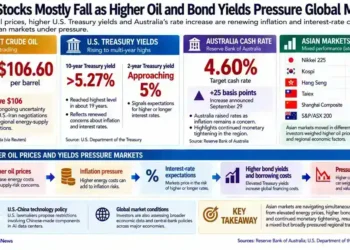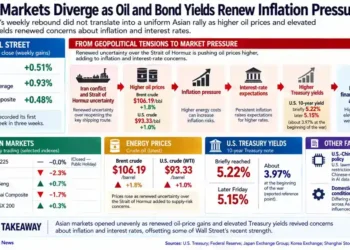
Global equity markets retreated from recent record highs on Friday as investors reassessed inflation risks tied to rising oil prices and climbing government bond yields. The selloff spread across Wall Street, Europe, and Asia, with technology shares and smaller-cap companies leading declines amid renewed concerns over energy-driven inflation and tighter financial conditions.
The S&P 500 fell 1.2%, while the Nasdaq Composite declined 1.5% and the Dow Jones Industrial Average dropped more than 500 points, according to market data. Analysts said the downturn reflected growing unease over the economic implications of higher crude prices following continued disruptions linked to the conflict involving Iran and restricted oil flows through the Strait of Hormuz.
Bond market volatility intensifies inflation fears
The sharp rise in Treasury yields became a central concern for investors as markets adjusted expectations for future interest rates. The yield on the benchmark 10-year U.S. Treasury climbed to roughly 4.6%, while the 30-year yield moved above 5%, approaching levels last seen during periods of elevated inflation pressure in previous decades.

Higher yields typically increase borrowing costs for consumers and businesses, placing pressure on economic activity and equity valuations. Smaller companies appeared particularly vulnerable, with the Russell 2000 index falling more than 2% during the session as investors moved away from risk-sensitive assets.
Market participants said the combination of rising energy costs and persistent inflation may complicate the policy outlook for central banks, especially the U.S. Federal Reserve.
“Markets have pushed into overbought territory,” Brian Jacobsen, chief economic strategist at Annex Wealth Management, said in comments reported by Associated Press-affiliated coverage. He added that while corporate earnings and broader economic conditions remain relatively durable, volatility is likely to persist.
Oil prices fuel concerns over global growth
Brent crude oil traded above $108 per barrel during the session, significantly higher than levels seen before the escalation of Middle East tensions earlier this year. Analysts noted that prolonged supply disruptions could intensify inflationary pressures globally and reduce consumer spending power across major economies.
The increase in energy prices also renewed concerns about supply-chain costs and manufacturing input inflation. Industry commentary and market analysis published this week suggested rising fuel costs are beginning to affect broader pricing expectations across industrial sectors and transportation markets.




Currency markets reflected broader risk aversion, with the U.S. dollar strengthening against major peers as traders sought safer assets amid market volatility. Investors also reduced exposure to growth-oriented technology shares that had driven much of this year’s equity rally.
Technology shares reverse after record rally
Artificial intelligence-linked companies, which have fueled gains across global equity benchmarks in recent months, experienced some of the steepest declines. Nvidia fell more than 4%, while Micron Technology dropped nearly 7%, according to market data.
Analysts said elevated valuations in semiconductor and AI-related shares left the sector vulnerable to profit-taking once bond yields began rising sharply.
Global markets also weakened outside the United States. South Korea’s Kospi index fell more than 6%, while several European indexes posted broad declines amid concerns that persistent inflation could delay interest-rate cuts in major economies.
Despite Friday’s pullback, major U.S. indexes remain positive for the year, supported by strong corporate earnings, continued investment in AI infrastructure, and resilient consumer demand earlier in the quarter. However, economists cautioned that sustained energy inflation and elevated borrowing costs could increasingly weigh on growth expectations in the months ahead.