The global oil market surged toward $100 per barrel on Thursday as escalating conflict involving Iran disrupted key energy supply routes, triggering declines across major equity markets and increasing concerns about inflationary pressure on the global economy.
International benchmark Brent crude briefly climbed above $101 per barrel overnight before easing slightly, while global stock indexes moved lower as investors assessed the economic impact of sustained disruptions to oil shipments through the Persian Gulf.
Analysts and market data compiled by financial media organizations including Reuters and Bloomberg indicate that energy supply risks linked to the closure of the Strait of Hormuz are driving volatility across commodities, equities, and government bond markets.

Energy Market Volatility Drives Global Risk Sentiment
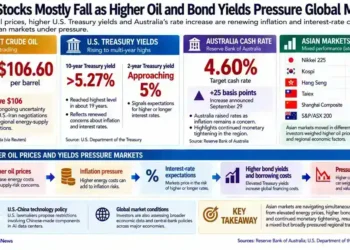
Brent crude futures rose about 8% to approximately $99.50 per barrel after reaching an intraday high near $101.59, according to market data cited by Reuters. U.S. benchmark West Texas Intermediate (WTI) crude also increased, climbing roughly 8.4% to $94.57 per barrel.
The surge follows intensified attacks targeting energy infrastructure in the region and the effective suspension of cargo traffic through the Strait of Hormuz, a strategic maritime corridor through which roughly one-fifth of global oil supply normally passes.
Industry analysts note that prolonged disruption to the shipping route could significantly tighten global crude supply. Some forecasts cited by financial news outlets suggest prices could rise further if the closure continues.
Energy producers have reportedly reduced output in certain cases due to the inability to transport crude shipments through the blocked corridor.
Strategic Reserves Deployed to Stabilize Supply
Governments and international agencies are attempting to mitigate the supply shock by releasing emergency reserves.




The International Energy Agency said member countries would release roughly 400 million barrels of oil from strategic stockpiles. According to the agency, the move represents one of the largest coordinated emergency energy releases designed to stabilize markets during supply disruptions.
However, analysts interviewed by Financial Times caution that reserve releases are typically temporary solutions and may not offset longer-term supply shortages if shipping routes remain restricted.
Global Equity Markets Retreat
The surge in oil prices coincided with declines across major stock indexes as investors adjusted expectations for economic growth and inflation.
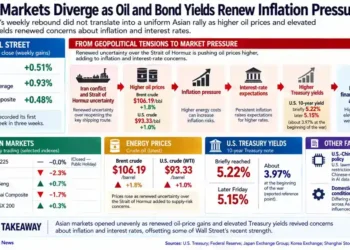
The S&P 500 fell approximately 1.1% in early trading, while the Dow Jones Industrial Average dropped about 588 points, or 1.2%. The Nasdaq Composite declined roughly 1.4%.
Market data cited by The Wall Street Journal shows energy-sensitive sectors experiencing some of the largest declines. Companies with high fuel costs—including airlines and cruise operators—were particularly affected.
Shares of United Airlines fell sharply, while cruise operator Carnival Corporation also declined as investors reassessed operating costs in an environment of elevated energy prices.
European and Asian markets followed a similar trend. Japan’s Nikkei 225 index declined about 1%, while France’s CAC 40 slipped roughly 0.7%.
Rising Energy Costs Add to Inflation Concerns
Higher oil prices have also pushed government bond yields upward as markets factor in potential inflationary pressure.
The yield on the 10-year U.S. Treasury increased to approximately 4.22%, up from about 3.97% before the conflict escalated, according to bond market data cited by financial media outlets.
Rising yields generally increase borrowing costs across the economy, affecting mortgage rates, corporate debt issuance, and investment valuations.
Economists warn that a prolonged energy shock could complicate monetary policy decisions for the Federal Reserve. Sustained oil price increases could slow economic growth while keeping inflation elevated, a scenario often described as stagflation.
Recent economic indicators present a mixed picture. U.S. unemployment claims declined slightly in the latest weekly data, suggesting the labor market remains relatively stable despite broader economic uncertainty.
Corporate Signals Reflect Consumer Pressure
Corporate earnings announcements also reflected the potential impact of rising energy prices on consumer spending.
Discount retailer Dollar General reported quarterly profit and revenue exceeding analyst expectations. However, company guidance pointed to slower sales growth in the coming year, highlighting concerns that higher fuel costs could strain lower-income households that form the retailer’s core customer base.
Market analysts say the combination of geopolitical risk, elevated oil prices, and uncertain economic data is likely to sustain volatility across global financial markets in the near term.