A deadly terror attack in Sydney has intensified scrutiny of Australia’s domestic security environment after authorities said a Bondi Beach shooting targeting a Jewish Hanukkah gathering left at least 15 people dead and dozens wounded.
Police allege the attack was carried out by father and son Sajid Akram and Naveed Akram, who investigators say were influenced by Islamic State ideology. The assault has prompted an urgent investigation into potential extremist networks, travel patterns, and the broader risks facing public events tied to religious communities.
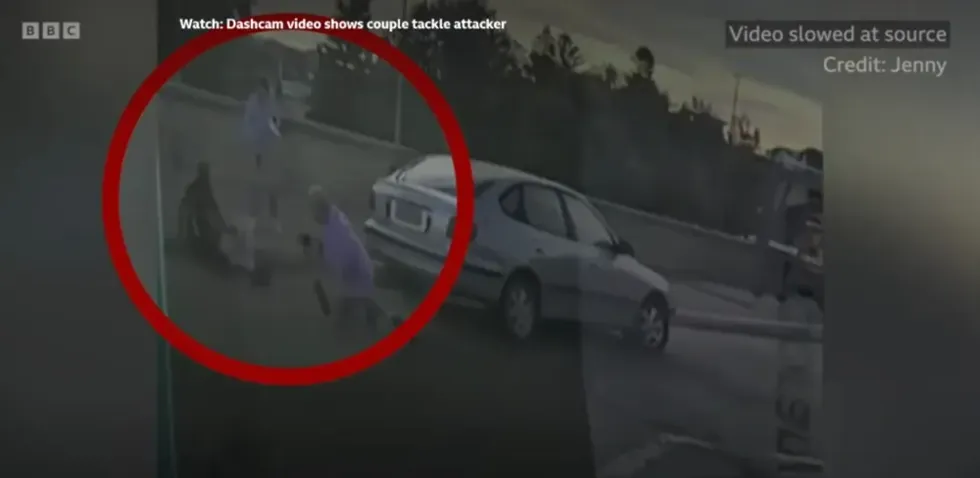
As first reported by Reuters, dramatic dashcam footage circulating among investigators captured the moment two victims attempted to confront one of the gunmen in the opening moments of the attack.

Authorities say the violence unfolded during celebrations marking the first night of Hanukkah, amplifying concerns about targeted attacks against minority communities.
Civilian Intervention Emerges in Early Moments of the Attack
Among the first victims were Boris Gurman, 69, and his wife Sofia Gurman, 61, long-time residents of the Bondi area.
Dashcam video reviewed by investigators shows Boris Gurman grappling with one of the attackers in an attempt to seize his firearm. According to witnesses cited by Reuters, Gurman briefly managed to wrest the weapon away before both men fell onto the road.
Footage suggests Gurman then stood and struck the attacker with the gun before the assailant obtained another weapon and fatally shot both him and his wife.
Family members described the couple’s actions as instinctive and consistent with their character.

“While nothing can lessen the pain of losing Boris and Sofia, we feel an overwhelming sense of pride in their bravery and selflessness,” relatives said in a statement.
Civilian Resistance Highlights Public Response Under Fire
Witnesses say the confrontation occurred in the earliest moments of the attack, when gunfire had already begun but before emergency services arrived.
The owner of the dashcam footage told Reuters that Gurman “did not run away — instead he charged straight toward the danger,” attempting to wrestle the firearm from the attacker.
Another eyewitness told Australian broadcaster Nine Network that Gurman confronted the gunman despite bullets already being fired.
“He was a hero,” the witness said. “There were bullets flying already, and he put himself in that face of danger.”
Casualty Toll Underscores Severity of the Assault
Authorities say the attack killed at least 15 people and left 22 others hospitalized. Nine of the wounded remain in critical condition.
Victims ranged in age from 10 to 87. Among those killed were a British-born rabbi, a retired police officer, and a Holocaust survivor, highlighting the breadth of those caught in the violence.
Earlier in the incident, another bystander — Ahmed al Ahmed, 43 — was also credited with intervening. According to family members speaking to BBC Arabic, he managed to seize a weapon from one of the attackers but was shot multiple times. He survived and later underwent surgery.
Investigators Probe Possible International Radicalization Links
Police have alleged that the suspects had traveled internationally shortly before the attack, raising questions about the pathways that may have contributed to their radicalization.
Authorities confirmed the pair visited the Philippines for approximately four weeks beginning on 1 November. Investigators are examining whether the trip involved contact with extremist networks or training opportunities.
Some media reports have suggested the possibility of “military-style training” during their time in Southeast Asia, though the Armed Forces of the Philippines has said there is currently no verified evidence confirming such claims.
Investigators have also recovered improvised explosive devices and homemade Islamic State flags from a vehicle linked to the suspects.
Domestic Security Response Faces New Test
The attack has renewed debate over how security agencies track radicalization within migrant communities and online extremist networks.
Officials say Naveed Akram, who was critically injured during the incident, has regained consciousness in hospital and may become a central figure in the ongoing investigation.
Meanwhile, authorities are examining the broader context of the suspects’ background. According to an Indian police official speaking to BBC Telugu, Sajid Akram had previously lived in the southern Indian city of Hyderabad before migrating to Australia, though investigators say there is currently no evidence linking his radicalization to contacts in India.
For Australian authorities, the attack represents one of the most serious terrorism incidents in recent years and raises pressing questions about security planning for religious and community events.