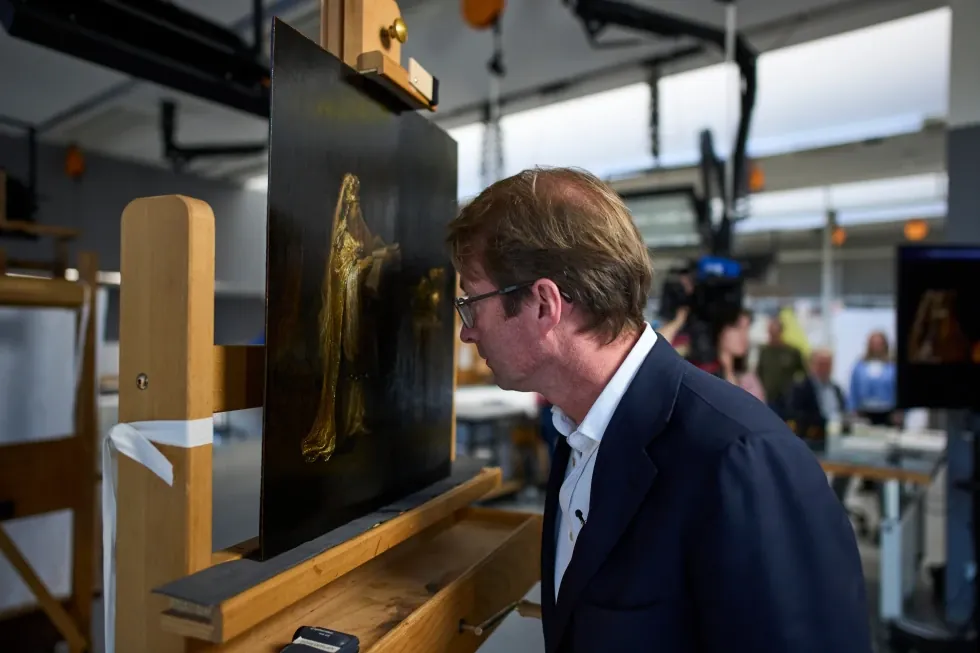
A Rembrandt authentication breakthrough has been confirmed by the Rijksmuseum after two years of technical and historical research. The painting, Vision of Zacharias in the Temple, was previously dismissed as not being by Rembrandt van Rijn but has now been formally attributed to the artist.
The discovery adds to the approximately 350 known works by Rembrandt and underscores how advances in imaging technology continue to reshape art historical understanding. The painting will go on long-term loan display at the museum in Amsterdam after decades outside public view.
The Reassessment of a Disputed Artwork
The painting was acquired by a private collector in 1961, one year after it had been rejected as a Rembrandt. According to museum officials, the owner initially sought confirmation only of whether the work was Dutch in origin.

Director Taco Dibbits told the Associated Press that requests to authenticate potential Rembrandts are frequent but rarely lead to confirmation. He described the process as comparable to “finding a needle in a haystack,” highlighting the difficulty of distinguishing genuine works from those by contemporaries or students.
The reassessment began after the work was brought to the Rijksmuseum for closer inspection. What followed was a two-year investigation combining scientific analysis with stylistic comparison.
The Science Behind Rembrandt Authentication
Museum experts conducted macro X-ray fluorescence scans and detailed pigment analysis. According to Jonathan Bikker, curator of 17th-century Dutch paintings, the wooden panel used for the painting dates to a tree felled before 1633—the year inscribed on the artwork.
Pigment composition and paint layering were also compared with other authenticated works by Rembrandt. The findings indicated consistency in materials and technique, including brushwork and light treatment, which align with the artist’s early Amsterdam period.
Research suggests that scientific imaging methods have become increasingly central in attribution studies, particularly for artists with extensive workshops. Rembrandt’s studio practice often involved pupils and collaborators, complicating authentication efforts.
■ Related News

Cultural and Historical Context
Painted in 1633, when Rembrandt was 27 and newly established in Amsterdam, the work depicts a biblical scene in which the high priest Zacharias receives a revelation from the Archangel Gabriel about the birth of John the Baptist.
The dramatic use of light—an early example of Rembrandt’s mastery of chiaroscuro—highlights Zacharias’ expression of astonishment. Art historians note that biblical themes dominated much of Rembrandt’s early career, reflecting both market demand and religious culture in the Dutch Republic during the 17th century.
The painting’s confirmation offers new insight into Rembrandt’s stylistic development during a formative period in Amsterdam, where he built his reputation among wealthy patrons.
Broader Implications for Art Scholarship
Authentication debates have long shaped the study of Rembrandt’s oeuvre. Over the decades, numerous works have been reattributed, sometimes removed from and later restored to the canon. Institutional research projects and technological advances have narrowed—but not eliminated—scholarly disagreement.
Experts say the case illustrates how interdisciplinary research, combining art history with material science, continues to refine understanding of Old Master paintings.
While museum officials stress they are not actively searching for undiscovered works, the confirmation demonstrates that reassessment remains possible—even decades after an artwork has been dismissed.