Russia has stepped up attacks on Ukraine’s southern Odesa region, hitting port facilities and energy infrastructure in what Ukrainian officials say is a coordinated effort to disrupt access to the Black Sea.
The strikes have caused prolonged power outages and civilian casualties. They come as Odesa grows more critical to Ukraine’s economy following the loss or occupation of other southern ports. Ukrainian leaders say the attacks aim to weaken maritime routes that support trade and global food exports.
Deputy Prime Minister Oleksiy Kuleba said Moscow was carrying out sustained assaults on the region. He warned last week that Russia’s military focus appeared to be shifting toward Odesa. President Volodymyr Zelensky said the repeated strikes were intended to block Ukraine’s sea-based logistics used for trade and humanitarian supplies.
Damage to ports and civilian infrastructure
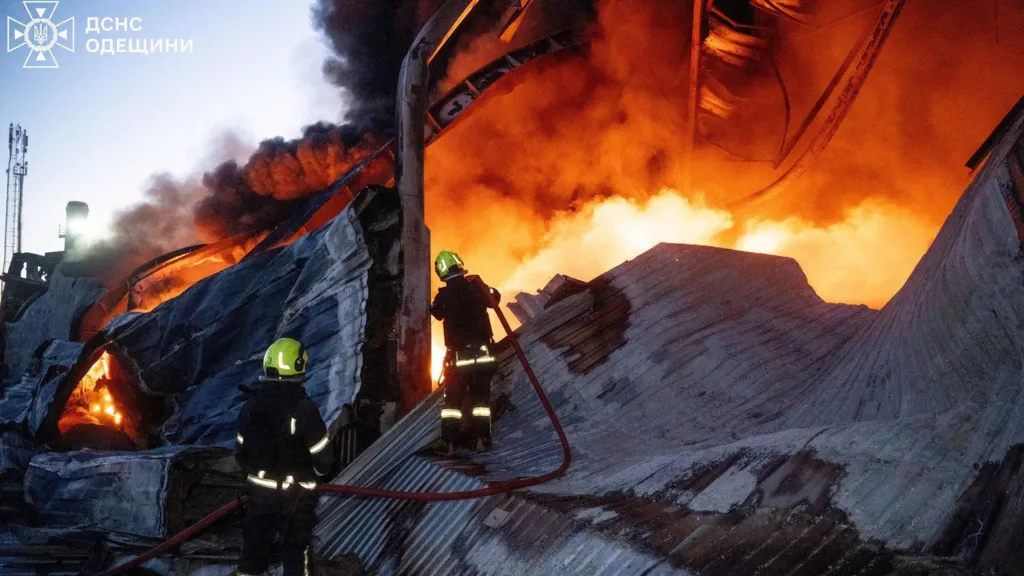
Late on Monday, Russian strikes hit port infrastructure in Odesa, damaging a civilian vessel, according to the regional governor. Officials said the attack was part of a broader campaign that has strained emergency services and disrupted electricity supplies.
On Sunday night, strikes cut power to around 120,000 people across the region. A fire also broke out at a major port, destroying dozens of containers filled with flour and vegetable oil, local authorities said.
Earlier attacks damaged transport links and residential areas. Last week, a ballistic missile strike on the Pivdenniy port east of Odesa killed eight people and injured at least 30 others.
In another incident earlier in the week, a woman was killed while travelling in a car with her three children. That strike temporarily cut the Odesa region’s only bridge connecting Ukraine with neighbouring Moldova.
Zelensky said a new regional air force commander would be appointed following the dismissal of Dmytro Karpenko over the weekend. He did not provide further details.
Why Odesa matters
Odesa has long played a central role in Ukraine’s economy. It is the country’s third-largest city after Kyiv and Kharkiv. Its importance has increased as ports in Zaporizhzhia, Kherson, and Mykolaiv remain inaccessible due to Russian occupation or ongoing fighting.
Despite the war, Ukraine remains one of the world’s leading exporters of wheat and corn. Since August 2023, Odesa has served as the starting point for a key maritime corridor that allows grain shipments to leave the country.
The route follows the coastlines of Romania and Bulgaria before reaching Turkish waters. It helped stabilise exports after earlier Black Sea agreements collapsed.
Ukrainian officials say continued strikes on Odesa threaten both domestic energy supplies and global food security, given Ukraine’s role in international agricultural markets.
Russian warnings and the “shadow fleet”
Earlier this month, Russian President Vladimir Putin warned that Moscow could move to cut Ukraine off from the sea. His remarks followed drone attacks on tankers linked to Russia’s so-called “shadow fleet” in the Black Sea.
Western governments and analysts use the term “shadow fleet” to describe hundreds of tankers Russia is accused of using to bypass sanctions imposed after its full-scale invasion of Ukraine in 2022.
Moscow denies evading sanctions. Kyiv, however, has accused Russia of using civilian shipping to support its war effort.
Zelensky has previously accused Russia of “sowing chaos” among the people of Odesa. He said stronger international pressure was needed, arguing that Moscow had shown no real intention of ending its military campaign.
Diplomatic efforts show little progress
The escalation in Odesa comes as US-led diplomatic efforts have failed to deliver a breakthrough. Talks held in Miami involved separate meetings between US officials and delegations from Ukraine and Russia.
The discussions produced cautiously optimistic statements but no clear steps toward ending the war, which is now approaching its fourth year.
US President Donald Trump’s special envoy, Steve Witkoff, said he and Ukraine’s Defence Minister Rustem Umerov worked to align positions on a 20-point draft peace plan proposed by Kyiv earlier this month.
The Ukrainian plan was presented as an alternative to a US proposal circulated in November. Ukrainian and some European officials viewed that earlier plan as more favourable to Moscow.
Russian officials quickly dismissed hopes of compromise. Before Russian envoy Kirill Dmitriev returned to Moscow, Kremlin foreign policy aide Yuri Ushakov said European and Ukrainian changes would not improve the chances of a settlement.
On Monday, Deputy Foreign Minister Sergei Ryabkov accused European Union countries of trying to derail any potential Russia–US agreements on Ukraine. He also said they were blocking broader efforts to improve relations with Washington.
Ryabkov said Russia was prepared to confirm in writing that it had no intention of attacking the European Union or NATO. His remarks echoed earlier comments from Putin.
In November, Putin said Russia had never planned to attack Europe and was willing to formalise that position if Western leaders demanded it.
For Ukraine, the immediate priority remains the defence of Odesa and the protection of maritime routes that support its economy and international trade. As the strikes continue, officials warn that the Black Sea corridor and energy supplies in southern Ukraine face growing pressure.
This article was rewritten by JournosNews.com based on verified reporting from trusted sources. The content has been independently reviewed, fact-checked, and edited for accuracy, neutrality, tone, and global readability in accordance with Google News and AdSense standards.
All opinions, quotes, or statements from contributors, experts, or sourced organizations do not necessarily reflect the views of JournosNews.com. JournosNews.com maintains full editorial independence from any external funders, sponsors, or organizations.
Stay informed with JournosNews.com — your trusted source for verified global reporting and in-depth analysis. Follow us on Google News, BlueSky, and X for real-time updates.