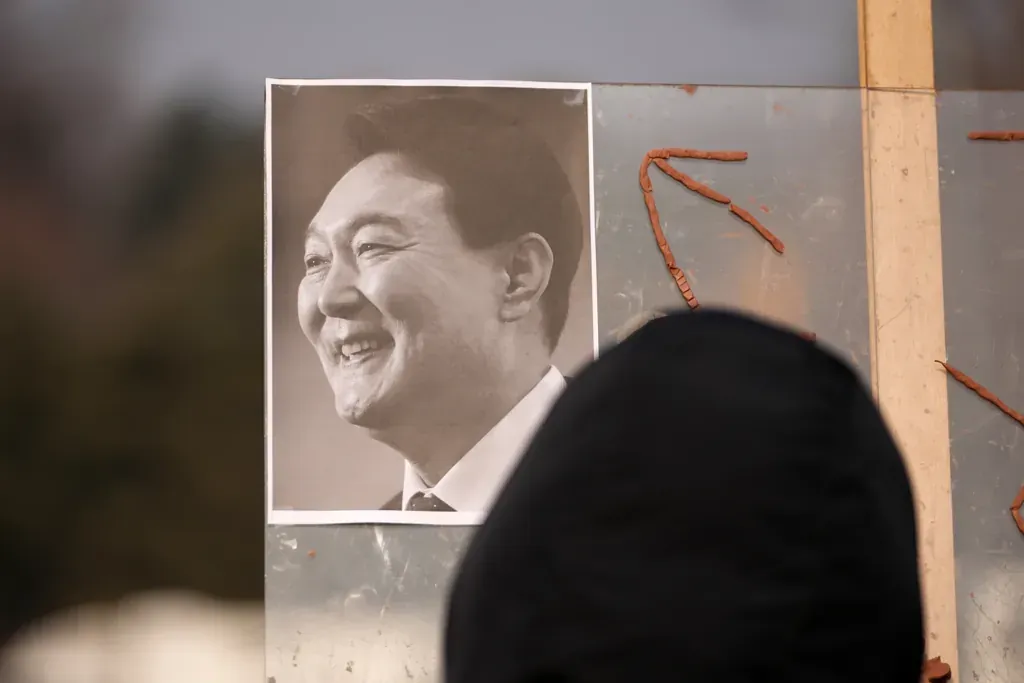
SEOUL, South Korea (Journos News) – A South Korean court on Friday sentenced former president Yoon Suk Yeol to five years in prison, delivering the first verdict among multiple criminal cases stemming from his short-lived declaration of martial law in late 2024.
The ruling marks a significant legal milestone following Yoon’s impeachment, arrest and removal from office after the decree triggered mass protests and plunged the country into its most serious political crisis in decades. Prosecutors and independent investigators argue the actions surrounding the decree undermined constitutional order and democratic governance.
The Seoul Central District Court convicted Yoon on charges including obstructing his lawful detention, fabricating aspects of the martial law proclamation, and bypassing required Cabinet deliberations. Far more serious charges, including rebellion, remain pending in separate trials scheduled to conclude in the coming weeks.

Court cites lack of remorse and damage to legal order
Presiding judge Baek Dae-hyun said the court considered a “grave punishment” necessary, citing Yoon’s refusal to acknowledge wrongdoing and what the judge described as implausible justifications for his actions.
The court found that Yoon sidestepped a legally mandated full Cabinet meeting before declaring martial law, thereby depriving ministers of their constitutional right to deliberate on the decision. Judges also ruled that Yoon defied lawful attempts by investigators to detain him during the inquiry.
In a televised decision, the court said restoring trust in legal and constitutional systems damaged by the episode was a central consideration in determining the sentence.
Yoon’s legal team immediately said it would appeal, calling the ruling politically motivated. Defense lawyers argued the court failed to draw a clear boundary between presidential constitutional authority and criminal liability, and said the independent counsel pursued an overly expansive interpretation of the law.
Rebellion trial still pending
The five-year sentence is separate from Yoon’s most serious case, in which prosecutors allege that his use of martial law amounted to rebellion. Independent counsel has sought the death penalty in that trial, with a verdict expected next month.
Yoon has consistently denied that he intended to place South Korea under prolonged military rule. He has said the decree was meant to alert the public to what he described as obstruction by the opposition-controlled National Assembly, not to dismantle democratic institutions.
Investigators, however, argue the move was designed to strengthen and prolong his grip on power. In addition to rebellion, they have charged Yoon with abuse of authority and other offenses tied to the episode.
Legal experts say the outcome of the rebellion case will determine whether Friday’s sentence has practical impact. If Yoon receives a life sentence or a lengthy prison term, additional convictions would carry limited effect.
Death penalty seen as unlikely
South Korea has not carried out an execution since 1997, and courts rarely impose death sentences. Park Sung-bae, a criminal law specialist, said it was highly unlikely that judges would sentence Yoon to death even if they uphold the rebellion charge.
Park said courts would likely consider that the martial law decree was brief and did not result in casualties, despite its constitutional implications. A sentence of life imprisonment or several decades behind bars would be more consistent with past rulings, he added.
South Korea also has a long history of pardoning former presidents convicted of serious crimes in the name of national reconciliation. Former military ruler Chun Doo-hwan, initially sentenced to death for his 1979 coup and the violent suppression of pro-democracy protests in 1980, was later pardoned.
Some analysts believe Yoon’s continued defiance may reflect a calculation that, while a heavy sentence is likely, a future pardon could still be possible.
Martial law decree triggered national crisis
Yoon declared martial law on the night of Dec. 3, 2024, in a surprise televised address, vowing to eliminate what he called “anti-state forces” and protect constitutional order. Troops and police were deployed around the National Assembly, raising fears of a return to authoritarian rule.
Lawmakers were nevertheless able to enter the assembly hall and vote down the decree within hours. No major violence was reported, but the move shook financial markets, strained South Korea’s diplomatic standing and revived painful memories of military-backed rule in the 1970s and 1980s.
Public outrage quickly followed, leading to Yoon’s impeachment and eventual removal from office. In a snap election held last June, opposition leader Lee Jae Myung won the presidency and later appointed independent counsels to investigate allegations involving Yoon, his family and close associates.
Additional cases add to legal pressure
Beyond the martial law cases, Yoon faces several other trials. Prosecutors allege he ordered drone flights over North Korea to inflame tensions and create a pretext for invoking emergency powers. Other charges include interfering with an investigation into the drowning of a marine in 2023 and accepting free political opinion surveys from an election broker in exchange for favors.
Each case adds to the legal reckoning facing the former president, whose fall from power has reshaped South Korea’s political landscape and prompted renewed debate over the limits of executive authority.
For now, Friday’s ruling stands as the first judicial verdict tied to the crisis — a formal acknowledgment by the courts that the actions surrounding the martial law decree crossed legal boundaries, even as the most consequential judgments are still to come.
This article was rewritten by JournosNews.com based on verified reporting from trusted sources. The content has been independently reviewed, fact-checked, and edited for accuracy, neutrality, tone, and global readability in accordance with Google News and AdSense standards.
All opinions, quotes, or statements from contributors, experts, or sourced organizations do not necessarily reflect the views of JournosNews.com. JournosNews.com maintains full editorial independence from any external funders, sponsors, or organizations.
Stay informed with JournosNews.com — your trusted source for verified global reporting and in-depth analysis. Follow us on Google News, BlueSky, and X for real-time updates.