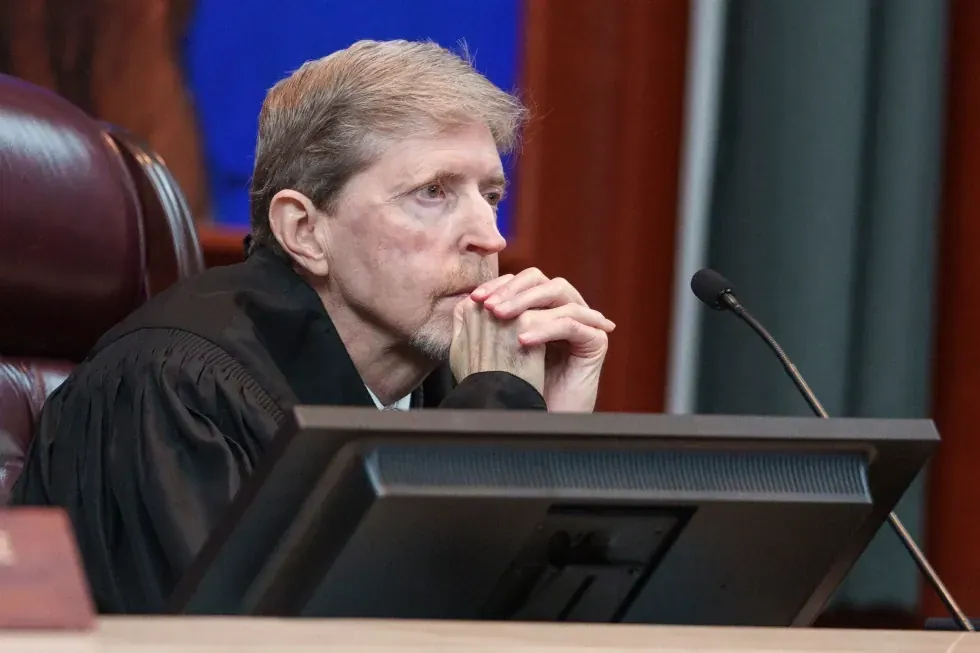
SALT LAKE CITY (JN) – Utah’s highest court will soon grow from five to seven justices after Gov. Spencer Cox signed legislation authorizing the expansion, a move that takes effect immediately and arrives at a politically sensitive moment for the state. The decision follows months of friction between Republican lawmakers and the judiciary over a series of rulings, including a recent decision on congressional redistricting that could influence the balance of power in Washington.
The timing has drawn scrutiny because the Legislature last week asked the Utah Supreme Court to overturn a redistricting ruling that could give Democrats a realistic opportunity to compete for one of Utah’s four Republican-held congressional seats in the upcoming election. With two new seats now authorized, the governor could appoint additional justices before the court considers the appeal.
Supporters describe the measure as a practical step to improve efficiency and align Utah with similarly sized states. Critics — including legal scholars, bar leaders and former judges — argue it risks eroding judicial independence at a time of visible strain between the branches of government.
Utah Supreme Court expansion and the debate over judicial independence
Because the bill passed with more than two-thirds support in both legislative chambers, it bypassed the usual waiting period and became law as soon as Cox signed it. That allows the governor to begin the appointment process immediately. In Utah, Supreme Court justices are appointed by the governor and confirmed by the state Senate, unlike in many states where justices are elected.
Cox, a Republican, has rejected claims that the expansion is politically motivated. He has said the change brings Utah in line with other states of comparable population, many of which have either five or seven justices on their high courts. He also noted that recent appointments have already been made by Republican governors and confirmed by Republican senators.
Once the two new seats are filled, Cox will have appointed five of the seven sitting justices.
House Majority Leader Casey Snider, a Republican sponsor of the bill, said more justices would strengthen deliberation on complex legal questions. “Seven sets of eyes reviewing the most complex and difficult issues our state has ever faced is better than having only five sets of eyes,” Snider said.
But others question whether more justices will actually accelerate the court’s work.
John Pearce, who recently retired as associate chief justice, said adding members can slow deliberations because draft opinions must circulate among more people before publication. “The more sets of comments you have to take into account, the longer the process takes,” Pearce said, adding that if lawmakers hoped to speed up the court, the result could be “counterproductive.”
Experiences in other states offer mixed evidence. Arizona expanded its Supreme Court in 2016, also citing efficiency. Several current and former justices there later said the change initially made internal processes more cumbersome because more people had to review each opinion. In recent years, Arizona’s court has issued slightly more rulings annually, while Georgia — which also expanded its court — has produced slightly fewer decisions than before.
Earlier in the legislative session, Utah Chief Justice Matthew Durrant told lawmakers the Supreme Court had “essentially no backlog” and urged them to focus resources on lower courts, where caseload pressures are greater. Sponsors of the bill responded by adding some trial court judges and clerks alongside the high court expansion.
Redistricting appeal heightens focus on court’s composition
The controversy surrounding the expansion is closely tied to the redistricting case now before the court. A recent ruling created a pathway for Democrats to mount a competitive challenge in a congressional district that had previously been drawn in a way that favored Republicans.
Democratic lawmakers, united in opposition to the bill, said the timing raised concerns about whether the change was meant to influence the court’s composition before it hears the appeal. They argue that expanding the court in the midst of a major election-related case risks undermining public confidence in judicial neutrality.
The Utah State Bar has also expressed concern, warning that the expansion — along with other proposals moving through the Legislature — could weaken the judiciary’s independence. Among those proposals is a bill to create a new trial court with exclusive authority to hear constitutional challenges, potentially limiting the ability of other courts to block state laws through injunctions.
Last month, Republican lawmakers also shifted the authority to select the chief justice of the Utah Supreme Court from the justices themselves to the governor, further increasing executive influence over the court’s leadership.
Separately, Republicans have been gathering signatures to place a ballot initiative before voters in November that would restore lawmakers’ authority to draw legislative and congressional districts in ways that deliberately favor a political party — a practice commonly known as gerrymandering.
Together, these measures form part of a broader reshaping of how judicial and electoral powers intersect in Utah.
Efficiency argument versus separation-of-powers concerns
Most U.S. state supreme courts have either five, seven, or nine justices. Cox has said Utah’s current structure is an outlier for a state of its size and that expansion is a routine administrative adjustment rather than a constitutional confrontation.
Legal observers note, however, that changes to court size are rare and often politically sensitive because they directly affect how judicial power is exercised. Even when framed as efficiency measures, such changes can raise questions about separation of powers, especially when they coincide with disputes over election law and constitutional authority.
The Utah judiciary did not request additional justices on the high court. Court leaders instead emphasized the need for more resources in trial courts, where cases often face longer delays and heavier caseloads.
For now, the practical effect of the law is clear: the governor can begin appointing two new justices without delay, and those justices could take their seats before the Supreme Court weighs the fate of Utah’s congressional map.
Whether the expansion improves court operations, as supporters predict, or deepens concerns about judicial independence, as critics warn, will likely become clearer only over time — and possibly through the court’s own rulings in the months ahead.
This article was rewritten by JournosNews.com based on verified reporting from trusted sources. The content has been independently reviewed, fact-checked, and edited for accuracy, neutrality, tone, and global readability in accordance with Google News and AdSense standards.
All opinions, quotes, or statements from contributors, experts, or sourced organizations do not necessarily reflect the views of JournosNews.com. JournosNews.com maintains full editorial independence from any external funders, sponsors, or organizations.
Stay informed with JournosNews.com — your trusted source for verified global reporting and in-depth analysis. Follow us on Google News, BlueSky, and X for real-time updates.