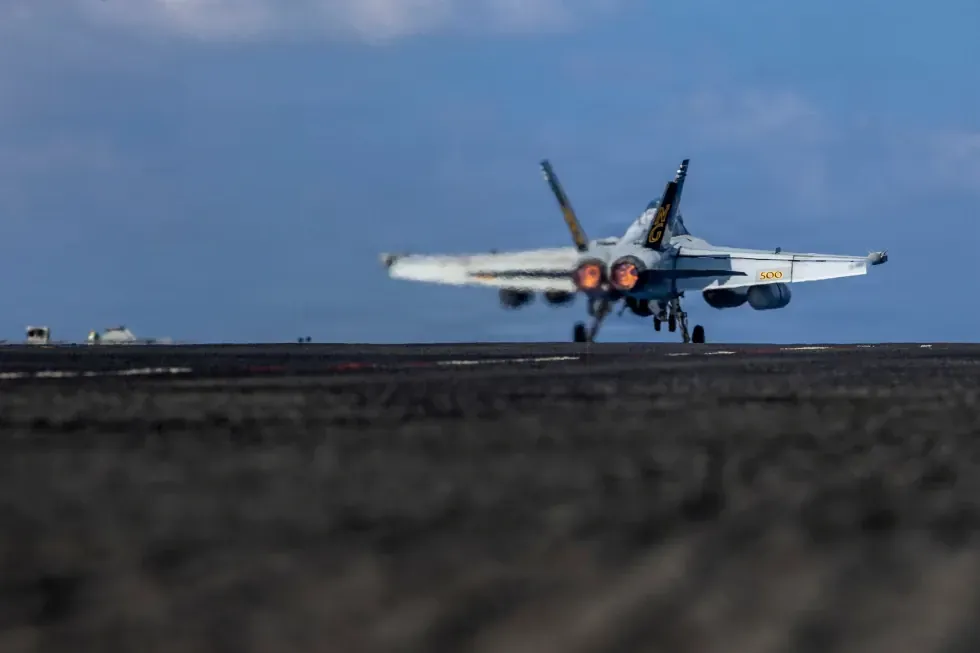
WASHINGTON (JN) – The U.S. military said a Navy fighter jet shot down an Iranian drone that approached the aircraft carrier USS Abraham Lincoln in the Arabian Sea, an incident that unfolded alongside a separate encounter involving a U.S.-flagged merchant vessel in the Strait of Hormuz. American officials described the drone’s approach as “aggressive,” while Iran said it was reviewing what it called an interruption to the aircraft’s mission.
The developments come at a delicate moment, with Washington and Tehran signaling interest in renewed talks over Iran’s nuclear program even as military activity in the region has intensified. The episode highlights the persistent risk of miscalculation in waterways that carry a significant share of the world’s energy trade.
U.S. Central Command said the drone continued toward the carrier “despite de-escalatory measures taken by U.S. forces operating in international waters.” Capt. Tim Hawkins, a CENTCOM spokesman, said the aircraft’s intent was “unclear” but that the decision to engage was taken to protect the ship and its personnel.
According to the statement, an F-35C fighter from the Lincoln shot down the drone, identified by U.S. officials as a Shahed-139, when the carrier was roughly 500 miles (800 kilometers) from Iran’s southern coast. No U.S. personnel were injured and no equipment was damaged.
Iranian state media reported that the Islamic Revolutionary Guard Corps was investigating the disruption to the drone’s flight. The semiofficial Tasnim news agency said the drone transmitted imagery back before contact was lost.
Merchant vessel encounter in the Strait of Hormuz
Hours after the aerial incident, U.S. officials said Iranian Revolutionary Guard boats and a Mohajer drone approached the U.S.-flagged and U.S.-crewed tanker Stena Imperative in the Strait of Hormuz at high speed and threatened to board it. The guided-missile destroyer USS McFaul responded and escorted the tanker, with additional air support provided by the U.S. Air Force, according to CENTCOM. The vessel later continued its voyage without further incident.
Iran did not immediately issue a detailed public account of the tanker encounter. Previous confrontations in the narrow strait, which links the Persian Gulf to global markets, have involved reciprocal accusations over unsafe maneuvers and sovereignty.
Talks still planned amid military signaling
Despite the incidents, officials on both sides said discussions over Iran’s nuclear program were still expected in the coming days. U.S. special envoy Steve Witkoff is in the region, and President Donald Trump told reporters that “we are negotiating with them right now,” declining to specify a venue.
Iranian President Masoud Pezeshkian said he had instructed the foreign minister to pursue “fair and equitable negotiations” with Washington. Foreign Ministry spokesman Esmail Baghaei told state television that details, including the location, were still under discussion. Turkey and Oman are among countries that have offered to host, according to Iranian media.
The juxtaposition of diplomatic overtures and military friction is familiar in U.S.–Iran relations. Analysts note that tactical encounters at sea and in the air often occur even as backchannel or formal talks proceed, raising the stakes for disciplined communication on both sides.
Expanded U.S. military presence in the region
The Abraham Lincoln carrier strike group arrived in the region recently, adding thousands of service members and multiple ships to an already substantial U.S. footprint. The group joined destroyers and littoral combat ships operating in nearby waters, while open-source flight-tracking has shown a stream of U.S. military cargo aircraft heading toward Middle Eastern bases in recent weeks.
U.S. officials have framed the deployments as defensive and intended to deter attacks on American forces and commercial shipping. The United States maintains several major installations across the region, including Al Udeid Air Base in Qatar, which serves as a forward headquarters for Central Command.
The current posture echoes earlier periods when Washington surged air defenses and naval assets after strikes on Iranian nuclear facilities and amid concerns over potential retaliation. Iran has previously launched missiles toward U.S. positions in the region following such episodes.
Background of renewed strain
Tensions have risen again after months of unrest inside Iran tied initially to economic pressures before broadening into political protests. Washington has publicly criticized Tehran’s response while also pressing for a renewed nuclear agreement. U.S. officials say military pressure and diplomacy can proceed in parallel; Iranian officials have signaled conditional openness to talks.
Maritime and aerial encounters in the Gulf and adjacent waters are not uncommon, but the proximity of advanced aircraft and naval vessels leaves little room for error. Both sides have at times accused the other of unsafe behavior while asserting a right to operate in international waters and airspace.
For now, neither Washington nor Tehran has indicated an intent to escalate beyond the immediate incidents. But with additional forces in theater and negotiations still unsettled, the episode underscores how quickly routine patrols can intersect with broader strategic tensions.
This article was rewritten by JournosNews.com based on verified reporting from trusted sources. The content has been independently reviewed, fact-checked, and edited for accuracy, neutrality, tone, and global readability in accordance with Google News and AdSense standards.
All opinions, quotes, or statements from contributors, experts, or sourced organizations do not necessarily reflect the views of JournosNews.com. JournosNews.com maintains full editorial independence from any external funders, sponsors, or organizations.
Stay informed with JournosNews.com — your trusted source for verified global reporting and in-depth analysis. Follow us on Google News, BlueSky, and X for real-time updates.