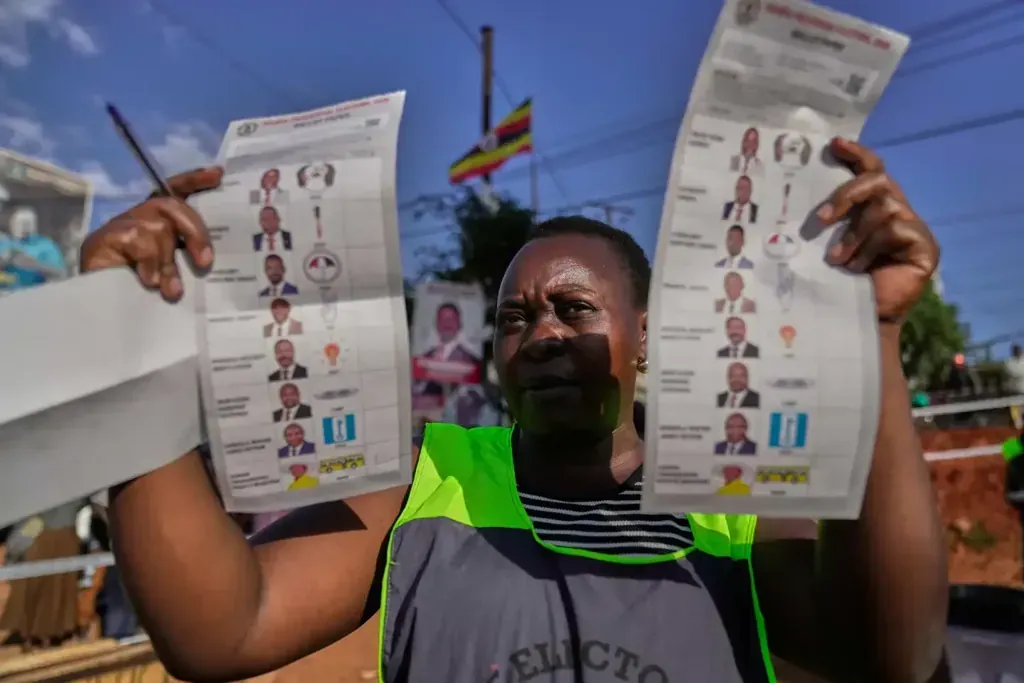
KAMPALA, Uganda (Journos News) – Uganda’s long-serving President Yoweri Museveni held a commanding early lead on Friday as provisional results emerged from a tense presidential election marked by an internet shutdown, voting delays, and opposition allegations of widespread irregularities. The vote unfolded under heavy security, with restrictions that opposition figures say undermined transparency and voter participation.
With results still being tallied, the election has renewed scrutiny of Uganda’s political landscape, where power has not changed hands peacefully since independence in 1962. The outcome, if confirmed, would extend Museveni’s rule into a fifth decade, reinforcing a system increasingly shaped by security forces and institutional continuity.
Early results and vote tallying
Provisional figures released from about half of the country’s polling stations showed Museveni with more than 70% of the vote, according to early counts cited by election officials. His main challenger, opposition leader Robert Kyagulanyi — widely known as Bobi Wine — was reported to have secured around 19%.

The slow release of results followed delays at some polling stations and a nationwide internet shutdown that began ahead of voting. Authorities have previously justified such measures as necessary for security, while critics say they limit independent monitoring and the flow of information during critical electoral periods.
A presidency approaching five decades
Museveni, 81, has ruled Uganda for 40 years and already holds one of the longest tenures of any African leader. His leadership has been characterized by stability in parts of the country, alongside persistent criticism over democratic space, term limits, and the concentration of power.
In recent years, observers and opposition figures have pointed to the growing role of the military in governance. The armed forces are led by Museveni’s son, Muhoozi Kainerugaba, a factor that has intensified debate over succession and civil-military relations in the East African nation.
Opposition allegations and security presence
Kyagulanyi, a musician-turned-politician who has positioned himself as a symbol of political change, said he was unable to leave his home to vote on Thursday. He alleged that several of his polling agents, particularly in rural areas, were detained before voting began, limiting the opposition’s ability to observe the count.
Security forces maintained a visible presence throughout the campaign and on election day. Police and military units were deployed across Kampala and other urban centers, with particularly heavy security outside Kyagulanyi’s residence after the vote.
A police spokesperson told local broadcaster NBS that Kyagulanyi was considered “a person of interest” and that the deployment was intended for his protection. The opposition has rejected that explanation, arguing the measures amounted to intimidation.
Claims of ballot stuffing and arrests
In a post on X on Thursday, Kyagulanyi said a senior party official responsible for Uganda’s western region had been arrested. He also alleged “massive ballot stuffing everywhere,” accusations that authorities have denied.
Western Uganda is widely regarded as a stronghold of the ruling party, and the absence of opposition polling agents during counting could place challengers at a disadvantage. To counter this, Kyagulanyi had urged supporters to document alleged irregularities at polling stations and to help “protect the vote.”
During the campaign, he said his supporters were harassed and dispersed with tear gas. He frequently appeared at rallies wearing a flak jacket and helmet, citing security concerns.
Echoes of previous elections
The current contest mirrors tensions seen in the previous presidential election five years ago, when Museveni officially won 58% of the vote to Kyagulanyi’s 35%. Kyagulanyi rejected those results, alleging the process was rigged in favor of the incumbent.
Museveni, after casting his ballot on Thursday, defended the use of biometric voting machines in the current election, saying they were intended to secure the process. He also accused the opposition of attempting to infiltrate earlier elections.
A familiar test for Uganda’s democracy
Uganda’s electoral history has been marked by disputed outcomes and the absence of a peaceful transfer of presidential power since independence from Britain in 1962. International observers have repeatedly called for reforms to strengthen electoral institutions, ensure equal campaigning conditions, and safeguard civil liberties.
As counting continues, attention remains focused on whether the final results will be accepted by all sides — and on how authorities respond to opposition concerns in the days ahead.
This article was rewritten by JournosNews.com based on verified reporting from trusted sources. The content has been independently reviewed, fact-checked, and edited for accuracy, neutrality, tone, and global readability in accordance with Google News and AdSense standards.
All opinions, quotes, or statements from contributors, experts, or sourced organizations do not necessarily reflect the views of JournosNews.com. JournosNews.com maintains full editorial independence from any external funders, sponsors, or organizations.
Stay informed with JournosNews.com — your trusted source for verified global reporting and in-depth analysis. Follow us on Google News, BlueSky, and X for real-time updates.