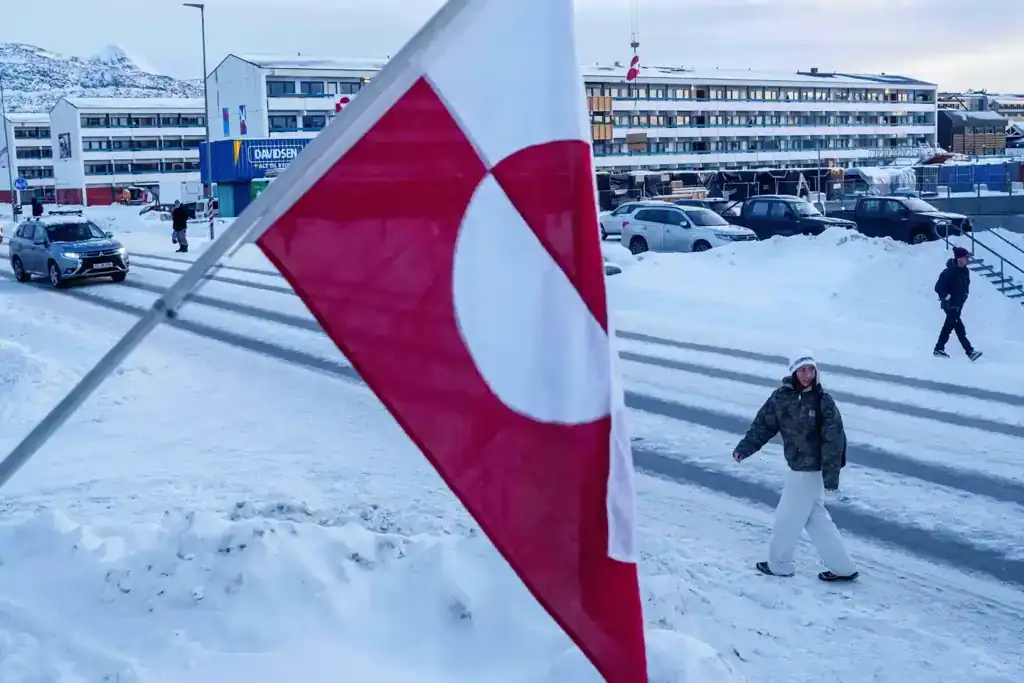
NUUK, Greenland (Journos News) – U.S. President Donald Trump’s renewed insistence that the United States should take ownership of Greenland — including comments suggesting force could be used — has thrust the Arctic island into an uneasy global spotlight, unsettling residents and straining relations with Denmark.
Greenland, a vast but sparsely populated territory of about 57,000 people, is a self-governing region within the Kingdom of Denmark. While Washington has long maintained a strategic military presence on the island, Trump’s language has marked a sharp departure from established diplomatic norms, prompting Danish officials to acknowledge a “fundamental disagreement” with the U.S. administration following talks in Washington this week.
For many Greenlanders, the dispute is no longer an abstract geopolitical debate. Local officials say it has begun to affect daily life, particularly among children and families, as uncertainty and anxiety spread across the island’s tight-knit communities.

Naaja Nathanielsen, a Greenlandic minister, told lawmakers in the British Parliament that the rhetoric has been deeply disruptive. “People are not sleeping, children are afraid, and it just fills everything these days,” she said, describing a population struggling to understand why its future has become a subject of international confrontation.
Perceived attack on Greenlandic culture
Trump has repeatedly downplayed Denmark’s defense capabilities in Greenland, at one point referring dismissively to “two dog sleds.” For many Greenlanders, that remark cut far deeper than its flippant tone suggested.
Mari Laursen, a former fishing trawler worker now studying law, said such comments amount to an insult to Greenland’s history and identity. “By saying that, Trump is undermining us as a people,” she told the Associated Press.
Laursen pointed to World War II, when Greenlandic hunters using dog sleds worked alongside U.S. forces to monitor Nazi German activity on the island. In the Arctic’s extreme terrain, she said, traditional methods were often more effective than modern military hardware.
“The Arctic climate and environment is so different from what they are used to with warships and helicopters and tanks,” Laursen said. “A dog sled is more efficient. It can go where no warship and helicopter can go.”
Her comments reflect a broader frustration among Greenlanders who feel their knowledge of the region — and their long-standing cooperation with the United States — is being dismissed or trivialized.
Skepticism over security claims
Trump has also justified his interest in Greenland by citing alleged threats from Russian and Chinese vessels operating near the island. Many locals say those claims do not align with what they observe on the water.
“I think he should mind his own business,” said Lars Vintner, a heating engineer in Nuuk. He said that despite frequent sailing and hunting trips, he has never encountered the foreign military presence described by Trump.
“We are only 57,000 people,” Vintner said. “The only Chinese I see is when I go to the fast food market.”
At Nuuk’s small harbor, fisherman Gerth Josefsen echoed that skepticism as he prepared his lines. He said he had seen only a single Russian fishing vessel in the past decade. “I don’t see them,” he said simply.
Such accounts underscore a gap between Washington’s strategic narrative and the lived experience of those who depend on Greenland’s seas for their livelihoods.
Minerals, not security, residents say
Some Greenlanders believe Trump’s interest is driven less by security concerns than by the island’s untapped natural resources, including rare earths and other critical minerals increasingly sought by major powers.
Maya Martinsen, a 21-year-old shop worker, said she doubts the U.S. president’s stated motives. “I know it’s not national security,” she said. “I think it’s for the oils and minerals that we have that are untouched.”
Martinsen described the situation as feeling like a commercial transaction rather than a partnership between allies. Still, she welcomed recent talks between American, Danish, and Greenlandic officials at the White House, saying they showed alignment between Copenhagen and Nuuk despite ongoing debates over Greenlandic independence.
“It is nerve-wracking that the Americans aren’t changing their mind,” she said, adding that she felt reassured by Denmark’s announcement that it would send additional allied support to Greenland.
Reliance on Denmark’s social model
Others worry about what a transfer of sovereignty could mean for Greenland’s social protections, which are closely tied to Denmark’s welfare system.
Tuuta Mikaelsen, a 22-year-old student, said she hopes the U.S. administration has heard the clear message from Danish and Greenlandic leaders to “back off.” She said joining the United States would put at risk essential services Greenlanders take for granted.
“In Greenland there are laws and stuff, and health insurance — we can go to the doctors and nurses and we don’t have to pay anything,” she said. “I don’t want the U.S. to take that away from us.”
Her concerns highlight how the debate extends beyond geopolitics into questions of everyday security, healthcare, and social stability.
At the center of a media storm
The controversy has also placed Greenlandic politicians under intense international scrutiny. Juno Berthelsen, a member of parliament from the Naleraq opposition party, which supports independence, said he has given multiple media interviews daily for the past two weeks.
Despite Naleraq’s pro-independence stance, Berthelsen said aggressive rhetoric from Washington is unhelpful. If he were able to address Trump and Vice President JD Vance directly, he said, he would urge them to tone down their language and recommit to diplomacy.
“A lot of Republicans as well as Democrats are not in favor of having such an aggressive rhetoric and talk about military intervention,” Berthelsen said. “We would tell them to move beyond that and continue this diplomatic dialogue.”
Ultimately, he added, the question of Greenland’s future belongs to its people alone. “It is our country,” he said. “Greenland belongs to the Greenlandic people.”
This article was rewritten by JournosNews.com based on verified reporting from trusted sources. The content has been independently reviewed, fact-checked, and edited for accuracy, neutrality, tone, and global readability in accordance with Google News and AdSense standards.
All opinions, quotes, or statements from contributors, experts, or sourced organizations do not necessarily reflect the views of JournosNews.com. JournosNews.com maintains full editorial independence from any external funders, sponsors, or organizations.
Stay informed with JournosNews.com — your trusted source for verified global reporting and in-depth analysis. Follow us on Google News, BlueSky, and X for real-time updates.