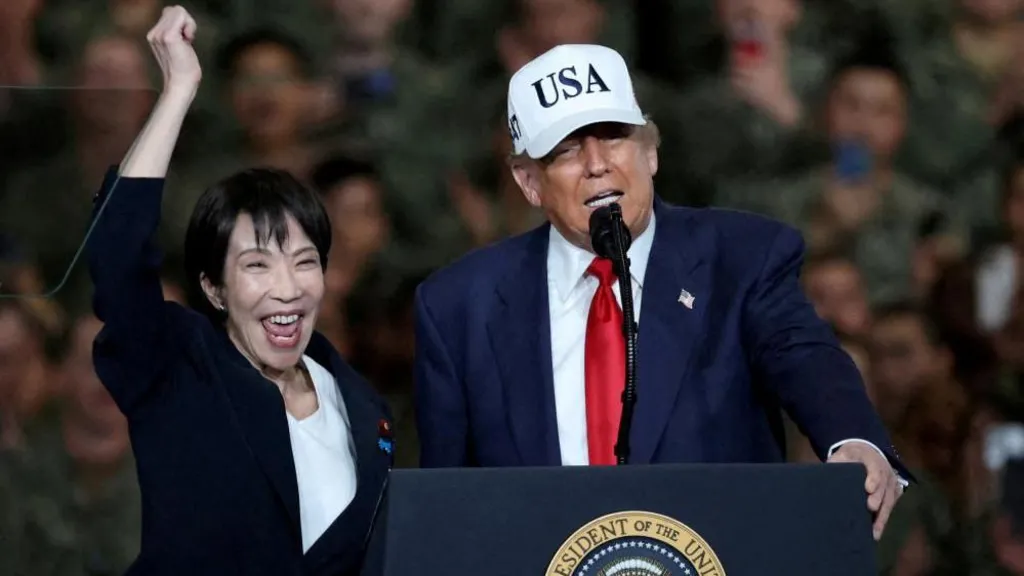
Tokyo, Japan (JN) – A rare public endorsement by a sitting US president has entered Japan’s election debate days before voters head to the polls. Donald Trump’s praise for Prime Minister Sanae Takaichi highlights how closely Tokyo’s domestic politics are now intertwined with the stability of its alliance with Washington.
The endorsement comes at a moment when trade negotiations, defence policy, and regional tensions with China are shaping Japan’s political conversation. For Takaichi, who called the snap election to seek a public mandate after taking office, the timing reinforces her positioning as a leader able to manage relations with the United States during an unpredictable period in global diplomacy.
It also underlines the strategic importance of Japan in Washington’s Indo-Pacific outlook, where security coordination and economic cooperation increasingly intersect.
Trump posted on Truth Social on Thursday that Takaichi had “already proven to be a strong, powerful, and wise leader… one that truly loves her country,” adding that “she will not let the people of Japan down.”
It is unusual for US presidents to publicly endorse candidates in foreign elections, though Trump has previously voiced support for leaders including Argentina’s Javier Milei and Hungary’s Viktor Orbán.
A relationship tested by tariffs and trade
The endorsement follows months of delicate negotiations between Tokyo and Washington after Trump threatened to impose a 25% tariff on Japanese imports earlier this year. Japan subsequently agreed in July to invest $550 billion in the United States, a deal that led Washington to lower planned levies to 15%.
The trade arrangement has become a key reference point in Takaichi’s effort to portray herself as capable of managing economic and diplomatic friction with Japan’s closest ally. The episode also illustrated how economic policy now overlaps with national security considerations in the US-Japan relationship.
Takaichi, 64, became prime minister in October after winning her party’s leadership race and securing parliamentary backing. Within weeks, she called a snap election to seek broader public legitimacy for her government.
Early diplomacy and visible symbolism
Shortly after taking office, Takaichi hosted Trump in Tokyo with full state honours at the Akasaka Palace. Images of her touring the USS George Washington aircraft carrier alongside the US president were widely circulated, reinforcing the visual narrative of close defence ties.
Both leaders spoke publicly of a “golden age” in bilateral relations and announced cooperation on rare earth minerals, a sector seen as strategically important for technology supply chains and energy transition industries.
Trump, in his post, referred to progress in national security cooperation and economic ties, and said he plans to host Takaichi at the White House on 19 March.
The symbolism of those exchanges has been central to Takaichi’s political messaging, as she presents herself as a leader with direct access to Washington at a time of shifting global alliances.
Defence spending and shared priorities
Trump has repeatedly called on allies to increase defence spending, and Takaichi has taken a similar position domestically, arguing that Japan must invest more heavily in its own security capabilities as regional risks grow.
Public debate in Japan has gradually shifted toward greater acceptance of defence expansion, particularly as concerns rise over tensions in the Taiwan Strait and maritime disputes in the East China Sea.
Takaichi’s stance has drawn attention from Beijing. In November, she suggested that Japan’s Self-Defense Forces could respond if China were to attack Taiwan. She has since declined to withdraw those remarks.
China, Taiwan, and regional signalling
Trump’s endorsement comes amid strained relations between Tokyo and Beijing, which have deteriorated over territorial, security, and historical issues. The US president’s comments also followed a phone call with Chinese leader Xi Jinping, during which Trump described their relationship as “extremely good.”
Chinese state media reported that Xi emphasised Taiwan as “the most important issue” in US-China relations and urged Washington to be cautious in supplying weapons to the self-governed island, which Beijing claims as its territory.
Against this backdrop, Trump’s public support for Takaichi is being read by analysts as a signal beyond Japan’s electorate, reaching audiences across the region.
Election stakes beyond the vote
Opinion polls indicate Takaichi is well placed heading into Sunday’s vote, though winning the election would mark only the beginning of a more complex governing phase.
Her administration will face the challenge of addressing Japan’s sluggish economic growth while navigating an increasingly delicate balance between the United States, its primary security ally, and China, its largest trading partner.
How she manages those relationships may define her tenure more than the election itself.
For voters, the endorsement from Washington adds an international dimension to a campaign already shaped by concerns over security, economic resilience, and Japan’s role in a rapidly changing Indo-Pacific landscape.
This article was rewritten by JournosNews.com based on verified reporting from trusted sources. The content has been independently reviewed, fact-checked, and edited for accuracy, neutrality, tone, and global readability in accordance with Google News and AdSense standards.
All opinions, quotes, or statements from contributors, experts, or sourced organizations do not necessarily reflect the views of JournosNews.com. JournosNews.com maintains full editorial independence from any external funders, sponsors, or organizations.
Stay informed with JournosNews.com — your trusted source for verified global reporting and in-depth analysis. Follow us on Google News, BlueSky, and X for real-time updates.