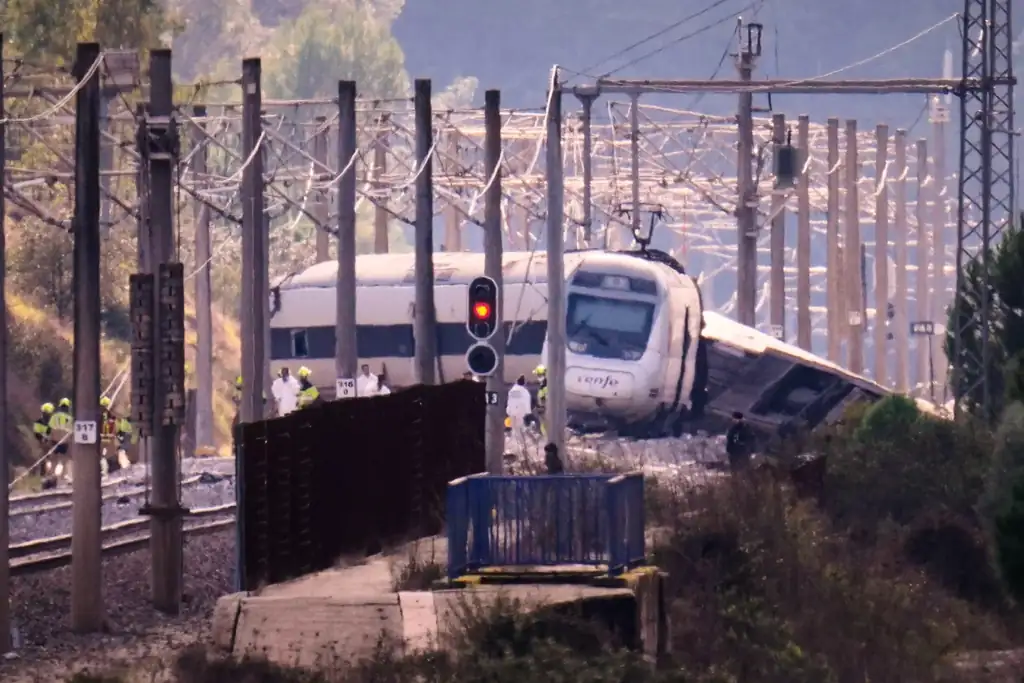
ADAMUZ, Spain (JN) – A deadly collision between two high-speed trains in southern Spain has killed at least 40 people, regional authorities said, as rescue teams warned the toll could rise with parts of the wreckage still being searched.
The crash, which occurred late Sunday on a key rail corridor linking Andalusia with Madrid, has shaken a country that prides itself on having one of Europe’s most advanced and extensive high-speed rail networks. Officials declared three days of national mourning as families gathered across several cities to seek information about missing relatives.
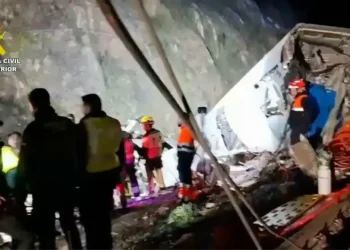
Emergency services said all survivors had been rescued by early Monday, but recovery operations were continuing amid twisted metal and derailed carriages scattered along the track near the town of Adamuz, in the province of Córdoba.

Collision on a busy high-speed route
Juanma Moreno, president of the Andalusian regional government, confirmed the revised death toll during an afternoon briefing, saying efforts were still under way to recover bodies from two severely damaged carriages.
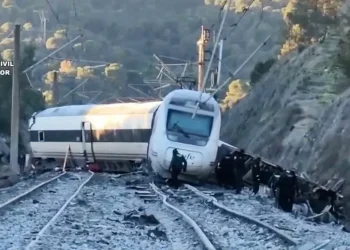
The crash happened at about 7:45 p.m. on Sunday when the rear section of a train traveling from Málaga to Madrid derailed. The out-of-control carriages struck an oncoming train heading from Madrid to the southern city of Huelva, rail infrastructure operator Adif said.
The impact caused the leading cars of the second train to leave the tracks and plunge down a slope of around four meters. Moreno said some victims were found hundreds of meters from the point of collision, underlining the force of the impact.
Transport Minister Óscar Puente said the second train, which was carrying close to 200 passengers, absorbed most of the collision. Its first two carriages derailed, and authorities believe the majority of fatalities occurred there.
Search, rescue, and identification
Andalusian emergency services reported that 41 people remained hospitalized on Monday, including 12 in intensive care units. Another 81 passengers were treated and discharged later in the day.
Authorities also turned their attention to supporting hundreds of distraught relatives. Offices were opened in Córdoba, Madrid, Málaga, Huelva, and Seville to assist families and collect DNA samples to help identify victims.
Francisco Carmona, Córdoba’s fire chief, told Spanish radio that rescuers faced harrowing conditions. “There were moments when we had to remove the dead to get to the living,” he said.
A sports center in Adamuz was converted into a temporary medical and support facility, while the Spanish Red Cross established a help center for both emergency workers and families seeking information.
A nation in mourning
Prime Minister Pedro Sánchez declared three days of national mourning and traveled to Adamuz on Monday. “Today is a day of pain for all of Spain,” he said, praising local residents who helped emergency crews tend to injured passengers through the night.
The crash has stunned a nation where high-speed rail is widely viewed as a safe, affordable, and modern form of transport. Spain has invested heavily in its rail network over the past three decades and now operates the largest high-speed system in Europe.
Video released by the Civil Guard showed the scale of the destruction: carriages ripped open, seats strewn across the gravel, and one train car bent around a concrete pillar. Passengers described escaping through smashed windows, some using emergency hammers to break the glass.
Transport disruption across southern Spain
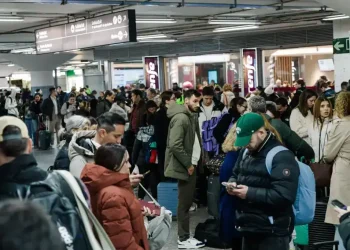
Rail services between Madrid and several Andalusian cities were suspended on Monday, causing widespread disruption. National airline Iberia added extra flights to Seville and Málaga to accommodate stranded travelers, while bus operators reinforced services across the region.
Officials said restoring rail traffic would take time, as investigators needed access to the scene and damaged infrastructure had to be assessed.
Cause under investigation
Puente said the cause of the accident was not yet known, describing it as “truly strange” given that it occurred on a flat section of track renovated in May. The train that derailed was less than four years old, he added.
The Málaga–Madrid service was operated by Iryo, a private company owned by Italy’s Trenitalia, while the oncoming train belonged to state-run operator Renfe. According to Puente, the rear of the Iryo train derailed and collided with the front of the Renfe service.
An official investigation could take up to a month. Renfe president Álvaro Fernández told public radio RNE that both trains were traveling well below the line’s speed limit of 250 kilometers per hour. One was moving at 205 kph, the other at 210 kph, he said, adding that human error could be ruled out.
Fernández suggested the cause was likely related either to infrastructure or to the rolling stock of the derailed train. Iryo said in a statement that its train was manufactured in 2022 and had passed a safety inspection on Jan. 15.
The Spanish Union of Railway Drivers said it had warned national rail authorities last August about potential flaws on high-speed lines and had called for reduced speeds in certain areas until repairs were completed. Those recommendations included the line where Sunday’s crash occurred, the union said.
Rare tragedy on Spain’s high-speed network
Sunday’s collision marked the first fatal accident involving Spain’s high-speed rail system since the network’s inaugural line opened in 1992.
Spain now has more than 3,900 kilometers of high-speed track, according to the International Union of Railways. Renfe said more than 25 million passengers used its high-speed services in 2024, while Iryo entered the market in 2022 as the first private competitor on these routes.
The country’s deadliest rail disaster in recent decades occurred in 2013, when 80 people were killed after a train derailed in northwestern Spain on a conventional, non–high-speed section of track. Investigators later found that the train was traveling at more than twice the permitted speed.
As Spain grapples with the aftermath of the latest tragedy, officials have pledged a full and transparent investigation, even as families wait for answers and the nation mourns its dead.
This article was rewritten by JournosNews.com based on verified reporting from trusted sources. The content has been independently reviewed, fact-checked, and edited for accuracy, neutrality, tone, and global readability in accordance with Google News and AdSense standards.
All opinions, quotes, or statements from contributors, experts, or sourced organizations do not necessarily reflect the views of JournosNews.com. JournosNews.com maintains full editorial independence from any external funders, sponsors, or organizations.
Stay informed with JournosNews.com — your trusted source for verified global reporting and in-depth analysis. Follow us on Google News, BlueSky, and X for real-time updates.