ADAMUZ, Spain (Journos News) – Emergency crews in southern Spain continued recovery operations on Monday after a late-night collision between two high-speed trains left at least 39 people dead, with authorities warning the toll could still rise as mangled carriages are lifted from the tracks.
The crash, one of the deadliest rail accidents in Spain in more than a decade, occurred on a busy intercity route linking major southern cities with the capital, Madrid, disrupting services and prompting a national response from senior officials.
Investigators have yet to determine what caused the derailment and subsequent impact, which happened on a recently renovated stretch of railway and involved both public and private operators.
Spanish police said the confirmed death toll stood at 39 by Monday morning, while 159 people were injured, including five in critical condition and 24 listed as seriously hurt. Authorities cautioned that the number of fatalities may increase as heavy machinery is used to access crushed sections of the trains.
Collision on busy Andalusia route
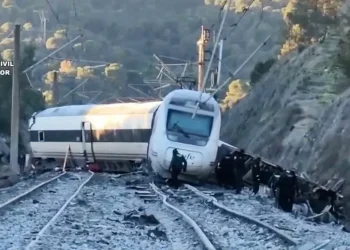
The accident occurred at around 7:45 p.m. on Sunday near the town of Adamuz, in the province of Córdoba, roughly 370 kilometers south of Madrid. According to rail infrastructure operator Adif, the rear portion of a high-speed train traveling from Málaga to Madrid derailed and collided with an oncoming service running from Madrid to the southern city of Huelva.

The second train, carrying nearly 200 passengers, bore the brunt of the impact. Spain’s Transport Minister, Óscar Puente, said the head of that train was struck after the first train left the rails, knocking its leading two carriages off the track and sending them down a four-meter embankment.
Puente said early indications suggested that most of the fatalities were concentrated in those front carriages. “The violence of the impact is evident when you see the condition of the cars,” he told reporters, adding that the full picture would only become clear once recovery work was complete.
Search continues amid twisted wreckage
Andalusia’s regional president, Juanma Moreno, said emergency services were still working through what he described as a mass of twisted metal. Firefighters and rescue teams labored overnight under floodlights, carefully cutting into the wreckage to reach trapped victims.
“It is likely that more victims will be found once the heavy machinery is brought in to lift the carriages,” Moreno said. He praised the efforts of first responders but acknowledged the grim expectations at the site.
Video footage and photographs from the scene showed train cars lying on their sides, windows shattered and metal frames crumpled. Survivors described chaotic moments immediately after the collision, with passengers climbing out through broken windows to escape.
Salvador Jiménez, a journalist with Spanish broadcaster RTVE who was traveling on one of the trains, said passengers used emergency hammers to break windows. “There was a moment when it felt like an earthquake,” he told the network by phone. “The train had clearly derailed.”
Emergency response and local impact
A nearby sports center in Adamuz was converted into a temporary medical facility to treat the injured, while the Spanish Red Cross set up an assistance center to support emergency services and families seeking information about passengers. Members of the Civil Guard and civil defense units remained on site throughout the night and into Monday.
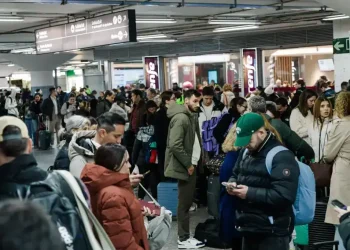
Hospitals across the region were placed on alert to receive casualties, and local authorities urged residents to avoid the area to allow rescue operations to continue unhindered. Train services between Madrid and several Andalusian cities were suspended on Monday, disrupting travel for thousands of passengers.
Investigation focuses on unusual circumstances
Transport Minister Puente described the crash as “truly strange,” noting that it occurred on a flat section of track that had been renovated as recently as May. He said the train that derailed was less than four years old and operated by Iryo, a private rail company, while the second train belonged to state-owned operator Renfe.
According to Puente, the back section of the Málaga–Madrid train left the track before colliding with the front of the oncoming service. When asked how long the investigation might take, he said preliminary findings could take up to a month, with a full inquiry likely to extend beyond that.
Rail safety experts are expected to examine signaling systems, track conditions, train speed, and operational procedures. Authorities have not suggested any single cause, and officials have urged caution against speculation while evidence is gathered.
National reaction and condolences
Spanish Prime Minister Pedro Sánchez expressed condolences to the families of the victims, calling the incident “a night of deep pain for our country” in a message posted on social media platform X. His office said Sánchez would visit the crash site later on Monday.
The government has pledged full support to the investigation and to those affected, including assistance for victims’ families and coordination with regional authorities.
Spain’s high-speed rail record
Spain operates Europe’s largest high-speed rail network, with more than 3,100 kilometers of track designed for trains traveling above 250 kilometers per hour, according to European Union data. High-speed rail is widely used, competitively priced, and generally regarded as safe.
Renfe said more than 25 million passengers traveled on its high-speed services in 2024. Despite that record, the country has experienced major rail disasters in the past. The deadliest this century occurred in 2013, when 80 people were killed after a train derailed in northwestern Spain. Investigators later concluded that excessive speed was a key factor in that crash.
As recovery operations continue near Adamuz, authorities say their immediate priority remains locating all victims and caring for the injured, while a detailed investigation seeks to explain how two high-speed trains came to collide on a modern Spanish rail line.
This article was rewritten by JournosNews.com based on verified reporting from trusted sources. The content has been independently reviewed, fact-checked, and edited for accuracy, neutrality, tone, and global readability in accordance with Google News and AdSense standards.
All opinions, quotes, or statements from contributors, experts, or sourced organizations do not necessarily reflect the views of JournosNews.com. JournosNews.com maintains full editorial independence from any external funders, sponsors, or organizations.
Stay informed with JournosNews.com — your trusted source for verified global reporting and in-depth analysis. Follow us on Google News, BlueSky, and X for real-time updates.