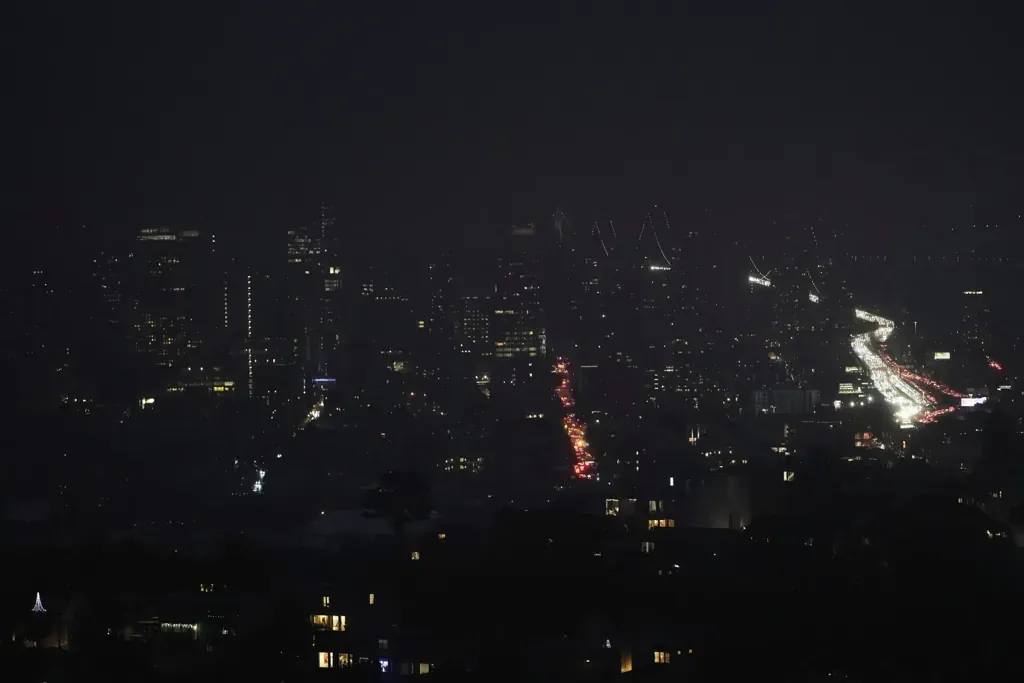
A large power outage left roughly 130,000 homes and businesses without electricity across San Francisco on Saturday afternoon, according to Pacific Gas and Electric Co. (PG&E), disrupting transit, shuttering businesses, and darkening streets in parts of the city.
The outage affected a broad section of northern San Francisco, beginning in neighborhoods including the Richmond District and Presidio and extending toward areas around Golden Gate Park. The blackout began in the early afternoon and expanded over several hours, ultimately impacting about one-third of PG&E’s customers in the city.
Scope of the outage
PG&E said the outage knocked out service to approximately 130,000 customers, making it one of the more significant power disruptions in San Francisco in recent years. The utility did not immediately provide a detailed explanation for the initial failure when contacted, and the cause was not fully confirmed during the early hours of the incident.
Residents across affected neighborhoods reported darkened intersections, nonfunctioning street lights, and closed storefronts. Social media posts and local media accounts showed restaurants and retail businesses closing mid-day, while holiday decorations in some areas went dark during one of the city’s busiest shopping weekends.
The blackout also affected public safety infrastructure, prompting city agencies to issue advisories to residents navigating traffic and public transportation.
San Francisco power outage disrupts transportation and city services
The San Francisco Department of Emergency Management said on X that “significant transit disruptions” were occurring citywide as a result of the power failure. Officials urged residents to avoid nonessential travel and to treat inoperative traffic signals as four-way stops.
City transportation agencies reported service changes and delays across multiple systems. San Francisco Municipal Transportation Agency (SFMTA) officials said some Muni bus routes were being rerouted or bypassing stops where power outages affected signals or station operations. Bay Area Rapid Transit (BART) said some stations were also being bypassed due to power-related issues, though trains continued to operate on limited or adjusted service.
Transit disruptions added to congestion on surface streets, particularly in areas where traffic signals were dark. Emergency officials emphasized caution for drivers, cyclists, and pedestrians as the outages persisted through the afternoon.
Fire at substation linked to some outages
Fire officials said at least part of the blackout was linked to a fire inside a PG&E substation near the intersection of 8th and Mission streets. The San Francisco Fire Department posted on X around 3:15 p.m. that crews were responding to the incident.
Authorities did not immediately say how much of the outage was directly attributable to the substation fire or whether other technical issues were involved. No injuries were reported in connection with the fire as of Saturday evening.
Substations play a critical role in converting and distributing electricity across dense urban areas, and incidents at such facilities can lead to cascading outages, particularly in older or heavily loaded grids.
Utility response and restoration timeline
By about 4 p.m., PG&E said it had stabilized the power grid and was not expecting additional customers to lose service. However, the utility cautioned that it could not immediately confirm when electricity would be fully restored to all affected areas.
PG&E said crews were assessing damage and working to safely bring systems back online. The company did not provide a firm restoration timeline, leaving many residents and business owners uncertain about how long the outage would last into the evening.
Power restoration in dense urban centers can take hours as utilities inspect equipment, isolate damaged components, and gradually re-energize circuits to avoid further failures.
Impact on businesses and daily life
The outage disrupted daily routines across a wide swath of the city. Restaurants, cafes, and small businesses reported closing early or operating on limited service due to a lack of power for lighting, payment systems, and refrigeration.
Residents in affected neighborhoods described using mobile phones for light and information, while some apartment buildings experienced elevator shutdowns and limited access to essential services.
The outage also coincided with a busy weekend period, amplifying its economic and social impact, particularly in commercial corridors near parks and transit hubs.
Broader context
San Francisco’s electrical grid, like those of many major U.S. cities, faces ongoing challenges related to aging infrastructure, high demand, and the complexity of serving dense urban environments. PG&E, California’s largest electric utility, has been under pressure in recent years to improve reliability while upgrading systems to reduce fire risk and withstand extreme weather.
While Saturday’s outage appeared to be linked at least in part to a localized substation fire, officials had not confirmed whether broader infrastructure issues contributed to the scale of the blackout.
City and utility officials said updates would be provided as crews continued restoration work and investigations into the cause of the outage progressed.
This article was rewritten by JournosNews.com based on verified reporting from trusted sources. The content has been independently reviewed, fact-checked, and edited for accuracy, neutrality, tone, and global readability in accordance with Google News and AdSense standards.
All opinions, quotes, or statements from contributors, experts, or sourced organizations do not necessarily reflect the views of JournosNews.com. JournosNews.com maintains full editorial independence from any external funders, sponsors, or organizations.
Stay informed with JournosNews.com — your trusted source for verified global reporting and in-depth analysis. Follow us on Google News, BlueSky, and X for real-time updates.