Moscow, Russia (Journos News) – A senior Russian military officer has been killed in a car bombing in Moscow, Russian authorities said, in the latest targeted attack involving high-ranking figures since the start of the war in Ukraine.
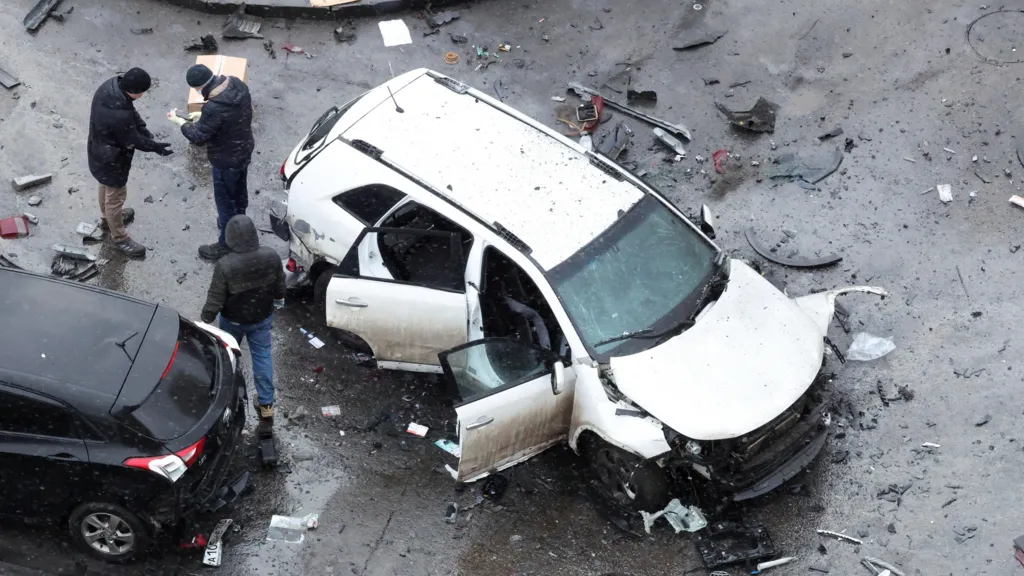
Russia’s Investigative Committee said Lieutenant General Fanil Sarvarov, 56, died on Monday after an explosive device planted beneath a vehicle detonated in the south of the capital. Sarvarov later succumbed to his injuries in hospital, investigators said.
The blast occurred in a car park near an apartment complex. Images released by Russian media showed a white vehicle heavily damaged, with doors blown off and debris scattered among nearby parked cars.
Investigation and official response
The Investigative Committee said it had opened a criminal case into murder and the illegal trafficking of explosives. Forensic specialists and investigators were dispatched to the scene shortly after the explosion.
In a statement, the committee said one line of inquiry was whether the bombing involved Ukrainian intelligence services. No evidence was publicly presented, and Ukraine has not commented on the allegation.
Kremlin spokesman Dmitry Peskov said President Vladimir Putin was informed of Sarvarov’s death shortly after it occurred.
Russian authorities did not immediately say whether any suspects had been identified or detained.
Sarvarov’s military career
According to the Investigative Committee, Sarvarov served as head of the Russian armed forces’ operational training department, a senior role within the military hierarchy.
Russian media reports said he had taken part in combat operations during the Ossetian-Ingush conflict and the Chechen wars in the 1990s and early 2000s. He was also reported to have led Russian military operations in Syria between 2015 and 2016, during Moscow’s intervention in support of the government of President Bashar al-Assad.
The Russian defence ministry has not issued a separate statement on his death.
Pattern of targeted attacks
Sarvarov’s killing comes amid a series of high-profile attacks in Moscow since Russia launched its full-scale invasion of Ukraine in February 2022. Several military officials and figures linked to the Kremlin have been targeted, often using explosive devices concealed in vehicles.
In August 2022, Darya Dugina, the daughter of a prominent nationalist commentator and close ally of the Kremlin, was killed in a suspected car bombing outside Moscow. Russian authorities accused Ukrainian security services of involvement, a claim Kyiv denied.
Last April, General Yaroslav Moskalik was killed in another car bomb attack in the capital. In December 2024, General Igor Kirillov died after a device hidden in a scooter was detonated remotely, according to Russian investigators.
Following Kirillov’s death, a Ukrainian source told the BBC that Ukraine’s security service was responsible. The claim was never confirmed on the record, and Ukrainian authorities did not publicly acknowledge involvement. As a matter of policy, Kyiv rarely comments on or claims responsibility for targeted attacks inside Russia.
Security implications
The repeated use of car bombs and other remotely detonated devices has raised questions about security in Moscow, even as Russian authorities have said they are taking measures to protect senior officials.
The Investigative Committee has not indicated whether Sarvarov had received any specific security protection at the time of the attack. It also did not say how the explosive device was planted or when it may have been armed.
Analysts say the attacks underscore the extent to which the conflict linked to Ukraine has spilled beyond the battlefield, though direct responsibility is often difficult to establish and rarely acknowledged publicly.
For now, Russian officials say the investigation into Sarvarov’s killing is continuing, with multiple scenarios under consideration.
This article was rewritten by JournosNews.com based on verified reporting from trusted sources. The content has been independently reviewed, fact-checked, and edited for accuracy, neutrality, tone, and global readability in accordance with Google News and AdSense standards.
All opinions, quotes, or statements from contributors, experts, or sourced organizations do not necessarily reflect the views of JournosNews.com. JournosNews.com maintains full editorial independence from any external funders, sponsors, or organizations.
Stay informed with JournosNews.com — your trusted source for verified global reporting and in-depth analysis. Follow us on Google News, BlueSky, and X for real-time updates.