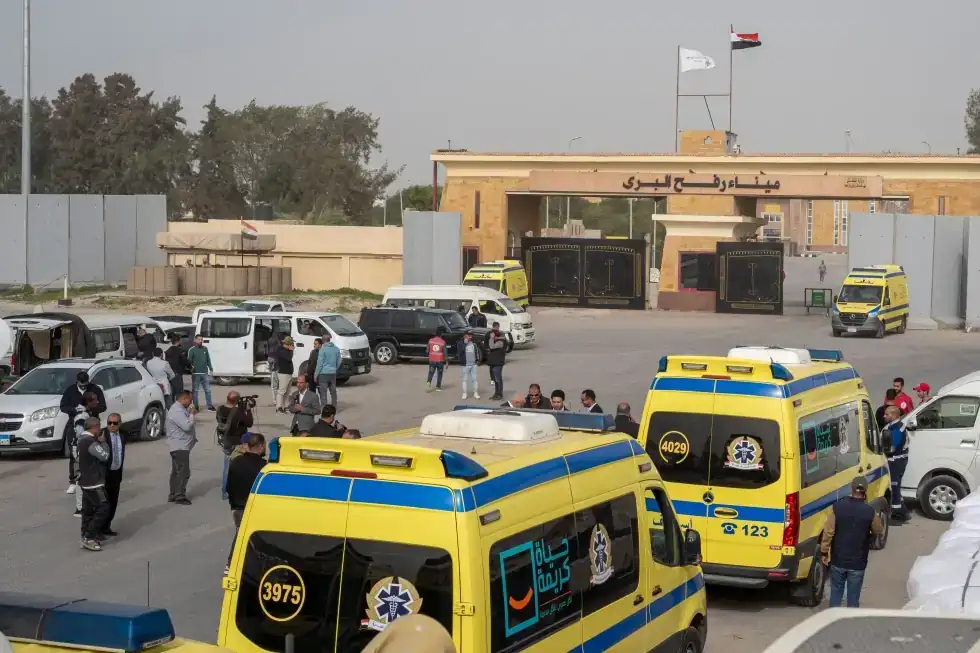
CAIRO (JN) – The long-closed Rafah border crossing between Gaza and Egypt reopened late Monday, allowing a limited number of Palestinians to return to the territory and enabling medical evacuations to proceed. The reopening marks a cautious step in implementing the Israel-Hamas ceasefire but remains constrained by strict limitations and ongoing security checks.
A small convoy of ambulances transported patients from Gaza into Egypt, while a bus carrying Palestinian returnees arrived at a hospital compound in Khan Younis. Observers noted long queues and delays, underscoring the logistical challenges at the isolated crossing. Despite expectations of broader movement, only a handful of people were permitted to cross initially, far below the 50 travelers per direction that officials had anticipated.
Gaza health authorities estimate that roughly 20,000 residents, including children, require medical care outside the territory. Thousands more seek to leave or return home as the border slowly reopens. The crossing had been sealed since Israeli forces took control in May 2024, halting most movement in and out of Gaza. Israeli and Egyptian authorities will continue vetting travelers for security purposes.
Medical Evacuations and Egyptian Support
Patients from Gaza face a six-hour journey to reach hospitals in Cairo, where around 150 facilities are prepared to provide care. The Egyptian Red Crescent has set up temporary “safe spaces” near the border to assist evacuees, while the World Health Organization reports that more than 10,000 patients have left Gaza since the war began.
Rajaa Abu Mustafa, a mother from Khan Younis, said her 17-year-old son Mohamed, who lost sight in one eye during last year’s fighting, was among those scheduled for evacuation. “The health ministry called and told us we will travel to Egypt for his treatment,” she said.
Israel’s blockade of patient transfers to East Jerusalem and the West Bank has further complicated medical evacuations. The United Nations has urged additional countries to accept patients from Gaza to ensure timely access to care.
Return of Displaced Palestinians
Alongside medical transfers, a small number of Palestinians who fled Gaza early in the war were allowed to return. Iman Rashwan expressed relief that her mother and sister, who had left due to her mother’s heart condition, would finally come home. “They called us yesterday and said they will leave. We have been waiting for it for too long,” she said.
The Rafah crossing will be monitored by European Union border agents, with a limited Palestinian presence. Israel and Egypt continue to vet travelers, and Cairo has emphasized that the crossing must remain open to allow residents to enter and exit Gaza safely.
Ongoing Violence Despite Ceasefire
While the crossing reopened, violence persisted in Gaza. Hospital authorities reported that an Israeli naval strike killed a 3-year-old boy in a tent camp in Khan Younis. Separately, Israel said it killed four Palestinians near northern Gaza who approached troops in areas under Israeli control.
Since the ceasefire took effect on October 10, over 520 Palestinians have been killed by Israeli fire, part of the more than 71,800 deaths recorded since the war began in October 2023, according to Gaza’s health ministry. These figures include both civilians and fighters and are monitored by U.N. agencies and independent experts.
Rafah Crossing as Ceasefire Milestone
Israel had initially resisted reopening Rafah, citing security concerns and Hamas’ use of the crossing for arms smuggling. The process gained momentum following the recovery of the last hostage in Gaza. The reopening is a key element of the second phase of the U.S.-brokered ceasefire, which also includes forming a new Palestinian governing committee in Gaza, deploying international security forces, disarming Hamas, and initiating reconstruction efforts.
The truce has halted more than two years of fighting that began with the Hamas-led attack on southern Israel in October 2023. The first phase focused on hostage exchanges, humanitarian aid delivery, and partial Israeli troop withdrawal. The reopening of Rafah now signals tentative progress toward the more complex second phase of the agreement.
This article was rewritten by JournosNews.com based on verified reporting from trusted sources. The content has been independently reviewed, fact-checked, and edited for accuracy, neutrality, tone, and global readability in accordance with Google News and AdSense standards.
All opinions, quotes, or statements from contributors, experts, or sourced organizations do not necessarily reflect the views of JournosNews.com. JournosNews.com maintains full editorial independence from any external funders, sponsors, or organizations.
Stay informed with JournosNews.com — your trusted source for verified global reporting and in-depth analysis. Follow us on Google News, BlueSky, and X for real-time updates.