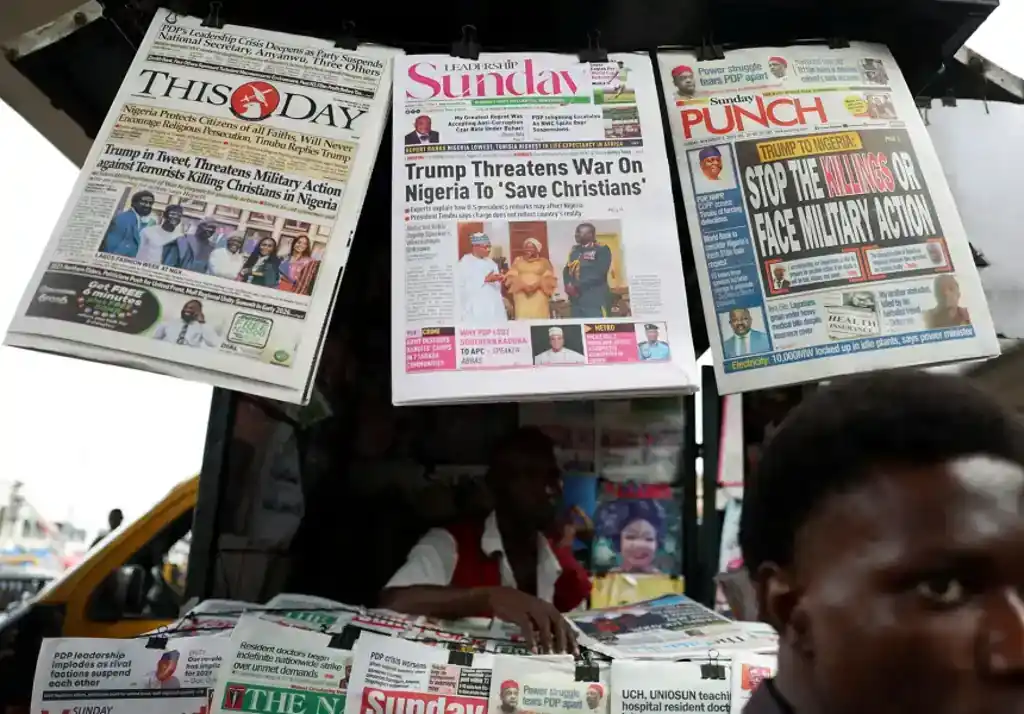
Nigeria, Africa (Journos News) – President Donald Trump ordered U.S. airstrikes against suspected Islamic State militants in northwestern Nigeria over Christmas. He said the action responded to violence against Christians. Nigerian officials confirmed the strikes were coordinated with Abuja. However, analysts say Nigeria’s violence stems from a wider security crisis that affects many communities.
Trump said the United States carried out the strikes on Christmas Day. The targets were camps linked to Islamic State in Nigeria’s northwest. The operation followed months of warnings that the U.S. could act militarily over attacks he described as targeting Christians.
U.S. Africa Command said the strikes took place in Sokoto state, near the border with Niger. Nigerian authorities worked with U.S. forces on the operation. AFRICOM said early assessments showed several Islamic State fighters were killed.

Meanwhile, Nigeria’s Information Minister Mohammed Idris said the strikes hit two militant camps in the Bauni forest area of Tangaza. He said the operation neutralized the targets. Later, Foreign Minister Yusuf Tuggar said President Bola Tinubu approved the strikes after speaking with U.S. Secretary of State Marco Rubio.
Trump told Politico the strike was planned for December 24 but moved to the next day. He said the militants did not expect the attack and claimed the camps were destroyed.
The strikes came weeks after Trump threatened to suspend U.S. aid to Nigeria. In November, he accused the country of failing to stop what he called systematic killings of Christians. At the same time, he told the Pentagon to prepare for possible military action.
However, Nigerian officials and security experts say the situation cannot be explained by religion alone.
Nigeria’s wider security crisis
Nigeria is Africa’s most populous country, with more than 230 million people. For over a decade, it has faced serious security challenges. These include jihadist violence, armed banditry, kidnappings for ransom, and repeated communal clashes.
The population is divided between a mostly Christian south and a largely Muslim north. Sokoto state, where the strikes occurred, lies in the northwest. Around four million people live there, and most are Muslim.
Analysts say criminal gangs have driven much of the violence in the northwest. These groups raid villages, steal livestock, and abduct residents. In recent years, some have built links with Islamic State-aligned militants. As a result, the threat now blends crime and terrorism.
Oluwole Ojewale, a Dakar-based security analyst, said criminal bandits dominate the area hit by the strikes. He said Islamic State West Africa Province, a Boko Haram splinter group, has only a small presence there. In contrast, stronger ISIS-linked groups operate in the northeast.
Nigeria has not named the group targeted in the strikes. Still, some analysts believe the target may have been Lakurawa, a Boko Haram offshoot that expanded rapidly this year. Nigerian authorities declared Lakurawa a terrorist group after attacks on rural communities and security forces increased.
Other armed groups also operate in the region. These include Ansaru, an al-Qaeda-aligned faction known for kidnappings and cooperation with foreign jihadist networks.
Non-ideological drivers of violence
Not all violence in Nigeria comes from extremist groups. Long-running disputes between farmers and herders over land and water often turn deadly. Ethnic and local tensions also fuel clashes, especially in rural areas.
Because of this, analysts say military strikes alone cannot end the violence. Retired U.S. Air Force Colonel Cedric Leighton said airstrikes may disrupt militants in the short term. However, he warned that lasting security requires broader action. He pointed to poverty, unemployment, and weak local governance as key drivers.
Attacks affecting Christian communities
Christian communities in northern Nigeria have suffered deadly attacks. Church leaders say these incidents deserve serious attention.
John Joseph Hayab, who leads the Christian Association of Nigeria in the north, said Christians have faced systematic violence. However, he said attacks have declined overall in the past two years. Even so, several high-profile incidents in 2025 drew renewed attention.
In April, gunmen believed to be armed herders killed dozens of people in a mainly Christian farming village. In June, more than 100 people were killed in Yelwata, a largely Christian community in Benue state, according to Amnesty International.
As a result, U.S. evangelical groups and some lawmakers raised concerns. In August, Senator Ted Cruz introduced a bill calling for sanctions against Nigeria over alleged religious freedom violations.
Muslim civilians also face attacks
At the same time, Muslim communities have suffered heavy losses from extremist violence. This is especially true in northern states where militant groups operate.
In August, gunmen killed at least 50 worshippers during an attack on a mosque in Katsina state. Over the years, similar attacks on markets, villages, and religious sites have killed thousands of Muslims.
Bulama Bukarti, a Nigerian human rights advocate, said extremist groups have killed many Muslims alongside Christian victims. He added that attacks in public spaces often affect Muslims more because militants operate mainly in Muslim-majority areas.
Available data does not support claims that Christians are uniquely targeted. According to the Armed Conflict Location & Event Data project, more than 20,400 civilians were killed between January 2020 and September 2025. Where religion was identified, attacks killed 317 Christians and 417 Muslims. In most cases, records did not list religious identity.
Because of this, Ojewale warned against framing the violence as anti-Christian alone. He said such language risks deepening divisions in an already polarized country.
Official responses and implications
In November, Trump designated Nigeria a “Country of Particular Concern” under the U.S. International Religious Freedom Act. The designation applies to countries accused of tolerating severe violations of religious freedom.
Nigeria’s government rejected the label. President Tinubu said it did not reflect the country’s reality. Still, he acknowledged that authorities must do more to protect civilians.
On Friday, Tuggar said Nigeria’s priority remains stopping terrorism regardless of religion. He said the goal is to protect all Nigerians from violence.
Former Senator Shehu Sani agreed. He said claims that militants target only one faith are misleading. He also warned against relying on foreign powers to solve Nigeria’s security problems.
Tinubu has not commented directly on the U.S. strike. However, in a Christmas message, he said he remains committed to protecting Christians, Muslims, and all Nigerians from violence.
This article was rewritten by JournosNews.com based on verified reporting from trusted sources. The content has been independently reviewed, fact-checked, and edited for accuracy, neutrality, tone, and global readability in accordance with Google News and AdSense standards.
All opinions, quotes, or statements from contributors, experts, or sourced organizations do not necessarily reflect the views of JournosNews.com. JournosNews.com maintains full editorial independence from any external funders, sponsors, or organizations.
Stay informed with JournosNews.com — your trusted source for verified global reporting and in-depth analysis. Follow us on Google News, BlueSky, and X for real-time updates.