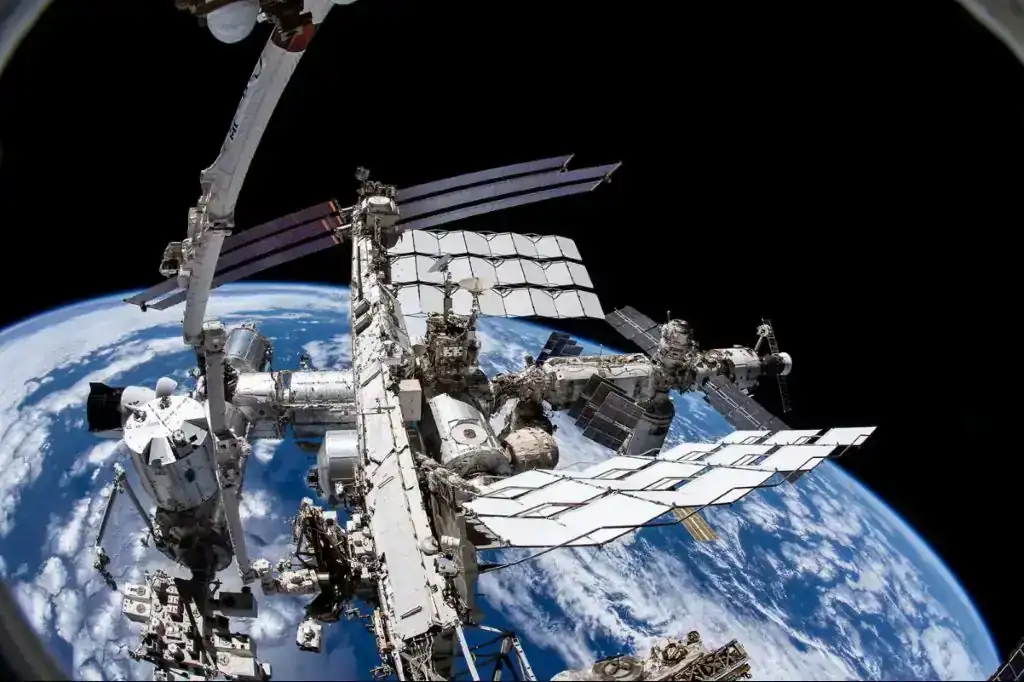
NASA said four astronauts will return to Earth from the International Space Station more than a month earlier than planned after one crew member experienced an undisclosed medical issue. The agency said the astronaut is stable, but doctors determined that further evaluation would be best carried out on the ground.
The decision marks a rare early end to a routine crew rotation and underscores the limits of medical care available aboard the orbiting laboratory, even as NASA maintains that the situation is not an emergency.
The affected crew member has not been identified, and NASA has declined to provide details about the condition, citing longstanding medical privacy policies.

NASA’s chief health and medical officer, Dr. James Polk, said during a news conference on Thursday that while the space station is equipped to handle a wide range of medical scenarios, it does not have the full diagnostic capabilities of a hospital emergency department.
“We have a very robust suite of medical hardware on board the International Space Station,” Polk said. “But we don’t have the complete amount of hardware that I would have in the emergency department, for example, to complete a workup of a patient.”
“In this particular incident,” he added, “we would like to complete that workup, and the best way to complete that workup is on the ground.”
The crew member’s condition is stable and is not expected to require special procedures during the return to Earth, Polk said.
Crew-11 mission cut short
The returning astronauts are part of NASA’s SpaceX Crew-11 mission and include American astronauts Mike Fincke and Zena Cardman, Japan Aerospace Exploration Agency astronaut Kimiya Yui, and Russian cosmonaut Oleg Platonov. The crew arrived at the space station as part of the program’s regular rotation and had been scheduled to remain on orbit until no earlier than next month.
Under normal circumstances, NASA avoids bringing a full crew home before a replacement team arrives, in order to maintain staffing levels and operational continuity aboard the station. Officials said this case is an exception driven by medical considerations and upcoming launch plans.
NASA Administrator Jared Isaacman, who was recently appointed to the role and has twice flown to orbit on private SpaceX missions, said he approved the early return. He told reporters that the decision was informed by the expected arrival of the next crew and by the agency’s ability to adjust launch timelines.
Isaacman said NASA is evaluating ways to expedite the launch of the SpaceX Crew-12 mission, which is currently scheduled for mid-February. The Crew-11 astronauts are expected to depart the station within “days,” he said.
Medical concern prompted delayed spacewalk
NASA publicly acknowledged the medical issue on Wednesday when it announced the postponement of a planned spacewalk, citing an unspecified “medical concern” affecting a crew member. The agency did not elaborate at the time, but said the decision was made out of an abundance of caution.
“These are the situations NASA and our partners train for and prepare to execute safely,” the agency said in a statement.
Spacewalks are among the most physically demanding activities astronauts perform, requiring hours in bulky suits and placing added strain on the body. Delaying such operations is a standard precaution when a crew member’s health status is uncertain.
Reduced staffing on the station
Once Crew-11 departs, only one NASA astronaut will remain aboard the International Space Station: Chris Williams, who arrived in late November aboard a Russian Soyuz spacecraft. His presence reflects long-standing crew-sharing agreements between the United States and Russia, under which astronauts and cosmonauts fly on each other’s vehicles to ensure continuous staffing of both the U.S. and Russian segments of the station.
NASA officials said Williams is trained to manage station operations during the interim period and that the agency is confident normal staffing levels will be restored once Crew-12 arrives.
“This is one of the reasons why we fly mixed crews on Soyuz and U.S. vehicles,” said Amit Kshatriya, NASA’s associate administrator. “We want to make sure we have operators for both the U.S. and Russian segments of the space station.”
Challenges of space medicine
Medical experts say that diagnosing and treating health issues in orbit presents unique challenges, even for highly trained astronauts who undergo extensive pre-flight screening.
Dr. Farhan Asrar, a space medicine researcher and associate dean at Toronto Metropolitan University’s School of Medicine, said that the environment of space can complicate otherwise routine conditions.
“Health care providers face unique challenges attempting to treat or diagnose astronauts as they orbit more than 200 miles above Earth,” Asrar said in an email. “The limitations can turn even common ailments — such as toothaches or ear pain — into difficult medical conundrums.”
Although astronauts receive continuous health monitoring, prolonged exposure to microgravity and radiation places stress on multiple systems in the body, including the heart, bones, eyes, kidneys and mental health, Asrar said.
NASA has spent decades developing protocols to manage medical risks in space, including telemedicine support from physicians on the ground and onboard equipment designed for emergency care. Still, officials acknowledge that some evaluations are only possible after a crew member returns to Earth.
A long history of medical privacy
NASA’s decision not to name the affected astronaut or disclose details about the condition follows a long-established practice. The agency generally releases information about the health effects of spaceflight through aggregated research and academic studies rather than through case-by-case disclosures tied to individual astronauts.
Several medical conditions associated with spaceflight only became widely understood years after missions took place. Space adaptation syndrome, which can cause nausea and vertigo during the first days in microgravity, was identified through cumulative research rather than individual incident reports. The condition has affected astronauts since the earliest human spaceflights.
In another case, a dangerous blood clot known as jugular venous thrombosis was identified in an astronaut during a mission and later documented in a scientific journal. The astronaut involved was never publicly named.
More recently, after SpaceX’s Crew-8 mission returned to Earth in October 2024, one crew member was transported to a Florida hospital for observation following what NASA described only as a “medical issue.” The agency said the individual was in stable condition, but did not release further details, and the astronaut’s identity remains undisclosed.
Over the more than 25 years of continuous operations aboard the International Space Station, NASA has dealt with a wide range of medical situations, Polk said.
“Fortunately for us, we’ve had equipment and medications and things to be able to handle all of those such that we were able to complete the treatment and or the diagnosis on orbit,” he said.
In this case, officials emphasized, the decision to return early reflects caution rather than crisis, and the agency said it remains confident in the safety of the crew and the station as it prepares for the next rotation.
This article was rewritten by JournosNews.com based on verified reporting from trusted sources. The content has been independently reviewed, fact-checked, and edited for accuracy, neutrality, tone, and global readability in accordance with Google News and AdSense standards.
All opinions, quotes, or statements from contributors, experts, or sourced organizations do not necessarily reflect the views of JournosNews.com. JournosNews.com maintains full editorial independence from any external funders, sponsors, or organizations.
Stay informed with JournosNews.com — your trusted source for verified global reporting and in-depth analysis. Follow us on Google News, BlueSky, and X for real-time updates.