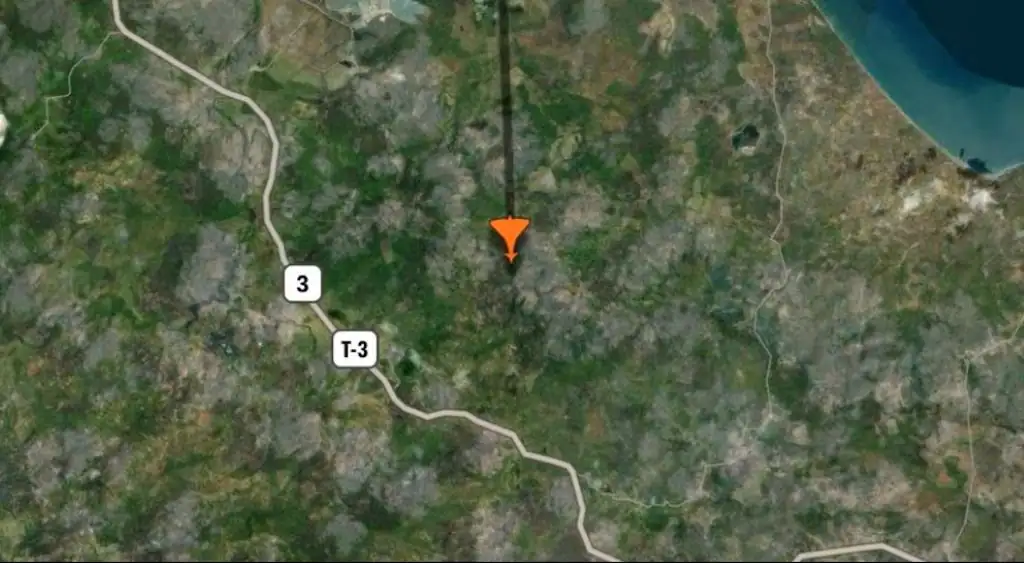
Civilian flight-tracking websites reported late Friday that a U.S. Navy F/A-18E Super Hornet appeared briefly over Venezuelan territory, prompting renewed attention to U.S. military movements in the Caribbean. U.S. officials have not confirmed any airspace incursion, and defense analysts caution that publicly available tracking data can be unreliable for military aircraft.
The aircraft sighting, first noted by Flightradar24, emerged amid heightened regional sensitivity following recent U.S. naval operations in the western Atlantic and Caribbean. No official statement has been issued by the White House or the U.S. Department of Defense regarding the reported flight.
Civilian Tracking Data Raises Questions, Not Conclusions
According to Flightradar24 logs, a Boeing F/A-18E Super Hornet associated with the U.S. Navy was visible on radar displays late Friday night, with a track that appeared to cross into Venezuelan airspace. Such sightings are not uncommon on civilian platforms, but their accuracy—particularly for military operations—remains limited.
Defense analyst Andrei Serbin urged caution, noting that aircraft positions displayed in black on Flightradar24 can reflect disrupted or misleading transponder signals. He said these anomalies may be caused by signal interference, incomplete data reception, or intentionally obscured transmissions.
“Military aircraft conducting real operations are typically not visible on civilian tracking services,” Serbin said, adding that transponder data can be inaccurate or manipulated in contested signal environments.
Additional Aircraft Detected Near Aruba and Curaçao
Minutes after the initial report, monitoring systems identified two additional F/A-18E Super Hornets—using the call signs RHINO61 and RHINO62—operating north of Aruba, off Venezuela’s northern coast. The aircraft remained outside Venezuelan territorial airspace, according to available data.
Similar activity was recorded earlier in the week. On Sunday morning, two Super Hornets identified as RHINO11 and RHINO12 were tracked north of Curaçao and offshore from Venezuela’s Falcón state. Open-source aviation records show the jets operating over international waters, consistent with routine naval air patrols.
USS Gerald R. Ford Operations Provide Broader Context
The reported movements coincided with the return to operations of the USS Gerald R. Ford, the U.S. Navy’s newest and most advanced aircraft carrier. The carrier has been operating in the region as part of broader U.S. maritime and security initiatives, including counter-narcotics missions and regional deterrence patrols.
U.S. officials have previously described such deployments as routine and defensive in nature. There has been no confirmation from Washington of offensive air operations directed at Venezuela, nor any verified announcement authorizing strikes against the country.
Claims circulating on social media suggesting imminent military action have not been supported by official statements or corroborated by independent reporting.
Capabilities of the F/A-18E Super Hornet
The F/A-18E Super Hornet is the U.S. Navy’s primary carrier-based fighter aircraft. Designed for multi-role missions, it is capable of air-to-air combat, air-to-surface strikes, reconnaissance, and escort operations.
According to the U.S. Department of Defense, the aircraft is equipped with an internal 20-millimeter cannon and multiple external hardpoints that can carry missiles, precision-guided munitions, and electronic warfare systems. Its versatility makes it a standard component of carrier strike groups operating worldwide.
Military Flights and the Limits of Open-Source Monitoring
Aviation analysts consistently note that civilian tracking platforms such as Flightradar24 rely on publicly broadcast transponder signals. Military aircraft can limit or disable these signals, meaning any appearance on such platforms may reflect partial data rather than actual flight paths.
In regions where signal interference is common, tracks may jump, disappear, or display inaccurate positions. As a result, experts advise against interpreting isolated radar images as evidence of airspace violations or combat operations without official confirmation.
No Official Confirmation From Washington or Caracas
As of publication, neither U.S. nor Venezuelan authorities have commented on the reported aircraft tracks. Venezuelan state media has not issued alerts regarding airspace violations, and no diplomatic protests have been publicly recorded.
Without corroboration from government sources, analysts say the reported sightings should be viewed as unverified observations rather than confirmed incidents.
Ongoing Regional Sensitivities
The Caribbean remains a strategically sensitive region, with frequent naval and air patrols by multiple countries. U.S. carrier operations, while closely watched, are generally announced in advance and framed as part of long-standing security and maritime missions.
For now, the reported F/A-18 activity underscores the challenges of interpreting open-source military data in real time—and the importance of distinguishing between routine operations, technical anomalies, and verified developments.
This article was rewritten by JournosNews.com based on verified reporting from trusted sources. The content has been independently reviewed, fact-checked, and edited for accuracy, neutrality, tone, and global readability in accordance with Google News and AdSense standards.
All opinions, quotes, or statements from contributors, experts, or sourced organizations do not necessarily reflect the views of JournosNews.com. JournosNews.com maintains full editorial independence from any external funders, sponsors, or organizations.
Stay informed with JournosNews.com — your trusted source for verified global reporting and in-depth analysis. Follow us on Google News, BlueSky, and X for real-time updates.