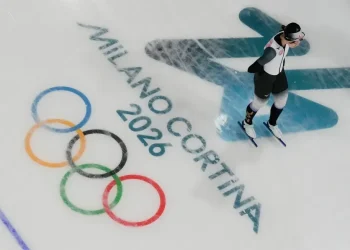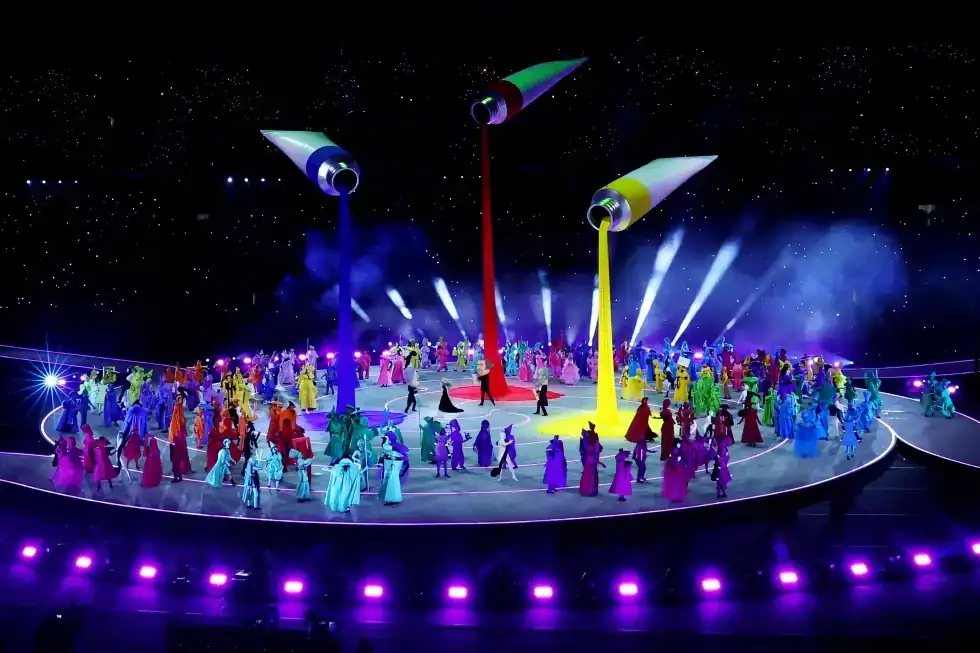
MILAN (JN) – The Milan Cortina Winter Olympics opened with an unprecedented ceremony spanning four locations and two Olympic cauldrons. The format showcased Italy’s cultural identity and geographic diversity while exposing the operational and political complexities of staging a globally watched event across distant venues.
The official opening of the Milan Cortina Winter Games was designed to signal harmony across distance. Instead, it offered a revealing case study in how the Olympics are adapting to modern constraints: geographic dispersion, political undercurrents, media imperatives, and evolving expectations of spectacle.
For the first time in Olympic history, the opening ceremony unfolded simultaneously across four sites—Milan’s San Siro stadium and mountain venues in Cortina d’Ampezzo, Livigno, and Predazzo. Two Olympic cauldrons were lit, 250 miles apart. Athletes marched in different locations. Cultural references stretched from Leonardo da Vinci to pop music. And crowd reactions, both celebratory and hostile, hinted at the geopolitical realities that inevitably accompany global sporting events.
What emerged was not simply an opening ceremony, but an illustration of how the modern Olympics are being re-engineered to accommodate geography, politics, and broadcast economics.
Geography as a central character
Unlike previous Winter Games, which typically cluster venues within a compact region, Milan Cortina’s competition sites span roughly 8,500 square miles—comparable to the size of New Jersey. Alpine skiing, bobsled, curling, and snowboarding are hours away from Milan in the Dolomites and Alpine valleys.
The decision to host the ceremony across multiple sites was framed by organizers as a solution to this dispersion. Athletes competing in mountain sports could participate locally without traveling to Milan. Symbolically, the ceremony was meant to bridge city and mountain, culture and sport.
In practice, the effect was striking: the first five nations called into San Siro’s Parade of Nations—Greece, Albania, Andorra, Saudi Arabia, and Argentina—had no athletes physically present in Milan. They were participating elsewhere.
This was not a logistical failure, but a deliberate design choice. Yet it altered the familiar visual rhythm of an Olympic opening: placards without athletes, cheers delayed, presence fragmented across screens.
The format suggested an evolving understanding of what participation means in a geographically distributed Games.
The dual cauldron as metaphor
The lighting of two Olympic cauldrons—one in Milan near the Arch of Peace, the other in Cortina—was presented as a tribute to Leonardo da Vinci’s geometric studies. But the symbolism ran deeper.
Traditionally, the single cauldron represents unity and continuity throughout the Games. By dividing the flame, organizers acknowledged the reality that these Olympics are physically and conceptually split between urban and alpine environments.
Italian Alpine ski champions Alberto Tomba, Deborah Compagnoni, and Sofia Goggia performed the lighting honors across the two sites, linking past, present, and future. Yet the image of two flames burning hundreds of miles apart subtly redefined a core Olympic ritual.
Rather than unity through singularity, Milan Cortina projected unity through coordination.
Cultural projection as national storytelling
The ceremony leaned heavily into Italian cultural heritage. References to da Vinci, Dante, Puccini, Fellini, Armani, pasta, and wine were woven into choreography and music. Dancers from Teatro alla Scala reinterpreted Antonio Canova’s sculptures. Andrea Bocelli’s performance of “Nessun Dorma” provided a climactic moment steeped in operatic grandeur.
This approach aligns with a long Olympic tradition: host nations using the ceremony to project cultural identity to a global audience. However, Milan Cortina’s execution was particularly layered, juxtaposing high art with pop references, and historical motifs with modern staging.
The inclusion of Mariah Carey singing “Nel Blu Dipinto Di Blu” (“Volare”) symbolized this blending of Italian and global popular culture.
The message was clear: Italy positioned itself not merely as host, but as curator of a cultural experience designed for international broadcast.
Broadcast economics in plain sight
IOC President Kirsty Coventry’s remarks included a notable acknowledgment of “media rights holders,” an unusual but candid reminder of the commercial foundations underpinning the Games. Opening ceremonies are among the most-watched segments of any Olympics, and their design increasingly reflects broadcast priorities as much as in-stadium experience.
The multi-site format, while logistically complex for spectators, translates smoothly to television. Camera feeds cut seamlessly between Milan and the mountains, creating a cinematic narrative that may have been more coherent for viewers at home than for those in any single venue.
This points to a broader evolution: Olympic ceremonies are now produced primarily for global screens rather than for the crowd in attendance.
Political reactions in the crowd
While organizers emphasized themes of peace and unity, crowd responses revealed the inescapable presence of global politics.
Israel’s delegation encountered boos amid ongoing debate over the Gaza war. The U.S. athletes were cheered, but Vice President JD Vance was jeered when shown on the video boards. Venezuela and Ukraine received strong applause, reflecting sympathies shaped by current conflicts.
Such reactions are not unprecedented in Olympic history, but they were particularly visible in this ceremony, amplified by giant screens and social media.
Coventry had earlier expressed hope that the ceremony would be seen as “an opportunity to be respectful,” an acknowledgment that the Olympic stage cannot be insulated from global sentiment.
Weather, setting, and the absence of winter
Milan’s clear skies and 10°C temperatures added another layer of contrast. There was no snow, no visible winter atmosphere in the financial capital hosting the main ceremony. The seasonal disconnect reinforced the conceptual split between city and mountain.
For viewers accustomed to Winter Games imagery dominated by snow-covered settings, the San Siro backdrop looked more like a summer cultural festival than a winter sporting event.
This visual dissonance again underscored how Milan Cortina is redefining spatial expectations of a Winter Olympics.
What this format suggests about future Games
The International Olympic Committee has increasingly encouraged the reuse of existing venues across regions to reduce costs and environmental impact. Milan Cortina represents one of the most ambitious implementations of that philosophy.
Rather than building centralized infrastructure, Italy distributed events across established winter sport hubs and an existing metropolitan stadium.
The opening ceremony’s structure mirrored this philosophy: adaptation rather than concentration.
This model raises questions for future hosts. Can Olympic identity remain coherent when geography is fragmented? Does a distributed Games improve sustainability while complicating shared experience? And how does ritual adapt when physical unity is no longer feasible?
Ceremony as reflection of a changing Olympics
In many ways, the ceremony reflected the broader transformation of the Olympics. It balanced tradition with adaptation, ritual with innovation, cultural pride with political sensitivity, and in-person spectacle with broadcast optimization.
The loudest cheers were saved for Italy’s final entrance, set to an electronic version of “The Barber of Seville.” It was a moment of national celebration that also felt like a culmination of careful orchestration across distances.
By the time President Sergio Mattarella declared the Games open, nearly three hours had passed. The ceremony had moved between cities, mountains, art forms, and emotional registers.
What it ultimately presented was not a seamless illusion of unity, but a managed coordination of diversity—geographic, cultural, and political.
That may be the defining characteristic of the Milan Cortina Olympics.
This article was rewritten by JournosNews.com based on verified reporting from trusted sources. The content has been independently reviewed, fact-checked, and edited for accuracy, neutrality, tone, and global readability in accordance with Google News and AdSense standards.
All opinions, quotes, or statements from contributors, experts, or sourced organizations do not necessarily reflect the views of JournosNews.com. JournosNews.com maintains full editorial independence from any external funders, sponsors, or organizations.
Stay informed with JournosNews.com — your trusted source for verified global reporting and in-depth analysis. Follow us on Google News, BlueSky, and X for real-time updates.