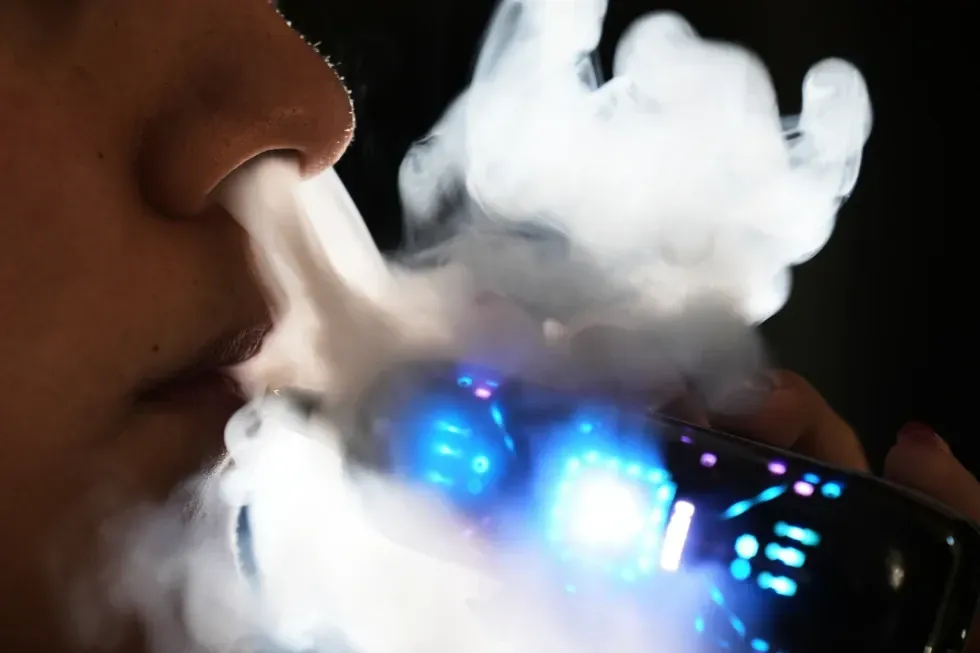
MEXICO CITY (JN) – Mexico’s new ban on the sale of electronic cigarettes is reshaping a once-legal industry into a fast-growing black market, with organized crime groups moving quickly to consolidate control, according to shop owners, lawyers, and policy researchers.
What had been a regulated consumer market valued at roughly $1.5 billion has, in the span of weeks, become an illicit trade. While possession and use of vapes remain legal, selling them can now carry prison sentences of up to eight years under legislation that took effect on Jan. 16.
For many former retailers, the choice is stark: close their businesses or risk entanglement with criminal groups that are stepping in as de facto distributors.
“They don’t come asking whether you want to give them your business or not,” said one former vape shop owner from northern Mexico, now living in the United States after cartel members abducted two of his employees in 2022 and forced him to relinquish control of his store. “They tell you what’s about to happen.”
A market pushed underground
Electronic cigarettes were already controversial in Mexico before the latest law. Former President Andrés Manuel López Obrador banned their import and sale, but Mexico’s Supreme Court ruled the measure unconstitutional. His successor, President Claudia Sheinbaum, secured a constitutional amendment in January 2025 to prohibit them outright, placing vapes in the same legal category as substances such as fentanyl.
A subsequent implementing law closed previous loopholes that had allowed devices to continue flowing into Mexico, largely from China and the United States. Authorities had already been conducting raids and seizures, including the confiscation of 130,000 devices last year at the Pacific port of Lázaro Cárdenas.
The new law prohibits virtually all commercial activity related to vapes, including sale, distribution, and marketing, while leaving personal consumption legal. That distinction has created uncertainty for consumers and retailers alike, particularly over what constitutes “personal use.”
“If a law is vague, it gives corrupt authorities the ability to interpret it in a way that allows extortion,” said Juan José Cirión Lee, a lawyer and president of the advocacy group Mexico and the World Vaping, who plans to challenge the legislation in court.
Retailers close as risks mount
Aldo Martínez, who ran a vape shop in Mexico City, said electronic cigarettes accounted for nearly two-thirds of his income. After the law took effect, he immediately stopped selling them.
“I don’t want to go to jail,” he said.
Martínez worries that even without selling vapes, authorities could raid his shop and plant devices to extract bribes. Others have taken more drastic steps. Some retailers have liquidated stock for personal use; others have shut down entirely.
Lawyer Alejandro Rosario, who represents vape sellers, said he has lost about 40% of his clients as shops close or leave the formal market. In some northern states such as Sonora and Sinaloa, he described a pattern of intimidation and extortion by criminal groups offering to “protect” sellers if they stock cartel-supplied products.
“Some accepted because they felt they had no alternative,” he said.
Cartels step into distribution
According to retailers and a recent report by the Mexican NGO Defensorxs, criminal organizations including the Jalisco New Generation Cartel and the Sinaloa cartel have moved into the vape trade, in some cases repackaging imported devices or sourcing components directly from Asian manufacturers.
In certain regions, products reportedly carry stickers or stamps identifying the supplying group, echoing branding seen on illicit drug markets.
The appeal for criminal groups is clear. The most popular devices are inexpensive disposable vapes, easy to transport, high in demand, and now illegal to sell through formal channels. With no regulatory oversight, there are also concerns about adulterated or unsafe products entering circulation.
Rosario said some groups present themselves as formal suppliers and businesses, blurring the line between licit and illicit commerce in a country where corruption and organized crime already intersect in many sectors.
Public health goals and unintended effects
Mexican authorities frame the ban as a public health measure, particularly aimed at protecting young people. The World Health Organization has expressed concern globally about rising teen vaping, and several Latin American countries have imposed similar prohibitions.
But critics argue that prohibition may have the opposite effect.
“Banned products attract youth,” Cirión Lee said. “Now the same people selling cocaine, fentanyl and marijuana are also selling vapes, and they do not care if the buyer is a minor.”
International experience has been mixed. Brazil banned vapes in 2009, yet their use remains widespread among young people. In the United States, where vaping is regulated but legal, adolescent use fell in 2024 to the lowest level in a decade, according to U.S. health authorities.
The U.S. Food and Drug Administration and many scientists say that, based on current evidence, e-cigarettes are significantly less harmful than traditional cigarettes, though not risk-free.
Zara Snapp, director of the Mexico-based Ría Institute, said the ban removes a potentially safer alternative for smokers while strengthening illicit markets.
“By banning it, you’re handing the market to non-state groups,” she said.
A climate of fear and uncertainty
For some former business owners, the consequences have been personal and immediate. The retailer who lost his store to a cartel in 2022 said the group already had detailed information about him and his family. He and his partner are now closing their remaining online business rather than risk further involvement.
Customers, he said, have been making “panic buys,” trying to secure months of supply amid uncertainty.
In Mexico City, one longtime seller said some of his clients have been harassed after purchasing vapes online, while a supplier he knew sold his inventory directly to criminal groups.
A small entrepreneur near the northern border said he continues to operate quietly through phone calls and messages, without a storefront or website. He avoids disposable devices, which he believes attract more attention from criminal groups.
“So far, they’ve left me alone,” he said. “But I know this won’t last forever.”
This article was rewritten by JournosNews.com based on verified reporting from trusted sources. The content has been independently reviewed, fact-checked, and edited for accuracy, neutrality, tone, and global readability in accordance with Google News and AdSense standards.
All opinions, quotes, or statements from contributors, experts, or sourced organizations do not necessarily reflect the views of JournosNews.com. JournosNews.com maintains full editorial independence from any external funders, sponsors, or organizations.
Stay informed with JournosNews.com — your trusted source for verified global reporting and in-depth analysis. Follow us on Google News, BlueSky, and X for real-time updates.